
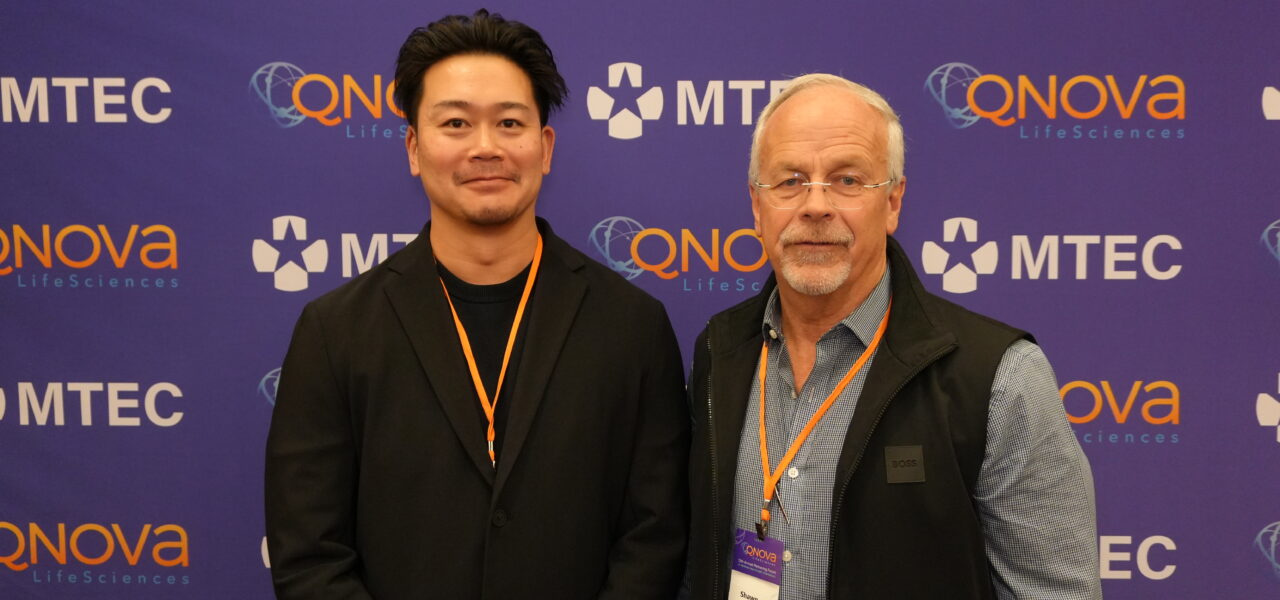
At QNova LifeScience’s Partnering Forum cohosted by MTEC, ITOCHU International’s Shohei Shibata outlined how long-term Japanese capital and U.S. life sciences innovation are beginning to align—and what founders need to understand to access it.
As life sciences companies navigate tighter capital markets and longer timelines to scale, the challenge is no longer just how to raise capital—but where it comes from, what it expects in return, and how long it is willing to wait.
Those questions are becoming increasingly relevant as global capital flows recalibrate. At QNova LifeSciences’ 12th Annual Partnering Forum, a cross-border perspective offered a useful lens on how U.S. innovation and Japanese capital are beginning to align—and why that alignment may matter more in the coming years. That perspective reflects the view of Shohei Shibata, Senior Manager and Department Leader at ITOCHU International Inc., whose work spans U.S. healthcare operations and long-term Japanese strategic investment.
The premise is straightforward: the U.S. continues to lead in life sciences innovation, while Japan remains one of the world’s most capital-rich markets. The disconnect has never been about interest. It has been about structure, incentives, and time horizon.
That gap is now narrowing.
Two Markets, Two Constraints
The U.S. life sciences ecosystem remains unmatched in scientific discovery, entrepreneurial density, and startup formation. But capital dynamics have shifted. Funding is still available, yet increasingly shaped by expectations of near-term validation, clearer exit paths, and faster capital efficiency. The constraint is not capital itself—it is patience.
Japan presents a different profile. Capital is more abundant and often oriented toward long-term value creation, but domestic growth opportunities in early-stage innovation are comparatively limited. Large Japanese investors are structurally designed to think in decades, not fund cycles, and to prioritize durability over velocity.
Viewed together, these conditions create a natural opportunity for cross-border capital. U.S. companies bring innovation and execution speed. Japanese investors bring long-term orientation and balance-sheet strength. The challenge has been building a bridge that works operationally—not just financially.
Why Strategic Capital Looks Different From Venture Capital
A critical distinction shaping that bridge is the difference between financial and strategic capital.
Financial investors are typically optimized for internal rate of return and valuation multiple, with exits as a central measure of success. Strategic investors operate under a different mandate. The goal is not simply to exit, but to build durable businesses, integrate operations, and generate long-term synergy across a broader ecosystem.
In healthcare, that difference matters. Life sciences platforms—particularly in pharma services, medtech, and healthcare delivery—are complex, regulated, and often fragmented. Scaling them requires more than capital alone. It requires operational involvement, patience through regulatory cycles, and a willingness to invest through integration challenges.
Strategic capital is often better positioned for that role.
Why Healthcare Favors Long-Term Investors
Healthcare’s structural characteristics reinforce this dynamic. Demand is non-cyclical and resilient. The sector is mission-critical. And despite its size, it remains highly fragmented across research, development, manufacturing, commercialization, and data services.
That fragmentation creates both inefficiency and opportunity. Platform-building—integrating services across the value chain—requires long-term commitment and operational coordination. It is rarely achieved through financial capital alone.
This is where strategic investors increasingly differentiate themselves: not by replacing venture capital, but by complementing it—providing stability, integration capability, and global reach as companies mature.
A Localized Approach to Global Scale
One emerging model for cross-border expansion challenges the idea that healthcare platforms must be globally centralized to succeed.
Rather than building a single global operating entity, some investors are pursuing localized platforms—U.S.-based organizations serving U.S. markets, and Japan-based organizations serving Japan—connected by shared ownership, strategy, and capital.
The rationale is pragmatic. Healthcare is global, but regulation, culture, and clinical practice are deeply local. Effective execution requires respecting those differences rather than abstracting them away.
Under this model, cross-border value is created not by forcing uniformity, but by enabling coordination—allowing companies to expand internationally while maintaining local credibility and operational effectiveness.
From Concept to Execution
What makes this shift notable is how quickly it is moving from concept to execution. Separate operating models are giving way to integrated strategies, supported by acquisitions, partnerships, and long-term investment commitments.
This reflects a core advantage of strategic capital: the ability to commit resources across geographies without waiting for a traditional exit horizon. The objective is not to flip assets, but to build infrastructure that compounds value over time.
For founders, this represents a different kind of investor relationship—one that prioritizes endurance, integration, and global relevance.
What Founders Should Take Away
Raising capital across borders is not simply about accessing new funding sources. It is about aligning with investors whose time horizon, operating philosophy, and strategic objectives match the realities of healthcare innovation.
For U.S. life sciences companies, Japanese strategic capital offers something increasingly scarce: long-term commitment, operational engagement, and a willingness to build through complexity rather than around it.
The bridge between U.S. innovation and Japanese capital is still taking shape. But it is no longer theoretical. It is being built through platforms, partnerships, and patient capital—by investors who are planning not for the next exit, but for the next decade.