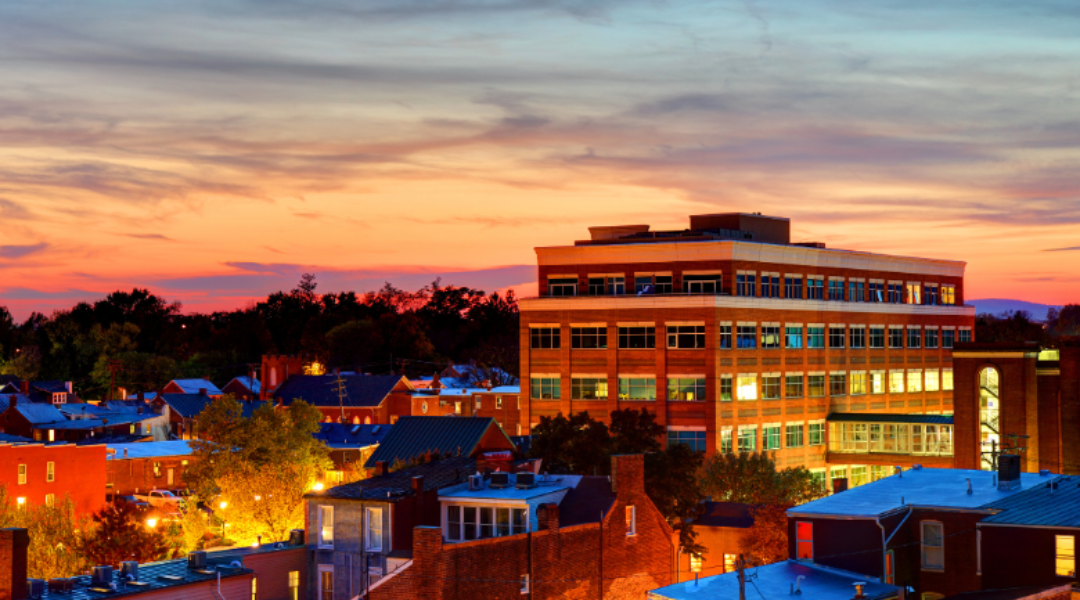
Frederick, Maryland is emerging as a powerhouse in the BioHealth Capital Region, driven by biotech innovation, public–private collaboration, and a strong talent pipeline. This article offers a firsthand look at how a college town is transforming into a destination for life sciences growth.
Background
When I moved to Frederick three years ago to attend Hood College, I wasn’t just choosing a school, I was choosing to be part of something bigger. I had learned about the I-270 biotech corridor and Frederick’s rising profile as a life sciences hub in Maryland. What drew me here was the promise of opportunity in a community where scientific innovation, education, and entrepreneurship converge. Since then, I’ve watched Frederick evolve into more than just a historic town, as it’s becoming a vital anchor in Maryland’s BioHealth Capital Region. Now, as BioBuzz’s Ecosystem Development Fellow, I have the unique opportunity to highlight the people, programs, and partnerships that are accelerating Frederick’s growth. This article is a firsthand look at why Frederick isn’t just on the map, it’s becoming a destination for biotech innovation.
One of my first major tasks in this role was to visit the I-270 Innovation Labs and connect with biotech founders, researchers, and ecosystem leaders. These conversations gave me an inside look at what’s really driving growth in Frederick, from the companies taking root here to the broader collaborations lifting the entire region. I participated in conversations with founders and leaders, listening to stories about overcoming startup challenges, forming strategic partnerships, and supporting local growth. These insights are shaping my understanding of what it takes to build and sustain a thriving life sciences community. You will hear more from these voices in upcoming stories, but what’s already clear is that Frederick has something special, and it’s evolving.
Frederick’s Biotech Boom
So, what makes Frederick such a promising location for biotech? First, the density and diversity of its bioscience sector. With over 80 bioscience companies based in Frederick County, including global organizations such as AstraZeneca, Thermo Fisher, Kite Pharma, and Lonza, the region has attracted more than $1 billion in investment in recent years. Anchored by Fort Detrick and the Frederick National Lab for Cancer Research, the area benefits mightily with its proximity to Washington, D.C. and Baltimore, ultimately allowing companies to tap into both commercial and federal ecosystems. “[The efforts in the region] have paid off with several million square feet of new industrial development, a growing biotech sector, new flex properties, revitalization of underutilized retail and commercial spaces, and a major effort to lure data centers to a new market” (Commercial Real Estate Development Association). This recent growth and increase of projects has supported Frederick in its development within the life sciences community.
The local education system has also played an important role in workforce development. Frederick Community College (FCC) offers biotech training programs, apprenticeships, and associate degrees that are directly aligned with employer needs, partnering with companies such as Kite and Thermo Fisher. According to Frederick Community College’s website, a recent grant of $292,600 was given to FCC in an effort to help expand their lab training capacity further. Hood College, home to the Bioscience Research & Education Center (BREC), provides applied research opportunities and entrepreneurial training, while also supporting the reskilling of displaced federal scientists. Together, FCC and Hood are building a workforce pipeline that’s not only job-ready but tailored to the region’s specific needs.
Public-private partnerships are a defining feature of Frederick’s ecosystem. FCC’s apprenticeship programs create incentives for local employers while ensuring students gain real-world experience. Hood’s “From Science to Startup” event series, held in partnership with Kite, the Federal Laboratory Consortium, and Frederick County, exemplifies how institutions and industries are working in real time to support innovation. This level of coordination helps Frederick respond to the evolving demands of the life sciences sector with efficiency and precision.
Another major strength worth mentioning is Frederick’s proximity to critical federal assets. With Fort Detrick and the Frederick National Lab effectively serving as anchors, along with nearby access to NIH, FDA, BARDA, and more. Frederick is ideally positioned for public–private collaboration, regulatory navigation, and access to non-dilutive funding. This makes it especially attractive to startups working in high-stakes, science-driven areas.
Innovation at the Intersection
Entrepreneurial energy is also palpable here. Organizations like FITCI and Tech Frederick are providing essential infrastructure for startups, including lab space, mentorship, and business support. High-potential companies like BioFactura and Theradaptive are emerging from this environment, signaling that Frederick’s ecosystem is not just supportive, it’s scalable.
Importantly, Frederick’s quality of life is proving to be a competitive edge. The cost of lab space is more affordable than in D.C., and the city’s historic downtown, growing food scene, and access to outdoor recreation offers a balance of opportunity and livability. This appeals to both early-career professionals and families looking to build long-term careers in a community that supports them. Frederick is benefitting from synergies across adjacent sectors like advanced manufacturing and precision fermentation. These overlaps allow for interdisciplinary innovation and ecosystem resilience, which is essential for long-term sustainability and regional competitiveness.
Essentially, Frederick is no longer just a participant in Maryland’s BioHealth Capital Region, it’s becoming a growth engine. Through thoughtful collaboration, strategic investment in workforce development, and a clear commitment to aligning education with industry, Frederick is laying the foundation for the next generation of life sciences innovation. As BioBuzz’s Ecosystem Development Fellow, I’m excited to continue telling the stories of the people and programs that are driving this transformation. Stay tuned because Frederick’s biotech future is just getting started.