When Kite, a Gilead company, announced on August 21, 2025 that it would acquire Philadelphia-based Interius BioTherapeutics for $350 million, the news carried more than financial weight. It symbolized a tectonic shift in the geography of biotech innovation—one that is increasingly concentrated in a dual-state corridor stretching from Philadelphia to Maryland.
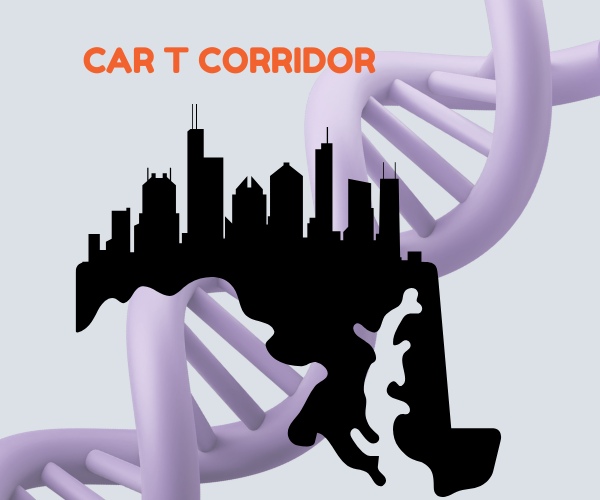
I see this as evidence of an emerging “CAR-T Corridor,” Philadelphia contributes the spark of academic discovery and entrepreneurial spin-outs with a proven commercial track record, while Maryland provides the manufacturing muscle, regulatory expertise and the infrastructure to help bring therapies to market. Together, they form a nexus uniquely suited to advance the next wave of cell and gene therapies – all within a 45 min train ride or two hour drive.
In biopharma there is a lot written about specific biotech hubs – however, stepping back and looking through a larger proximity lens can also be a valuable perspective to take – and provide benefits to companies, investors and the talent needed to advance not only CAR T therapies, but the broader advanced therapies ecosystems that thrive in both of these markets – as we outline below.
In this case, I think the data and infrastructure show that fostering a stronger “CAR T Corridor” with more intentional collaboration and engagement between these two hubs may prove to be a very beneficial exercise.
Philadelphia: Hub of Excellence from Discovery to Commercialization
Few places in the world can rival Philadelphia’s impact on modern medicine. The city has become synonymous with cell and gene therapy breakthroughs, its reputation anchored by a lineage of pioneers whose discoveries have seeded a vibrant commercial ecosystem.
- Carl June and colleagues at the University of Pennsylvania’s Perelman School of Medicine delivered the science behind the first FDA-approved CAR-T therapy, Novartis’s Kymriah. His early innovations in engineering long-lived T cells proved the blueprint for today’s entire CAR-T industry.
- At Children’s Hospital of Philadelphia (CHOP), Stephan Grupp spearheaded the first pediatric CAR-T clinical trial. His leadership turned a last-chance experiment into a repeatable therapeutic pathway, delivering life-saving outcomes for children with acute lymphoblastic leukemia.
- Bruce Levine, June’s long-time collaborator, has been equally central in bridging bench science and biotech creation. A co-founder of Tmunity Therapeutics (itself acquired by Kite) and Capstan Therapeutics, Levine has translated academic insight into entrepreneurial ventures that continue to push the boundaries of engineered T-cell therapies.
- James M. Wilson, director of Penn’s Gene Therapy Program, catalyzed the AAV gene therapy revolution. Wilson’s lab not only underpinned the creation of REGENXBIO and Passage Bio, but has spun out a constellation of companies including Gemma Biotherapeutics and Franklin Biolabs.
Philadelphia isn’t just where breakthroughs are born—it’s where they scale into products that reach patients. The region has proven itself repeatedly as a cradle for commercialization in cell and gene therapy, building on its rich academic pipeline with an equally formidable record of turning science into market-ready medicines.
- Spark Therapeutics, spun out of the Children’s Hospital of Philadelphia, became the face of modern gene therapy with Luxturna, the first FDA-approved gene therapy for a genetic disease in the U.S. Its 2019 acquisition by Roche for $4.8 billion remains one of biotech’s most visible success stories—and anchored Philadelphia as a global gene therapy capital.
- Iovance Biotherapeutics, while headquartered in California, chose Philadelphia’s Navy Yard as the home of its Cell Therapy Center (iCTC)—a sprawling commercial-scale manufacturing facility for tumor-infiltrating lymphocyte (TIL) therapies. In May 2024, Iovance won FDA approval for Amtagvi, the first cell therapy for solid tumors, with its Philly facility positioned as the supply backbone for the rollout.
- Adaptimmune Therapeutics, with U.S. operations in Philadelphia, has been a pioneer in TCR-based therapies for solid tumors. Its work on engineered T-cell receptor therapies represents another pathway to expand the promise of cell therapy beyond blood cancers, and its Philadelphia presence ties the region firmly into its clinical and commercial strategy.
These examples reinforce a critical point: Philadelphia doesn’t just invent therapies—it delivers them to market. That commercial translation is further strengthened by the region’s proximity to global pharma giants across Greater Philadelphia and New Jersey—Merck, Bristol Myers Squibb, Johnson & Johnson, Novartis, and GSK among them. Their expertise in regulatory affairs, global distribution, reimbursement, and commercialization strategy provides a natural bridge for startups evolving into scaled biopharma players.
Together, the academic-startup-pharma nexus creates an end-to-end ecosystem: from the first proof-of-concept in a Penn lab, to pivotal trials at CHOP, to FDA submissions supported by Big Pharma know-how, to commercial-scale supply chains rooted in the region. It’s a cycle that few places in the world can replicate—and it explains why Kite is doubling down with a new center of excellence in Philadelphia.
Maryland: Manufacturing Muscle Meets Regulatory Strength
Just two hours down I-95, Maryland offers a true compliment to Philadelphiat: unparalleled scale and translational infrastructure. If Philadelphia is the spark, Maryland is the engine block.
- Kite’s Commercial Cell Therapy facility in Frederick is part of the world’s largest in-house cell therapy manufacturing network, encompassing everything from vector process development to clinical and commercial manufacturing. This site anchors Maryland’s place as a CAR-T production powerhouse.
- Cartesian Therapeutics, headquartered in Gaithersburg, brings its own spin on engineered cell therapies, advancing mRNA-based approaches for oncology and autoimmune disease while building translational know-how in the region.
- Miltenyi Biotec, which established its North American headquarters in Gaithersburg, adds critical tools and capabilities. Its CliniMACS Prodigy system automates GMP-compliant cell processing, reducing the cost and variability that often hamper CAR-T scale-up. Beyond tools, Miltenyi has built out CDMO services for vector and cell therapy manufacturing—filling gaps for companies without in-house capabilities and helping to shepherd products through complex regulatory pathways.
- REGENXBIO, although born from Penn science, is firmly rooted in the Maryland biotech ecosystem. Its pioneering AAV vector engineering platform is now applied across multiple therapeutic areas and complements the corridor’s broader expertise in gene-enabled cell therapies.
- Arcellx, based in Rockville, has deepened ties to Kite through a multi-billion-dollar strategic partnership. Their combined work in next-generation CAR-T designs further cements Maryland’s role as both a testing ground and a manufacturing hub.
Delaware Spotlight
While less mature of a market, it’s clear that Delaware is well positioned in this corridor as well with several emerging CAR T and advanced therapy companies
- Cellergy Pharma, Inc.: A preclinical-stage biotechnology company located in Wilmington. It is developing CAR T-cell products to treat severe allergic diseases, including allergic asthma and food allergies.
- Essen BioTech: This Newark-based company specializes in advanced cellular therapies, including CAR-T, Tumor-Infiltrating Lymphocytes (TILs), and CRISPR-Cas9 gene editing.
- Avobis Bio: Originally launched as a Mayo Clinic + W.L. Gore joint venture, Avobis Bio focuses on developing implantable cell therapies using mesenchymal stem cells to treat debilitating conditions.
- CorriXR Therapeutics: This oncology-focused biotherapeutics company in Newark is developing genetic medicines for solid tumors using CRISPR gene-editing technology that is preparing for first-in-human clinical trials after securing a $1 million state investment from Delaware in August 2025.
The Making of a Corridor
Why does this geographic concentration matter? Because the obstacles in cell therapy are bigger than any one lab or facility. It takes discovery, translational rigor, manufacturing precision, and regulatory navigation—all aligned and accelerated.
- Talent Mobility: A scientist can train in Philadelphia’s academic labs, then move downstream to Maryland’s GMP facilities without leaving the region. This creates a workforce continuum unlike anywhere else in the country.
- Pipeline Velocity: Interius’s in vivo CAR-T approach may be refined in Philadelphia, then rapidly transitioned to Maryland’s large-scale suites for clinical deployment—shortening the journey from proof-of-concept to patient access.
- Access and Equity: In vivo CAR-T holds the promise of “off-the-shelf” scalability. Combined with Maryland’s production capacity, this could drive costs down and bring therapies to more patients, faster.
- Competitive Leadership: In consolidating assets across both states, Kite and its partners have effectively declared that the future of CAR-T innovation lies within the Philadelphia-Maryland corridor. For rival regions—from Boston to the Bay Area—the gauntlet has been thrown.
Trusted Infrastructure + Expertise
Layered throughout these hubs are global support players. QIAGEN’s US headquarters and center of excellence is in Germantown, MD and they also operate a new “QIAhub” showroom in Philadelphia offering research institutions and companies a first-hand look at all of their research equipment in the heart of the city. They offer cutting-edge molecular diagnostic tools and quality control technologies that are indispensable to clinical-grade cell therapy workflows.
“Cell and gene therapy developers face increasing demands for precise, scalable solutions to help ensure therapy safety and efficacy,” said Justus Krause-Harder, Vice President and Head of Molecular Tools & Oncology at QIAGEN. “With our expanded dPCR portfolio, we are not only meeting the needs of lentivirus-based therapies but also reaffirming our long-term commitment as a partner for quality control in CGT development and manufacturing.” (Apr 29, 2025). Qiagen
Some of the most trusted advanced therapy CDMOs in the market also call this corridor home – ABL/Ascend based in Rockville, MD and Minaris Advanced Therapies at the Philadelphia Navy Yard.
The markets are also home to expert product development lifecycle consulting firms Kymanox who also runs a cGMP development lab in Philadelphia, and leading manufacturing consultants like ProjectFarma, which was originally based out of Bethesda, MD. Firms like this are essential for helping companies through their development and manufacturing hurdles.
Together, this lattice-work of manufacturing, CDMO services, diagnostic platforms, and translational expertise ensures that Maryland is not simply producing therapies—it is shaping the standards by which cell therapies are tested, validated, and scaled.
In many ways, the Kite-Interius deal crystallizes that the Philadelphia-Maryland corridor has all the ingredients to dominate the future of engineered cell therapies.
Philadelphia, with its innovation heritage and unmatched academic-clinical translation, remains the discovery frontier. Maryland, with its robust infrastructure and manufacturing-regulatory excellence, turns promise into product.
Together they create a powerful dual-state ecosystem—one that could make the CAR-T Corridor not just a regional descriptor, but a global brand for the future of all advanced therapies.