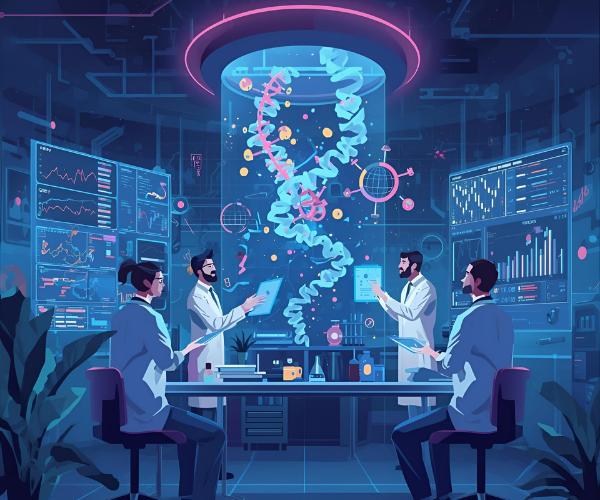
For the life sciences industry, advancements in AI, digitization, and data science technologies are giving drug developers a whole new set of tools and solutions that are ushering in a wave of new discoveries and new possibilities.
We are seeing this play out in the antibody therapeutics sector where it’s not just science driving the next wave—it’s technology. Maryland is home to a cluster of pioneering biotech companies in the antibody therapeutics space. We’ve identified three companies in particular that are harnessing artificial intelligence, digital infrastructure, and smarter R&D strategies to redefine what’s possible in antibody-based medicine.
“AI enables us to approach drug discovery in innovative ways that were previously only conceptual,” shared Thomas Bethune, VP of InfoPathways, a Maryland-based cutting-ed technology company providing management and consulting services to life science companies. “There is significant potential not only for novel therapies but also for highly targeted treatments tailored to specific populations and subgroups.”
Antibody therapeutics have transformed the treatment landscape for cancer, autoimmune disease, and infectious disease over the past two decades. But today’s breakthroughs are happening faster and smarter than ever before—not through serendipity or brute-force screening, but through digital design, predictive analytics, and AI-powered platforms.
These three companies are not only riding this technological wave—they’re helping shape it.
OncoC4: Proving AI-Designed Antibodies Can Work in Humans
Take OncoC4, Inc., a clinical-stage immuno-oncology company based in Rockville. Their bispecific antibody candidate AI-081 recently dosed its first patient in a Phase 2 trial for advanced solid tumors—a significant milestone that could mark a new era for AI-driven antibody development.
AI-081 targets two well-established pathways in cancer: PD-1, a checkpoint protein that dampens immune responses, and VEGF, a key driver of tumor angiogenesis. But rather than administering two separate drugs in combination, OncoC4 has fused both targets into a single, purpose-built molecule—and they did it using AI-enabled design platforms.
Drugs targeting immune checkpoints like PD‑1 revolutionized oncology. So did anti‑angiogenesis therapies like VEGF inhibitors. Fusing these two mechanisms into a single antibody designed in silico could represent a leap forward in terms of efficacy, toxicity profile, and development speed.
Why AI-081 matters:
- Designed for cooperation: Two mechanisms of action engineered into one synergistic biologic.
- High-affinity, low-dose response: Even at the smallest tested dose in Phase 1, tumor responses were observed.
- Speed to clinic: Digital design and modeling helped compress the discovery-to-IND timeline.
If AI-081 continues to show strong clinical signals, it will mark more than just a win for OncoC4—it will serve as a proof-of-concept for AI-designed multispecifics. It’s no longer just a futuristic vision of drug discovery. It’s happening in Maryland, right now.
MacroGenics: Building a Digital Backbone for Faster, Smarter Antibody R&D
While AI often gets the headlines, it’s the digital infrastructure behind the scenes that enables many of these breakthroughs. That’s the story at MacroGenics, a Maryland-based biotech known for its pioneering work in antibody therapeutics that is also now leveraging its two decades of expertise to offer CDMO services.
With a pipeline spanning monoclonal antibodies, bispecifics, and ADCs (antibody-drug conjugates), MacroGenics recognized that legacy R&D systems were slowing innovation. So, they partnered with Benchling to completely digitize their R&D workflows—centralizing data, streamlining collaboration, and accelerating time-to-decision.
“One of our strategic goals is to modernize our R&D infrastructure to better support scientific innovation,” said Leslie O’Neill, VP of IT at MacroGenics, in a case study with Benchling. “Our scientists needed an environment where data was findable, usable, and shareable.”
The results?
- 70% reduction in experiment documentation time
- Faster tech transfer between discovery and process development teams
- Improved reproducibility of results and scalability for pipeline expansion
In an era where antibody therapeutics are becoming more complex—with multispecifics, bispecifics, and engineered Fc regions—data liquidity and traceability are key competitive advantages.
MacroGenics’ digital transformation isn’t just about moving off paper. It’s a foundational shift in how science is done—with speed, precision, and scalability built into the process.
EliteImmune: Harnessing Donor-Derived Insights with Computational Power
While some companies lean heavily on AI-first approaches, EliteImmune has built a platform that uniquely integrates human immunology with advanced computational analytics. Their strategy centers around identifying “elite” donors—individuals whose immune systems have developed exceptionally potent antibodies through natural exposure or vaccination. By mining the antibody repertoires of these donors, EliteImmune gains access to blueprints of clinically relevant, high-affinity antibodies.
The company’s proprietary CellSeq™ platform combines high-throughput single-cell sequencing with computational analysis to map and prioritize antibody candidates at scale. This hybrid approach allows scientists to uncover rare, therapeutically valuable antibodies that traditional screening methods might miss. Importantly, the system captures not only binding properties but also functional and developability characteristics early in the discovery process.
This model shortens timelines by reducing the need for brute-force screening and creates a more data-informed path to therapeutic development. By fusing elite immunology with digital infrastructure, EliteImmune exemplifies how Maryland-based biotech companies are redefining antibody discovery—not just with algorithms, but by leveraging the best of human biology, cutting-edge sequencing, and computational power together.
In an era where precision, speed, and scalability define competitive advantage, EliteImmune is demonstrating that blending biology with data-driven insights can unlock antibody medicines with transformative potential.
Maryland’s Quiet Strength: An Ecosystem for Innovation
Maryland’s antibody therapeutic leadership is no accident. The region’s proximity to NIH, FDA, and a dense network of academic research centers has created a fertile ground for biologics innovation. But increasingly, it’s the tech-savvy approach to drug discovery and development that is setting companies apart and Maryland has one of the most advanced data and computer science workforce in the country
Other Maryland-based players in this space include:
- AstraZeneca (Gaithersburg, MD) explicitly says it uses AI/ML for biologics discovery and de novo design. It’s also done AI-antibody deals (e.g., Absci to design a new oncology antibody) and AI immunology collaborations (Immunai)—and Gaithersburg job postings reference partnering with AI/ML teams on multispecific protein engineering.
- Salubris Biotherapeutics (Gaithersburg, MD) – advancing a pipeline of bispecific antibodies, ADCs, and first-in-class antibody fusion proteins (e.g., JK07 for heart failure, JK08 for immuno-oncology), supported by robust antibody engineering platforms and selective use of AI-enabled discovery partnerships.
- NextCure (Beltsville) – advancing first-in-class immunomedicines through its proprietary FIND-IO™ platform to discover novel immune-modulating targets.
- Immunomic Therapeutics (Rockville) – developing universal antigen-presenting cell-targeted antibody therapies, with a strong focus on glioblastoma and infectious disease.
Gain Therapeutics (Bethesda, MD) is a biotech company applying AI-supported structural biology to discover novel allosteric small-molecule modulators via its Magellan™ platform. While not focused on antibody therapeutics, their computational platform exemplifies Maryland’s broader strength in AI-driven, physics-based drug discovery targeting disorders ranging from neurodegeneration to oncology
Each of these companies is leveraging computational tools, deep datasets, and platform-based discovery to increase the precision, efficacy, and manufacturability of next-gen antibody drugs.
What’s Next: A New Paradigm for Biologics
As antibody engineering moves beyond “one target, one antibody,” and into the realm of rationally designed, multispecific, immune-modulating biologics, the enabling technologies—AI, automation, cloud-based collaboration—will only grow in importance.
Maryland’s early success stories, like OncoC4 and MacroGenics, show that breakthroughs happen when biotech and tech truly converge. The future of antibody therapeutics is as much about informatics as immunology, and the companies that embrace both will define the next decade of medicine.
As AI-081 moves deeper into the clinic, and as digitized labs become the standard, one thing is clear: the old rules of biologics development no longer apply—and Maryland is one of the few places writing the new playbook.
To learn more about Maryland’s antibody innovation ecosystem or to engage with the companies featured here, visit BioBuzz.io.