US Pharmaceutical giant’s new advanced manufacturing facility will bring 1,800 construction jobs, 650 full time biotech jobs to Goochland County, VA – CEO contributes decision to a business-friendly climate and ready workforce.
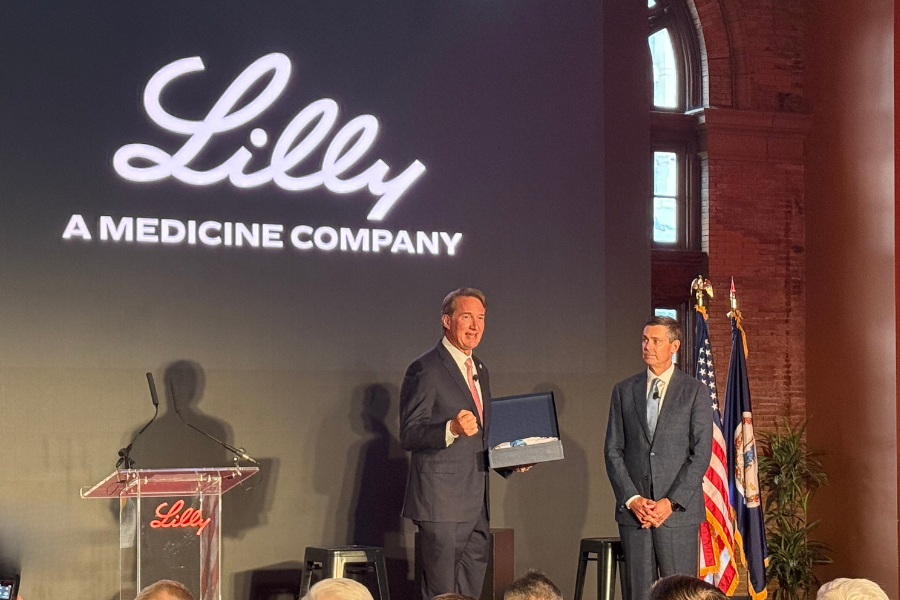
Richmond, Virginia, took center stage today as Eli Lilly Chair and CEO, Dave Ricks, along with Governor Youngkin and other local and state government officials and community partners gathered at historic Main Street Station announcing a landmark $5 billion investment to build its newest advanced manufacturing facility in Goochland County. It was clear to all in attendance that this project represents a defining moment for Virginia’s life sciences economy, signaling that the Commonwealth is emerging as a true biomanufacturing powerhouse.
The facility, which will be the company’s first fully integrated site for both active pharmaceutical ingredient (API) production and drug product manufacturing, will focus on some of the most complex therapies in modern medicine, including antibody-drug conjugates for cancer and autoimmune conditions. With this investment, Lilly is cementing Richmond’s role in reshaping how—and where—advanced medicines are made.
“We unite science and manufacturing to speed medicine to patients,” said Lilly CEO Dave Ricks. “This facility will make some of the most complex therapies known in medicine… and we believe this will be one of, if not the largest, bioconjugate facilities in the United States when this construction is complete.”
A Defining Win for Virginia
The project represents one of the largest private sector investments in Virginia’s history. It will bring 650 high-paying permanent jobs to the region, plus 1,800 construction jobs during the build-out. But beyond raw numbers, today’s announcement validates Virginia’s strategy of positioning itself as a serious player in the global biopharma economy.
Governor Glenn Youngkin, who has made workforce development and business-friendly policy central to his administration, framed the moment in personal terms:
“Opportunity is reflected in these magic words… you are hired,” Youngkin said. “Magic words that will be communicated to 650 great Virginians with great jobs who will build their future right along with this amazing investment.”
Youngkin called Lilly’s decision proof that Virginia’s combination of infrastructure, talent, and partnership-driven government is resonating with global leaders in advanced manufacturing.
Why Richmond—and Why Now?
Lilly’s choice of Goochland County came after a nationwide site selection process that saw more than 400 proposals across 46 states. Virginia’s edge? A skilled workforce, shovel-ready infrastructure, and what Ricks called a “partnership oriented climate that moves projects into production”.
That echoes a broader narrative: Richmond has quietly been building momentum as a life sciences hub. Local anchors like Phlow Corp. and Civica Rx are already positioned the region at the forefront of reshoring critical medicines. Regional innovation groups like Activation Capital are working to weave together an ecosystem of biotech startups, manufacturing capacity, and workforce pipelines.
Just weeks ago, AstraZeneca announced its own major expansion of a $2B plant in Virginia, further underscoring the Commonwealth’s growing biotech gravity. Together, these wins represent a reshuffling of the U.S. biomanufacturing map—one that increasingly includes Virginia alongside traditional hubs like Boston and North Carolina’s Research Triangle.
Building America’s Advanced Manufacturing Powerhouse
The new Lilly facility will specialize in antibody-drug conjugates (ADCs), a class of therapies that combine targeted precision with potent cancer-killing ability. ADCs are among the most promising modalities in oncology, offering new hope to patients while reducing side effects.
Lilly emphasized that the plant will feature state-of-the-art automation, digital quality systems, and real-time analytics. Sustainability is also a cornerstone: the company is targeting carbon neutrality, 100% renewable electricity, and zero routine waste to landfill by 2030.
“This site is built for complex biologics. And these are some of the most promising modalities we have—not just effective drugs but therapies with fewer side effects,” said Ricks.
By consolidating API and drug product production in one location, Lilly’s Goochland site will become a model for resilient supply chains, reducing reliance on foreign suppliers and accelerating delivery timelines for life-saving therapies.
Workforce at the Center
From the Governor down to local officials, today’s announcement carried one resounding theme: workforce. Virginia has long emphasized workforce readiness as a competitive advantage, and this project will put that to the test.
The facility is expected to draw heavily from partnerships with local schools, community colleges, and workforce development programs.
“We’re committed to partner with local education systems, local educators, and workforce programs to create pathways into advanced biomanufacturing careers,” said Ricks.
That commitment matters. Advanced manufacturing jobs are high-skill, high-wage opportunities with ripple effects across the economy. According to Virginia’s Secretary of Commerce and Trade Juan Pablo Segura, each life sciences job creates six additional jobs in related sectors.
Virginia’s Biotech Moment
This announcement is more than a single company investment—it’s part of a larger reordering of America’s biopharma landscape. For years, policymakers have spoken about the need to reshore critical drug manufacturing. Today, that rhetoric translated into reality.
Virginia now has powerful anchors across the state with Lilly now in Richmond alongside Phlow, Civica and Novo Nordisk in nearby Petersburg, and AstraZeneca in Albemarle County near UVA, —that gives it credibility as a national life sciences hub. Add to that the state’s reputation for business-friendly governance, world-class universities, and infrastructure, and the case for Virginia as a biotech destination becomes undeniable.
Governor Youngkin closed his remarks with a broader reflection:
“We get to collectively say that made in America means made in Virginia,” he said. “Those are opportunities that I want for Virginians. Those are opportunities that I want for Americans. Those are opportunities that I do firmly believe will change the future for all of us.”
Eli Lilly’s Goochland County facility won’t just make medicines—it will make Virginia part of the solution to some of the most pressing health and economic challenges of our time. It represents a commitment to patients, to innovation, and to the belief that communities like Richmond can and should play a central role in America’s biotech future.
The story of Richmond’s rise is still being written. But with Lilly’s investment, Virginia has signaled that it’s no longer an underdog in biotech. It’s a contender and it intends to keep winning. Governor Youngkin reaffirmed this by reminding the other government officials and representatives in the room, “we move at the pace of business here, not at the pace of government.”