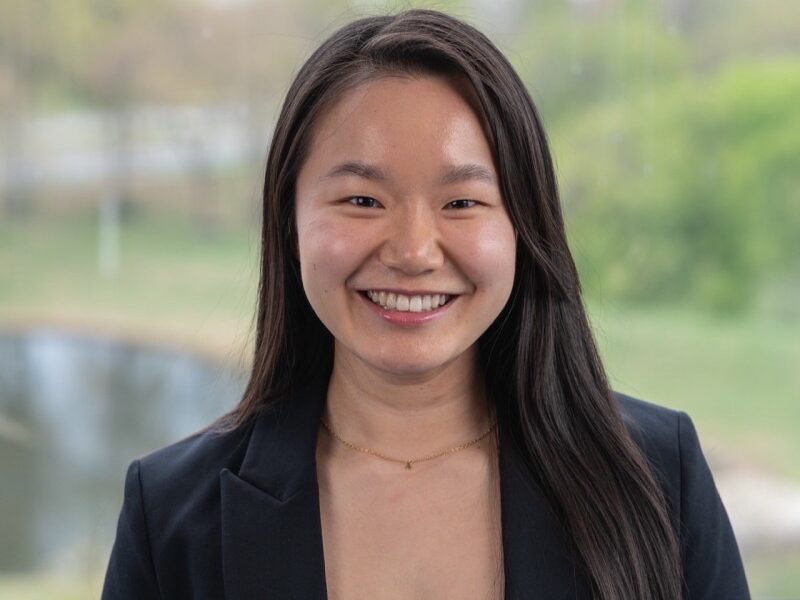
We sat down with Frederick, MD native Keira Mull on her unexpected journey from pre-med student to Bioburden Control Specialist at AstraZeneca. As Student Committee Co-Chair for ISPE CBA, she’s passionate about guiding emerging leaders into the pharmaceutical industry.
How did you get here?
Hello, my name is Keira Mull, and my journey into the pharmaceutical industry was an unexpected but deeply rewarding one.
I graduated in 2020 during the height of the pandemic. As a pre-med student, I had spent my undergraduate years immersed in research, volunteering at hospitals, and taking all the science courses with the goal of becoming a physician. I planned to take a gap year to study for the MCAT, but then the world shut down. That pause gave me space to reevaluate my priorities. I asked myself: Is becoming a doctor truly my dream, or someone else’s? Do I want to spend more of my 20s in school, or explore other paths where I can still help patients?
Around that time, a recruiter reached out to me on LinkedIn about a lab position at AstraZeneca (AZ), just ten minutes from my home. I said yes, thinking it would be a great way to explore the pharmaceutical industry while figuring out my next steps. I quickly fell in love with the culture and the people at AZ, and I never looked back.
I started as a QC Analyst, did well, and grew into a Senior QC Analyst role. In 2023, I enrolled in a master’s program in Biotechnology and Management at Mount Saint Mary’s University. I chose this program because I see myself in a leadership position one day, and I wanted to understand the full lifecycle of a drug, from discovery to FDA approval to manufacturing.
Armed with new knowledge and a curiosity to explore a different side of the business, I took a leap of faith and applied to a highly technical team within manufacturing. My peers and manager saw my potential, and I transitioned into my current role as a Bioburden Control Specialist. Nearly a year in, I’ve had the opportunity to work cross-functionally to drive impactful improvements, lead important projects, and support critical investigations that improve product safety and quality.
Outside of work and school, I began attending events hosted by the International Society for Pharmaceutical Engineering (ISPE), thanks to invitations from Hamid Teimourian, current VP of the Chesapeake Bay Area (CBA) Chapter. After learning that Allyssa Cochrane and I were both graduate students, Hamid encouraged us to take on leadership roles as Student Committee Co-Leads and Board Members. We saw this as an incredible opportunity to give back and offer students the advice and support we wish we had just a few years ago.
Since the formation of the committee earlier this year, we’ve built meaningful connections with local universities, faculty, and students. Our mission is to guide students as they transition into the pharmaceutical industry—not just as today’s emerging talent, but as tomorrow’s emerging leaders. If you know any students interested in pharma and looking to get involved, please reach out!
What is currently blowing your mind right now?
As a Bioburden Control Specialist, I’m deeply interested in how microbial control strategies are evolving across the pharmaceutical industry. The recent updates to Annex 1 have significantly influenced industry-wide practices, from gowning procedures to contamination control strategies and training programs. It’s exciting to see how regulatory guidance is driving innovation and elevating standards across the board.
Looking ahead, I’m especially curious about the integration of rapid microbiological methods (RMMs) and real-time monitoring. These technologies have the potential to transform how we detect and respond to contamination risks. I’m also intrigued by the role of AI in pharma—from predictive modeling to quality control, the possibilities for smarter, faster decision-making are endless.
Beyond the technical side, I’m energized by the next generation of professionals entering the industry. Co-chairing the ISPE-CBA Student Committee has shown me the power of intentional outreach, mentorship, and community building. In just seven months, we’ve been able to double our student membership! It’s incredibly rewarding to connect authentically—whether it’s mentoring students, collaborating with peers, or learning from industry leaders. These conversations fuel my passion and keep me grounded in purpose.
If you could explain yourself right now in only emojis, what would those be?
This question was hard for me, so I asked ChatGPT to describe me in emojis based on our past conversations and I couldn’t agree more:
🧪🎯 Bioburden Control Specialist: precise, science-driven, and goal-oriented
🧬📊 Analytical and detail-focused in your work
🚀👩🔬 Driven leader helping double student membership in just 7 months
🌱🤝 Passionate about mentoring and growing student involvement (ISPE-CBA Student Committee)
🎓💡 Curious, thoughtful, and always learning
🧠✨ Intelligent and insightful in how you approach challenges
😊📣 Approachable and communicative, with a collaborative spirit
If you could travel in to the future… what does your LinkedIn Headline say?
🔬 Bioburden Control Expert | 🌟 Emerging Industry Leader | 🚀 Future CEO/ Senior Leader | 🤝 Champion for Student Engagement & Innovation (Mentor)
Passionate about driving innovation in contamination control and shaping the future of pharmaceutical manufacturing. As a dedicated leader and co-chair of the ISPE-CBA Student Committee, I’m committed to mentoring the next generation and building bridges across industry and academia. My long-term vision is to lead at the executive level—bringing science, strategy, and people together to make a lasting impact on global health.
What has been your greatest challenge and how did you overcome it?
Balancing two master’s degrees, a full-time career in bioburden control, and life has been one of the most demanding yet transformative chapters of my life. There were moments when the workload felt overwhelming—juggling deadlines, class schedules, leadership roles, and personal commitments all at once.
What helped me overcome it was learning to lean into my community. I stopped trying to do everything alone and started asking for help—from my family, who supported me emotionally and practically; from friends, who reminded me to take breaks and celebrate small wins; and from coworkers, who offered guidance, encouragement, and flexibility when I needed it most.
I also learned to prioritize with intention, set boundaries, and give myself grace. That experience taught me that resilience isn’t just about pushing through—it’s about knowing when to pause, when to ask, and when to lean on others.