Insights from the QNova Life Sciences Partnering Forum reveal how investor expectations around volatility, AI, and commercial discipline are redefining life sciences fundraising.
During Day One of the QNova Life Sciences Partnering Forum at JPM Healthcare Week, a consistent message emerged across sessions and side conversations alike: the current fundraising environment in life sciences is not experiencing a temporary slowdown. It is undergoing a structural reset.
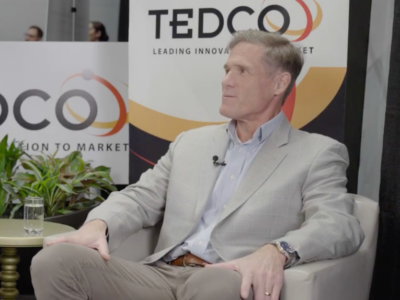
That reality was articulated early by Eric Mattson, principal at Denver-based private equity firm Excellere Partners, whose opening-day perspective helped frame many of the discussions that followed. With nearly 25 years of experience investing in and advising life sciences companies, Mattson offered a downstream investor’s view of a market increasingly defined by volatility, selectivity, and execution risk.
“We’re going to have continued volatility,” Mattson said. “And that is just the environment that you all are going to have to exist in.”
His remarks set the tone for a forum that focused less on optimism and more on realism—how capital is behaving today, what investors now expect earlier in company lifecycles, and why familiar fundraising assumptions no longer hold.
From steady growth to persistent volatility
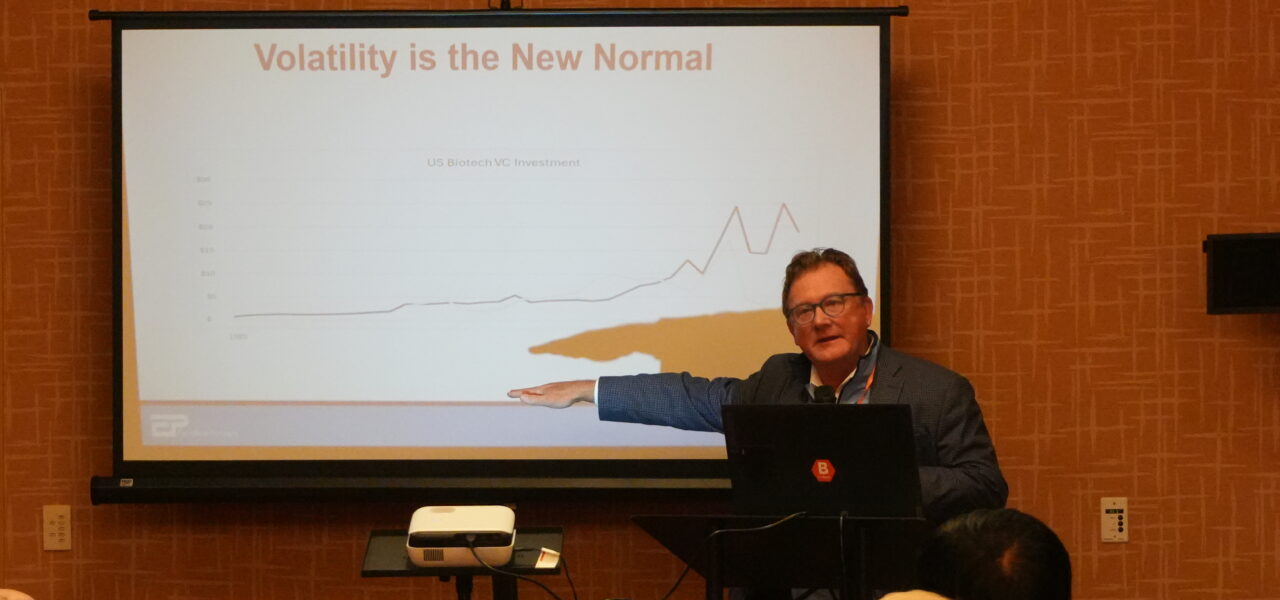
For decades, venture and private investment in life sciences followed a largely predictable trajectory. Capital flowed steadily upward, with periodic pullbacks offset by reliable public market exits. That dynamic began to fracture in the mid-2010s, when investment surged rapidly and expectations expanded alongside it.
The correction that followed has not resolved into a new equilibrium. Instead, volatility has become a defining feature of the market. Public biotech indices remain erratic, healthcare IPO activity continues to lag historical norms, and macro uncertainty—from geopolitics to trade policy—has filtered into every stage of company formation and financing.
For founders who launched companies during the prior expansionary cycle, the contrast is stark. As Mattson emphasized, the conditions many companies are navigating today are fundamentally different from what the industry experienced for much of the past two decades—and there is little indication of a near-term return to those earlier dynamics.
Capital is abundant—and still hard to access
One of the more counterintuitive themes raised on Day One was the disconnect between available capital and actual deployment. On paper, life sciences investors are sitting on historically high levels of dry powder across venture and private equity funds. In practice, much of that capital remains slow to move.
“We have hundreds of millions of dollars that we’re trying to find a home for,” Mattson said. “And it is hard.”
The challenge is not a lack of money, but a lack of conviction. Faced with heightened uncertainty, many investors are prioritizing companies they already know—often through follow-on financings or internal extensions—rather than initiating new relationships. The result is a market where capital exists, but confidence is unevenly distributed.
This dynamic echoed throughout the forum’s first day: fundraising challenges today are less about scarcity and more about trust, perceived downside protection, and clarity around value creation.
AI as an expectation, not a differentiation
Artificial intelligence emerged as one of the dominant themes of the forum’s opening sessions, and Mattson reinforced how central it has become to modern fundraising conversations. Across therapeutics, diagnostics, medtech, and platform companies, founders are now expected to articulate how AI impacts their development timelines, cost structures, or scalability.
“You have to be able to answer the AI questions,” Mattson said. “It’s not an option anymore.”
Importantly, this does not mean every company must position itself as AI-first. But investors increasingly treat AI fluency as table stakes. An inability to address its role signals a lack of preparedness rather than strategic restraint.
As multiple speakers underscored throughout Day One, AI has shifted from optional narrative to baseline assumption in how capital evaluates future efficiency and competitiveness.
Commercial reality moves upstream
Another signal-setting theme from the forum was the changing definition of success in life sciences development. Regulatory approval, once viewed as a definitive inflection point, no longer carries the same weight with investors unless accompanied by credible evidence of reimbursement, adoption, and payment.
Mattson emphasized that commercial strategy is now being pulled earlier into the lifecycle of company formation. Founders are expected to understand payer dynamics, pricing logic, and market access considerations well before late-stage clinical validation.
This shift adds complexity, particularly for scientific founders already navigating technical and regulatory risk. But as the forum’s opening sessions made clear, commercial conviction has become inseparable from scientific promise in the eyes of capital providers.
What investors want founders to get right
Throughout his remarks, Mattson returned to a set of practical realities that framed many of the Day One conversations:
Founders must differentiate quickly and clearly in an environment where investors are time-constrained and increasingly focused on downside risk. They must target aligned capital, avoiding conversations with investors whose stage, sector, or check size make a deal unlikely. They must demonstrate capital discipline by clearly explaining how funds will be deployed and how that deployment leads to value creation. And they must be prepared to discuss valuation logic, even when early-stage numbers are inherently imprecise.
Underlying each of these expectations is a single unifying requirement.
“Conviction has to be transferable,” Mattson said. “You have to be able to transfer that conviction to the person across the table.”
For investors, belief in a mission is insufficient on its own. What matters is confidence that capital will cycle back with returns—a reality that increasingly shapes how companies are evaluated at every stage.
Exits are longer, later, and more operational
In the closing Q&A, Mattson offered insight into how exit expectations have evolved from a private equity perspective. Excellere Partners focuses on profitable, founder-led life sciences businesses—typically generating meaningful earnings—where operational scaling and de-risking create value.
Rather than early exits tied to clinical milestones, private equity increasingly prioritizes infrastructure, predictability, and scalability. For earlier-stage companies, this underscores a longer road to liquidity and a growing emphasis on operational readiness well before exit conversations begin.
Why it matters
As the opening day of the QNova LifeSciences Partnering Forum made clear, the life sciences capital landscape has not simply tightened—it has recalibrated. Capital is more selective, more disciplined, and more demanding. AI has become an expectation. Commercial strategy has moved upstream. Volatility is no longer a phase, but a baseline condition.
For founders, operators, and ecosystem leaders, the takeaway from Day One was not pessimism, but clarity. The rules have changed, and understanding those rules is now a prerequisite for raising capital at any stage.
Despite the caution embedded in his assessment, Mattson closed with a long-term optimism shared by many speakers throughout the forum. Advances in AI-enabled drug development, personalized medicine, and advanced therapies continue to accelerate. The science remains powerful, and the opportunity remains real.
But as Day One of the QNova Forum underscored, progress will favor those who can navigate complexity, communicate conviction, and build companies designed for the market as it is—not as it once was.