
In a regulatory environment shaped by leadership turnover, evolving review practices, and policy shifts announced outside traditional channels, companies developing FDA-regulated medical products are being forced to operate with fewer clear signals than in years past.
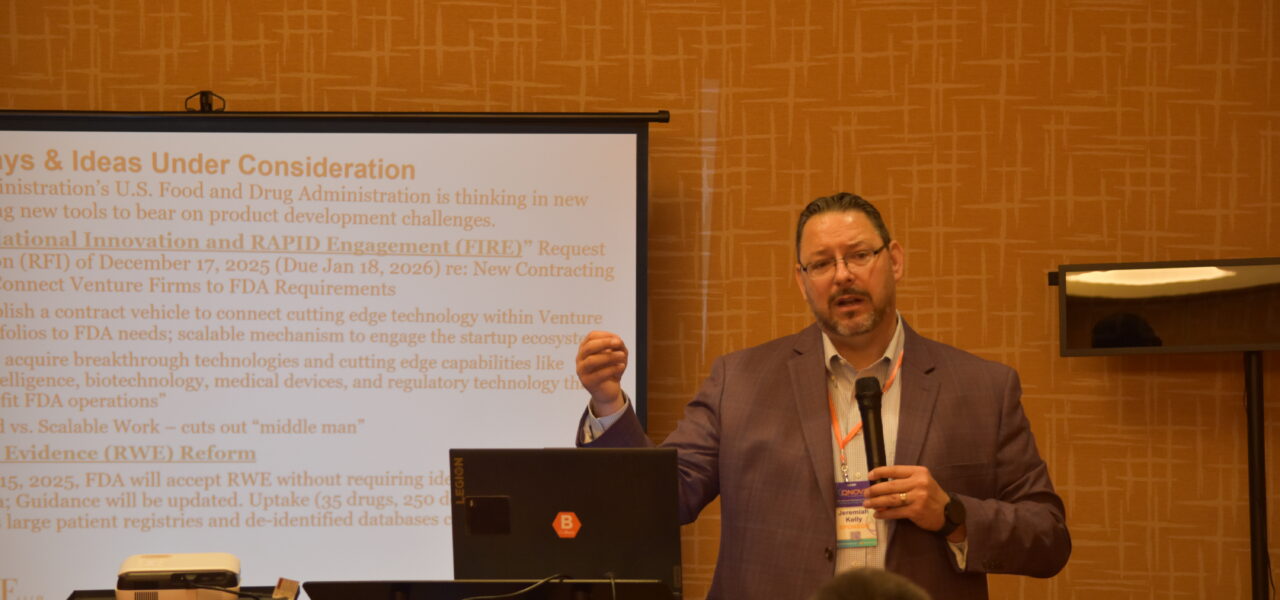
That reality framed a session at the QNova LifeSciences Partnering Forum co-hosted by the Medical Technology Enterprise Consortium (MTEC), where Jeremiah J. Kelly, partner at Venable LLP and former senior FDA regulatory attorney for the U.S. Army, offered a candid update on the state of the Food and Drug Administration—and a strategic case for leveraging one of the most underutilized expedited approval mechanisms available to industry: the Department of Defense dual regulatory pathway established under Public Law 115-92.
Drawing on experience spanning FDA leadership roles, Department of Defense medical R&D, and private practice, Kelly’s message was direct: regulatory fundamentals still matter, perhaps more than ever—but companies must be disciplined about which acceleration mechanisms they pursue and why.
An FDA in Flux
Kelly began by addressing what many in industry are already feeling. FDA is undergoing a period of internal transition, with significant leadership changes and a growing proportion of junior review staff operating in a rapidly shifting policy environment.
New initiatives—from the Commissioner’s National Priority Voucher pilot to pathways for ultra-rare diseases based on “plausible mechanism”—have been announced through speeches, journal articles, or press releases rather than through formal guidance or notice-and-comment rulemaking. While many of these programs are conceptually attractive, their durability and predictability remain uncertain.
For companies, this creates a real strategic tension. Novel pathways can offer speed, but over-reliance on mechanisms without clear statutory grounding can introduce risk if programs are paused, revised, or challenged. Kelly emphasized that disciplined FDA engagement—robust preclinical work, carefully constructed IND strategies, and well-prepared Type A, B, and C meetings—remains foundational.
In his view, chasing regulatory “shiny objects” without anchoring them to a defensible regulatory record can ultimately undermine valuation, partnering discussions, or exit readiness.
Key FDA Developments to Watch
Kelly highlighted several policy developments currently reshaping the regulatory landscape.
The Commissioner’s National Priority Voucher pilot promises accelerated NDA or BLA review, but unlike traditional priority review vouchers, it is not transferable and lacks explicit statutory authorization. That distinction has already drawn congressional scrutiny and raises questions about long-term stability.
The Plausible Mechanism Pathway for ultra-rare diseases offers flexibility where randomized trials are infeasible, particularly for personalized cell and gene therapies. However, eligibility criteria are narrow, and the pathway’s operational details remain limited.
FDA’s Foundational Innovation and RAPID Engagement (FIRE) initiative signals interest in integrating advanced technologies—potentially through engagement with venture-backed platforms—to modernize agency operations. While notable, the program appears focused on improving FDA’s internal capabilities rather than accelerating individual product approvals.
Expanded acceptance of real-world evidence, including aggregated data without patient-level identifiers, may reduce clinical burdens when used as confirmatory support. Kelly cautioned, however, that such evidence is unlikely to replace strong Phase II or Phase III efficacy data.
Meanwhile, negotiations around the next Prescription Drug User Fee Act cycle could introduce incentives to onshore early clinical development, including potential fee credits for U.S.-based Phase I trials and higher fees for overseas execution.
Kelly also flagged FDA’s recent practice of publicly releasing complete response letters—raising concerns about confidentiality, sponsor fairness, and the downstream commercial implications of unresolved regulatory disagreements.
Taken together, these developments point to an agency under pressure to move faster, but not always through mechanisms industry can rely on with confidence.
A Statutory Acceleration Path Hidden in Plain Sight
Against that backdrop, Kelly turned to the centerpiece of his talk: Public Law 115-92, a Department of Defense-specific expedited approval mechanism he helped negotiate, draft, and implement while serving within the Army Medical Research and Development Command.
Unlike newer FDA initiatives, PL 115-92 is grounded in statute. It requires the Department of Defense to submit an annual priority list of critical medical products—across drugs, biologics, and devices—to the FDA Commissioner. Products on this list are entitled to expedited regulatory engagement using any available FDA acceleration tools, including fast track, priority review, and tailored procedural flexibilities.
The statute also forced long-needed alignment across a historically fragmented DoD medical R&D ecosystem, bringing disparate programs and funding streams into a unified prioritization process overseen by the Medical Product Acceleration Committee.
For sponsors, inclusion on the DoD priority list can meaningfully compress development timelines, particularly for products addressing battlefield trauma, infectious disease threats, diagnostics, and medical countermeasures. Kelly cited more than 20 products whose paths to licensure were accelerated under this framework, including therapies for severe malaria, freeze-dried plasma, cryopreserved platelets, and diagnostics for traumatic brain injury.
Strategy, Not Just Designation
Kelly stressed that designation alone is not enough. The real value of PL 115-92 lies in actively using the statute to drive focused FDA engagement—separate meetings, tailored review strategies, and sustained coordination between DoD and FDA.
Without that pressure, products risk defaulting back into standard review pathways. Effective use of the statute requires regulatory fluency across both FDA and DoD systems, clear articulation of military relevance, and persistent advocacy to ensure the law’s intent is fully realized.
For companies already engaging with the Department of Defense—through OTA agreements, CRADAs, or consortia such as MTEC—the pathway offers a way to align national security priorities with commercial development goals without compromising regulatory rigor.
A Signal for Founders and Investors
Kelly’s message resonated beyond defense-focused programs. In an environment where regulatory predictability underpins valuation, capital formation, and exit timing, statutory acceleration mechanisms matter more than discretionary ones.
For founders, understanding which pathways are resilient—and how to integrate them into a disciplined FDA strategy—can be the difference between acceleration and distraction. For investors, DoD priority designation under PL 115-92 can serve as a tangible signal of de-risking when paired with credible regulatory execution.
Looking Ahead
The regulatory landscape is unlikely to stabilize quickly. Leadership transitions, policy experimentation, and geopolitical pressures will continue to shape how FDA operates.
For companies navigating this terrain, the challenge is not choosing between fundamentals and innovation, but integrating both. Programs like the DoD dual regulatory pathway demonstrate that acceleration, when grounded in statute and strategy, can coexist with rigor.
The opportunity now lies in knowing where those pathways exist—and how to use them deliberately, before they become crowded.