On a winter evening in Philadelphia, the room wasn’t filled with optimism alone. It was filled with realism—earned, hard-won realism—from people who have carried CAR-T cell therapy from a radical idea to a life-saving clinical reality, and who know better than anyone how steep the next climb will be.
That was the spirit behind Climb for a Cause, a fundraiser hosted by Brad Watts of Conner, Strong & Buckelew as part of his upcoming Timmerman Traverse (donate here) expedition to summit Mount Kilimanjaro. The event brought together a rare cross-section of the CAR-T ecosystem—academic pioneers, biotech CEOs, manufacturing leaders, and patient advocates—not to celebrate a victory lap, but to confront what still lies ahead.
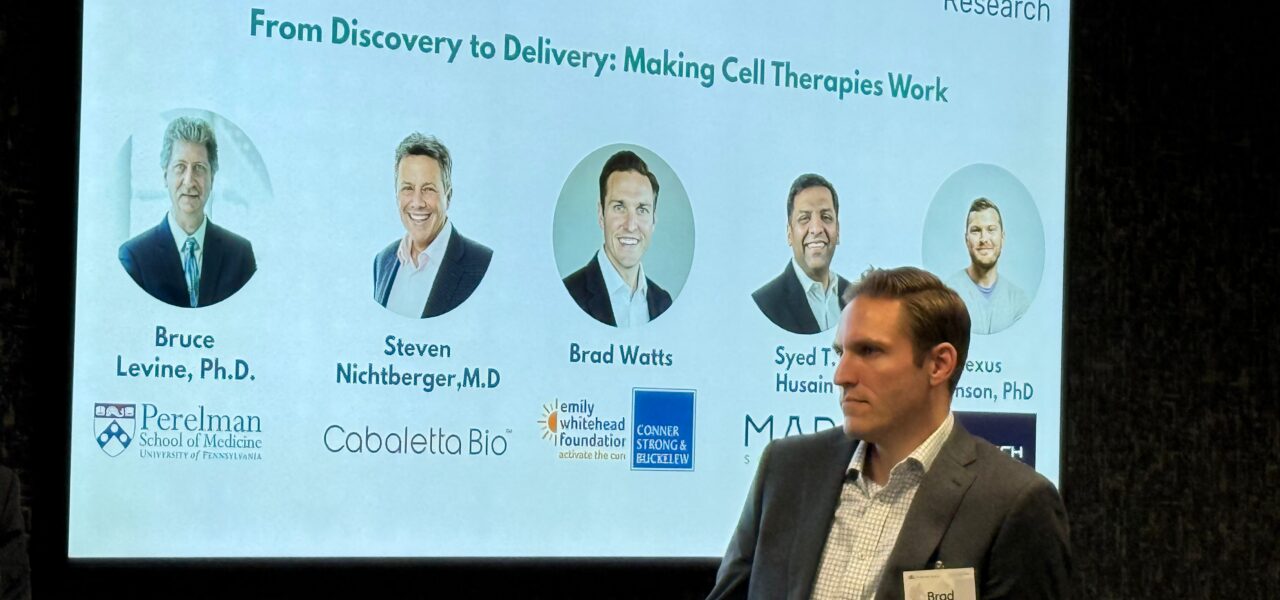
Framed around the theme From Discovery to Delivery: Making Cell Therapies Work, the discussion was candid and consequential, surfacing hard-earned lessons about scale, access, manufacturing, and collaboration from people who have lived those challenges firsthand and continue to shape where the field goes next.
The panel itself reflected the full arc of CAR-T’s evolution, bringing together leaders who have helped define the field at every stage. Bruce Levine, one of the original architects of CAR-T at the University of Pennsylvania, was joined by Steven Nichtberger, CEO of Cabaletta Bio, Syed T. Husain, chairman and CEO of Made Scientific, and Lex Johnson, co-founder of Dispatch Bio—executives and scientists whose work spans discovery, clinical development, manufacturing, and next-generation innovation.
For an industry built on audacity, it was a fitting moment of reflection.
From improbable science to lived reality
Watts opened the evening not as a host, but as evidence.
A CAR-T survivor diagnosed in his late 20s with aggressive forms of non-Hodgkin’s lymphoma, he recounted years of chemotherapy, radiation, stem cell transplant, immunotherapy, and finally CAR-T. “There were even times where I was receiving chemotherapy and hoping to fail it so that I could get to CAR-T,” he told the audience.
That lived experience framed the night’s central truth: CAR-T is no longer theoretical. It works. It sends people home. It gives them their lives back.
Few understand that arc better than Bruce Levine, one of the scientists who helped pioneer the technology at the University of Pennsylvania. Levine traced the early days—when engineering T cells to fight cancer sounded “crazy,” funding was scarce, and the field nearly stalled in the so-called dark years of gene therapy.
“We treated three patients who had failed everything,” Levine recalled. “We saw two complete responses and one partial response—and then ran out of money.” Within a decade, that work would lead to the first FDA-approved CAR-T therapy, Kymriah, and ignite an entire global industry.
Today, Levine said, “we have hundreds of companies developing these technologies. It has become an ecosystem.”
But ecosystems bring complexity.
Manufacturing: the mountain beneath the mountain
As the conversation shifted from discovery to delivery, a recurring theme emerged: CAR-T’s greatest limitations are no longer scientific—they’re structural.
Steven Nichtberger, CEO of Cabaletta Bio, put it bluntly. Autologous CAR-T “is fabulous because it works,” he said. “It’s safe relative to what’s being treated. But it is a bear to manufacture. Every step of the way is painful. It takes a long time. It’s very expensive.”
Nichtberger likened the current state of CAR-T manufacturing to pre-industrial automobiles—hand-built, bespoke, and fundamentally unsustainable at scale. “Before there was a Model T, cars were cobbled together by engineers. You didn’t have an automobile industry until you had industrialized production.”
The field is now living “the day after the Model T production line has become available,” a shift enabled by fully closed, automated autologous manufacturing systems pioneered by companies like Solaris. Nichtberger pointed to Solaris’s recently announced commercial manufacturing partnership with Bristol Myers Squibb as evidence that autologous CAR-T can now be produced at industrial scale without human intervention—an inflection point that, for Cabaletta, removes manufacturing as the limiting factor and allows the company to scale efficiently, pursue multiple autoimmune indications, and stay focused on clinical impact rather than infrastructure.
That analogy resonated across the panel. From a CDMO perspective, Syed T. Husain, chairman and CEO of Made Scientific, emphasized that the next phase of CAR-T depends on flexibility—facilities, regulatory frameworks, and business models that can evolve alongside rapidly changing therapies.
“The pressure now,” Husain said, “is how we do our part to create flexible operations—facilities that are purpose-built, but adaptable—while navigating an evolving regulatory landscape and brutal economics.”
In other words, the industry has proven CAR-T can work. It has not yet proven it can work for everyone.
Expanding the promise beyond blood cancers
For all of CAR-T’s success to date, the panel was clear-eyed about its limits—and where the field must go next. As Lex Johnson of Dispatch Bio noted, today’s approved CAR-T therapies overwhelmingly serve patients with leukemias, lymphomas, and myelomas—diseases that collectively represent just 5 to 10 percent of all cancers worldwide.
The remaining 90 percent, largely solid tumors, remain out of reach not because CAR-T lacks potency, but because it lacks precision. Early CAR-T targets like CD19 succeed precisely because they strike antigens that patients can live without; that margin for error disappears in solid tumors, where the inability to distinguish cancer cells from healthy tissue can be catastrophic. Dispatch’s work reflects a broader shift underway in the field: engineering entirely new targeting strategies—synthetic, tumor-specific signals that do not exist in healthy human biology—with the goal of extending CAR-T–like durability and curative potential to vastly larger patient populations.
That ambition intersects with a second, equally consequential evolution highlighted by Bruce Levine: the move from ex vivo CAR-T manufacturing toward in vivo approaches that reprogram immune cells directly inside the patient.
Instead of extracting T cells, engineering them in specialized facilities, and waiting weeks for reinfusion, in vivo CAR-T aims to deliver genetic instructions—via viral vectors or mRNA-based systems—straight into the body, turning patients into their own manufacturing sites. If successful, the implications are profound: faster treatment, broader access, and a dramatic reduction in the logistical and economic burdens that currently limit adoption.
Yet Levine cautioned that while much of the foundational science for ex vivo CAR-T emerged from U.S. academic centers, many of today’s in vivo CAR-T programs are advancing overseas, raising broader concerns about competitiveness, regulation, and geopolitical balance. The real question is – where will the next generation of innovation be built, and who will lead it?
Together, these two trajectories—precision targeting for solid tumors and in vivo delivery that collapses the distance between discovery and treatment—represent more than incremental progress. They define the future of the field. CAR-T’s next era will not be measured by how many patients it can cure at the margins, but by whether it can scale its promise to the vast majority of cancer patients who are still waiting.
Levine added another frontier: in vivo CAR-T—engineering immune cells directly inside the patient’s body. The approach could eliminate weeks-long manufacturing delays, but much of that work is now happening outside the U.S.,
The unspoken barrier: access
Perhaps the most sobering insight of the night came not from science, but from economics.
Nichtberger called reimbursement “the unspoken devil” in cell therapy adoption. Current hospital payment models were never designed to support therapies that are both personalized and expensive. The result is a system where hospitals lose money administering transformative treatments—and patients wait, or never receive them at all.
Today, only about 20 percent of eligible cancer patients receive CAR-T.
“That’s not a science problem,” Nichtberger said. “That’s a system problem.”
Why this industry climbed together
So why did this room—busy executives, scientists, operators—come together to support Brad Watts and his climb?
Perhaps it was the idea of divide and conquer which captured both the technical reality of CAR-T’s future and the human reason this room showed up for Brad Watts. As Syed T. Husain put it, “the only way cell therapy is going to be successful is if people embrace divide and conquer,” pointing to a model where researchers research, innovators innovate, manufacturers manufacture, and CDMOs do what they do best—without trying to be everything at once.
That mindset mirrors Brad’s climb itself. No one summits Kilimanjaro alone, and no single breakthrough carries CAR-T the rest of the way. The industry gathered that night because Brad’s story—and his climb—reflect the same truth facing cell therapy now: progress depends on shared effort, clear roles, and a collective willingness to shoulder different parts of the ascent so patients can ultimately reach the summit.
Watts represents the full arc of what this industry is trying to do.
As Levine put it, “Patients can go home and live their lives very happily. But Brad is an inspiration for the advocacy he’s taken—to share his experience and pay it forward.”
Watts’ Kilimanjaro ascent is raising funds for the Damon Runyon Cancer Research Foundation, which backs early-career scientists pursuing high-risk, high-reward cancer research—the same kind of research that once kept CAR-T alive when few believed.
The metaphor writes itself. CAR-T has already summited one peak: proving engineered cell therapies can cure otherwise untreatable disease. The next mountain—scaling access, manufacturing, reimbursement, and global competitiveness—may be even steeper.
But nights like this make one thing clear. The industry understands the terrain. And it’s willing to climb together.