At BioBuzz’s Insights to Impact program, local leaders outlined a blueprint for scaling companies, attracting capital, and integrating the state’s innovation infrastructure.
Maryland does not lack science, research funding or patents.
It does not lack federal proximity, world-class research institutions, or seasoned operators who have built and exited companies. What it has historically struggled with is something more structural: converting early promise into companies that scale — and stay.
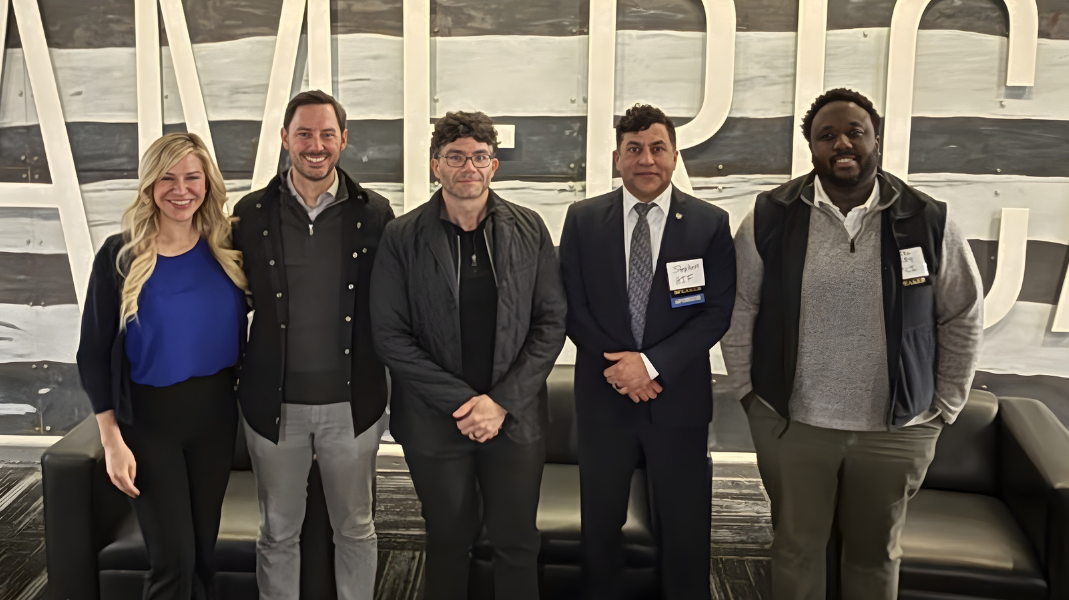
That reality framed the second half of the BioBuzz Insights to Impact program, where Deborah Hemingway, PhD of Ecphora Capital, moderated a discussion with leaders from across Maryland’s incubator and innovation landscape to examine a pressing question: What will it take to incubate better and grow the state’s bioeconomy?
Panelists included:
Stephen Dalal, D.V.M., M.P.H., COL, U.S. Army, (Ret.), Vice President, HJF Innovation Ecosystem Initiative
Matt Tremblay, PhD, CEO, Blackbird Laboratories
Mark VanderZyl, Director, Connect Labs Baltimore
Ezekiel Kelley, VP Engagement & Growth, Frederick Innovative Technology Center (FITCI)
The panel offered not just optimism, but a disciplined blueprint for ecosystem growth.
The Retention & Scale Gap
Hemingway grounded the discussion in a reality Maryland has wrestled with for years: too many university spinouts ultimately leave the state, particularly when they pursue institutional capital or preparing to scale.
Mark VanderZyl, reflecting on his tenure at Johns Hopkins Technology Ventures, noted that retention rates have improved significantly over time — from roughly 15 percent to closer to 50 percent. That progress matters. But improvement alone does not equal durability.
The underlying issue, he suggested, has long been density.
Capital and experienced biotech operators remain heavily concentrated in markets like Boston and the Bay Area. Founders gravitate toward ecosystems where there are multiple investors, repeat entrepreneurs, seasoned C-suite executives, and visible examples of companies that have scaled successfully.
Ecosystems are not judged only by science quality. They are judged by depth — by how many layers of support surround a founder at every stage.
Maryland has the science. The next phase requires building the surrounding layers.
Changing the Narrative: From Retention to Attraction
If the panel had a strategic turning point, it came when Matt Tremblay reframed the question entirely.
Too often, Maryland’s ecosystem conversations begin defensively around questions like; Why do companies leave? Why can’t we compete with Boston? Why would a founder stay?
Tremblay challenged the premise and the positioning. “Instead of saying why would a company stay in Baltimore,” he said, “it’s like, why not?”
That shift is not just semantics. It’s shifting our strategic positioning. Capital does not flow toward apology. It flows toward conviction.
Tremblay argued that while talent and investment are often discussed separately, they ultimately converge into a single defining variable.
“I think talent and investment are all critical factors. So maybe we could roll that up to community.”
Community, in this context, means repeat founders, operator networks, coordinated programming, aligned incubators, visible exits, and coordinated capital. Without this community, startups feel isolated and the breadth of what is here just isn’t visible. With it, founders and investors feel confidence.
But narrative must be backed by action.
Rather than sending Maryland startups outward to chase capital, Tremblay emphasized a playbook that he and his team have been executing from. “We need to bring investors into the ecosystem to experience it firsthand,” he emphasized, “particularly those who don’t know anything about Baltimore.”
Immersion changes perception. When investors walk through new lab facilities, meet operators with prior exits, and see coordinated infrastructure across the state, Maryland stops appearing like a feeder system and starts looking investable.
That strategy also demands discipline.
“Not every company idea is a good idea to actually take forward, and not every company idea is going to get financed,” Tremblay said. At the same time, Tremblay balanced realism with encouragement: “Every person who’s interested in being an entrepreneur has something to contribute to some company.”
That philosophy — recycling talent across ventures — is what builds mature ecosystems. Even when a company stalls, the people behind it remain assets to the community.
Narrative strength and operational rigor must move together.
Maryland’s Structural Advantage: Federal Alignment and Dual-Use Strategy
Beyond narrative, Maryland possesses a structural differentiator few regions can replicate: direct adjacency to federal power and military health infrastructure.
Stephen Dalal emphasized that Maryland is uniquely positioned to capitalize on dual-use innovation — technologies that serve both civilian healthcare markets and Department of Defense needs.
With Washington, D.C. minutes away, and major installations including Walter Reed National Military Medical Center, Fort Detrick, Aberdeen Proving Ground, and multiple Department of Defense facilities across the state, Maryland sits at the center of military medicine, biodefense, and translational research.
Proximity, however, is not enough.
For many entrepreneurs, the military ecosystem is opaque. Procurement pathways are complex. Funding mechanisms are unfamiliar. Collaboration with military treatment facilities can feel inaccessible. As Dalal noted, “founders frequently ask how to begin.”
This is where the Henry M. Jackson Foundation’s incubator shifts from being space to being strategy.
Deeply embedded within military medical research infrastructure and authorized by Congress, the Foundation provides startups with more than introductions. It offers a roadmap — helping entrepreneurs understand defense health priorities, navigate Department of Defense funding channels, structure proposals, and align innovations with operational needs.
Dual-use strategy broadens opportunity. It opens additional funding streams, including Department of Defense and SBIR programs. It expands potential markets. And it differentiates Maryland from peer regions.
Few ecosystems can offer startups immediate adjacency to federal agencies, military clinicians, and biodefense infrastructure at scale.
Leveraged intentionally, that proximity becomes competitive advantage.
From Incubators to Ecosystem: Lowering Friction Through Coordination
If differentiation is about strategy, growth is about friction reduction.
Ezekiel Kelley described FITCI’s role as meeting founders at the earliest stages — when ideas are forming and product-market fit is still being defined. But the panel made clear that supporting entrepreneurs cannot stop at the walls of a single incubator.
Dalal highlighted active collaboration between the Henry Jackson Foundation, TEDCO and Montgomery County incubators, including shared programming and cross-access to resources.
That cooperation signals a necessary shift from incubation silos to ecosystem choreography.
Kelley reinforced the point with an idea that he’d like to see take shape — a “passport” model. If a startup belongs to one incubator, why shouldn’t it have structured access to programming, mentorship, and perks across others?
Rather than competing for tenants, incubators could create seamless pathways: federal guidance in one region, GMP readiness in another, early-stage mentorship elsewhere — without bureaucratic barriers slowing progress.
This reframes incubation from location-based support to network-based support.
Maryland does not lack incubators. It has several across Baltimore, Montgomery County, Frederick, and even on the Eastern Shore and Western Maryland. The opportunity suggested by Kelley is better integration.
If founders can move fluidly from concept validation to dual-use alignment to GMP scale-up to investor exposure — without losing momentum at institutional boundaries — the ecosystem begins to function as a coordinated engine rather than a collection of parts.
In a tightening capital environment, reducing friction is not operational detail. It is growth strategy.
The Next Phase of Maryland’s Bioeconomy
Across the discussion, a consistent through-line emerged.
Maryland’s next phase is not about building more programs. It is about building depth.
That means attracting outside capital through confident positioning, practicing disciplined company formation, leveraging federal and military alignment strategically, coordinating incubators into an integrated network, and recycling talent to build operator density.
Ecosystem infrastructure is not limited to lab space and capital pools. Both VanderZyl and Tremblay pointed to the importance of connective platforms like BioBuzz that make talent, opportunity, and momentum visible. VanderZyl referenced BioBuzz’s workforce components as part of the solution to retaining displaced federal scientists, while Tremblay suggested such platforms could help professionals “transpose” government-based skill sets into private-sector biotech roles, or even become entrepreneurs.
The implication extended well beyond any single organization. Maryland’s next phase depends on connective infrastructure — programs, convenings, and shared visibility mechanisms that reduce information asymmetry, accelerate talent redeployment, and demonstrate coordinated momentum to outside capital. In competitive ecosystems, density must not only exist; it must be seen as a community.
Maryland already has the scientific engine. It is building infrastructure. It is investing in incubators and workforce pipelines.
Now it must match those investments with cohesion.
If investors are invited in — and encounter rigorously formed companies supported by coordinated infrastructure and federal differentiation — the ecosystem begins to compound.
The question then shifts from why companies leave Maryland, to why they would ever want to.
INSIGHTS TO IMPACT:
Insights to Impact is an eight part thought leadership series that BioBuzz runs in each market. The series differentiates itself by creating a peer-oriented experience with highly curated content and attendees that are highly limited to industry leadership, investors, startups with minimal participation from vendors or service providers, with the exception of series sponsors.
If you’d like to learn more about how you can participate as a panelist, join as an attendee, or partner as a sponsor – reach out to BioBuzz at hello(at)biobuzz.io.