At leadership breakfast, Stephen M. Perry, Dave Ousterout and dozens of regional executives laid out what North Carolina must build next — deeper venture capital, stronger research gravity, and more intentional, amplified storytelling to match its ambition.
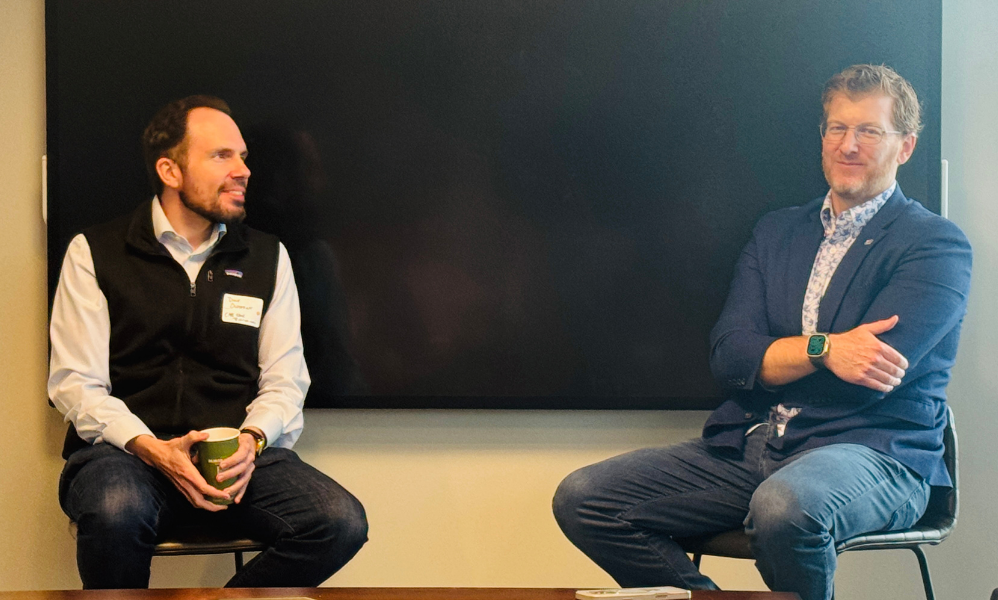
When Stephen M. Perry, CEO of Kymanox, and Dave Ousterout, PhD, General Partner at Cape Fear BioCapitol, took the stage at the KOL BioBreakfast at Kymanox Headquarters in Research Triangle to lead an authentic and reflective conversation about the the priorities for a region that is poised for a new phase of growth.
The event, presented by BioBuzz‘s Chris Frew as the first of eight additional thought leadership programs the organization has planned across the region this year, was designed to surface the conversations that matter most to site heads, executives and key opinion leaders within North Carolina’s life sciences community. What unfolded was not a ceremonial fireside chat. It was a candid examination of where the Research Triangle stands — and what it will take to move from strong to exceptional.
Executives from top companies across the Triangle region, including Kincell Bio, Seqirus, Solid Biosciences, iOrganBio, Inc., EnFuego Therapeutics and Clarus Biologics joined alongside ecosystem leaders from Duke University, NC Life Sciences, Center for Entrepreneurial Development and the North Carolina Biotechnology Center, underscoring the top down commitment that local companies have to investing in the region’s future growth.
Perry and Ousterout are not outside commentators. Perry has spent decades building and advising top global biopharma companies and life sciences companies in North Carolina, watching the region evolve from scattered facilities and farmland into a globally recognized manufacturing and innovation hub. Ousterout works at the earliest stages of company formation, where capital access, research density, and executive networks determine whether startups scale locally or drift toward coastal ecosystems.
Their shared message was clear: North Carolina has earned credibility. The next challenge is about building depth and moving more competitively.
Ousterout opened with a framing that cut through optimism. In today’s capital environment, selective and disciplined, startups do not advance through incremental gains.
“Be something exceptional. And people cannot deny you,” he said.
He followed with a sharper observation: “Today, our top 5% seem to compete with the median of the top-tier ecosystems.”
It wasn’t criticism. It was competitive realism.
Boston and the Bay Area benefit from density — of venture firms competing for deals, of repeat founders reinvesting locally, of executives with deep capital networks. RTP has excellence across research and manufacturing, but thinner layers of that venture and executive density.
Perry responded with a metaphor that resonated across the room. During the pandemic, he learned to bake sourdough bread. Ecosystems, he suggested, are similar. “You need all the ingredients.”
North Carolina has many of them: major manufacturers, expanding startups, respected universities, and organizations like NC Life Sciences and the North Carolina Biotechnology Center that provide connective tissue and workforce infrastructure. Doug Edgeton, CEO of the North Carolina Biotechnology Center, reinforced that long arc of collaboration during the event, pointing to the forthcoming book “Miracle Road: The RTP Story” as evidence that the region’s innovation foundation is deep and intentional .
But one ingredient remains comparatively thin: competitive venture capital.
“If you’re an emerging enterprise and you’re seeking capital,” Perry noted, “you’re probably gonna get some check writers… and they’re gonna be not located anywhere here in North Carolina.”
That dynamic shapes outcomes. When early capital clusters elsewhere, strategic gravity often follows. Research teams gravitate toward investor proximity. Executive talent follows network density. Companies sometimes exit earlier than they might in deeper venture ecosystems.
Coincidentally, this same morning, RTP-based Ten63 Therapeutics announced new financing from two new funders – outside of North Carolina. The company did raise earlier funding from Cape Fear BioCapital which show’s that Ousterout and his firm are walking the walk.
The challenge is not absence. It is scale.
The conversation then moved to a structural divide that many operators quietly acknowledge: research versus manufacturing. RTP has become a national powerhouse in biomanufacturing, with workforce programs and production facilities that other states study closely. Yet early-stage R&D, particularly in gene therapy and advanced molecular biology, remains more concentrated in Boston and San Francisco .
One executive described posting high-level research roles in Boston and receiving an overwhelming response, while similar postings in RTP draw smaller candidate pools . The implication was not that talent is absent here — it is that density drives options.
What RTP is really confronting is the challenge of scaling its ambition. That means more than attracting facilities or adding jobs. It means expanding the entrepreneurial mindset — encouraging more founders to take big swings and build for generational impact rather than early exits. It means deepening the pool of research talent so breakthrough science clusters locally instead of diffusing outward. And it means increasing the availability and competitiveness of venture capital so founders can raise meaningful rounds without leaving the state. Scaling, in this context, is about creating enough entrepreneurial courage, scientific density, and capital depth that building the next $10 billion company in North Carolina feels not aspirational — but normal.
Perry framed the next competitive frontier as the convergence of “carbon and silicon” — the integration of biological science with AI-driven discovery, digital infrastructure, and computational precision. RTP is strong in carbon. Silicon density remains thinner.
That integration may determine which ecosystems lead the next decade of biotech innovation.
It’s Time to Tell North Carolina’s Stories
If capital and research density are structural constraints, storytelling may be cultural.
“Boston and SF love to talk about themselves. We don’t,” Ousterout observed, capturing in one sentence what several attendees circled throughout the morning.
North Carolina’s state motto — “To be rather than to seem” — surfaced organically during the discussion. The ethos reflects a pride in substance over flash. Build first. Deliver quietly. Let the work speak for itself.
But in a competitive innovation economy, silence doesn’t signal strength. It creates ambiguity.
Throughout the open forum, storytelling emerged not as marketing theater, but as infrastructure. Julianne Bove, a representative from ISPE Emerging Leaders spoke about how critical it is for universities and community colleges to hear directly from industry — to understand not just what companies do, but who works there and how careers unfold. Young professionals described a tight entry-level job market and the need to see visible pathways upward. Angela Stoyanovitch, a community builders from Charlotte emphasized that storytelling is what connects academia to commercialization and helps early ecosystems take root.
Doug Edgeton reinforced the point, encouraging companies to leverage amplification channels they provide at the North Carolina Biotechnology Center, which has built a 40,000-plus follower network specifically to elevate local innovation. “If you have a great story, let us know. We amplify those,” he said referencing a company that received a sizable investment after catching the attention from a story the published.
Storytelling isn’t about vanity. It is about visibility as a competitive asset.
Investors evaluate signal. Scientists evaluate opportunity density. Executives with deep Rolodexes evaluate whether a region feels dynamic enough to take a risk to move their families. Without visible momentum, exceptional companies and people can appear isolated rather than systemic.
Storytelling, in this context, becomes a force multiplier. It attracts talent before a job is posted. It draws capital before a deck is sent. It gives students permission to imagine building here instead of leaving. And perhaps most importantly, it reinforces to the ecosystem itself that it is not a collection of isolated wins, but a coordinated, rising platform.
Perry’s “Starbucks test” — the idea that you should be able to sit in a café and assemble a founding team through proximity and shared networks — is as much about narrative as geography. In Boston’s Kendall Square, density is visible. You can feel it. In RTP, that density is less visible – but it is emerging. Unless the ecosystem begins to consistently tell its own story — of founders staying, of capital forming, of research translating, of executives relocating — that momentum wont reach the critical mass it needs to.
For BioBuzz, events and storytelling are about connecting the ecosystem to itself and the world.
As Stoyanovitch put it, “We’re ready for you here in RTP and Charlotte. Let’s get buzzing. We got your back.” That sentiment — collaborative, forward-leaning, and unapologetically supportive — may be exactly what North Carolina’s next chapter requires.
RTP no longer needs validation. It has global manufacturers, expanding startups, institutional support from NC Life Sciences and the North Carolina Biotechnology Center, and a quality of life that even European executives reportedly admire .
The question is whether it intends to deepen capital competition, attract more repeat founders, strengthen research density, and tell its story with enough confidence that exceptional companies built here become impossible to overlook.
Strong ecosystems are built over decades. Dominant ones emerge when they decide to compete at a different level.
At the KOL Breakfast, the Triangle’s leaders signaled that they understand the difference.