Baltimore’s life sciences ecosystem is entering a more defined phase—one where the conversation is shifting from individual breakthroughs to how the broader system comes together to support them.
That shift was on full display at BioBuzz’s Impact to Insight Series kickoff event in the BioHealth Capital Region, Built in Baltimore: Neuro Innovation, held March 19 at the newly opened 4MLK innovation hub. The gathering brought together leaders across economic development, venture, research, and startups to explore how Baltimore can translate its strengths into a more coordinated engine for neuro innovation.
Across the evening’s discussions and showcase, the signal was consistent: the building blocks are in place, and the focus is now on alignment and execution.
From Strategy to System-Level Execution
The event opened with a fireside chat featuring Otis Rolley, President & CEO of the Baltimore Development Corporation, and Robert Storey, Managing Partner at The LaunchPort, moderated by BioBuzz Founder Chris Frew.
The conversation reflected a more mature framing of Maryland’s life sciences strategy—one that views the ecosystem as an interconnected system rather than a collection of standalone efforts.
Rolley emphasized Baltimore’s role in linking economic development with innovation, ensuring that investments in infrastructure, policy, and community translate into real opportunities for companies to grow locally. “We have to think about this as an ecosystem—not just individual projects, but how it all connects to drive real impact.”
Storey underscored the importance of commercialization pathways, noting that without the right infrastructure to move ideas beyond early discovery, innovation struggles to reach scale.“Great science isn’t the problem—we see that every day. The challenge is building the pathway that actually gets it out into the world.”
Together, the discussion reinforced a central theme: progress depends less on isolated wins and more on how effectively the system supports companies from inception through growth.
Neuro Innovation Requires Coordination Across Disciplines
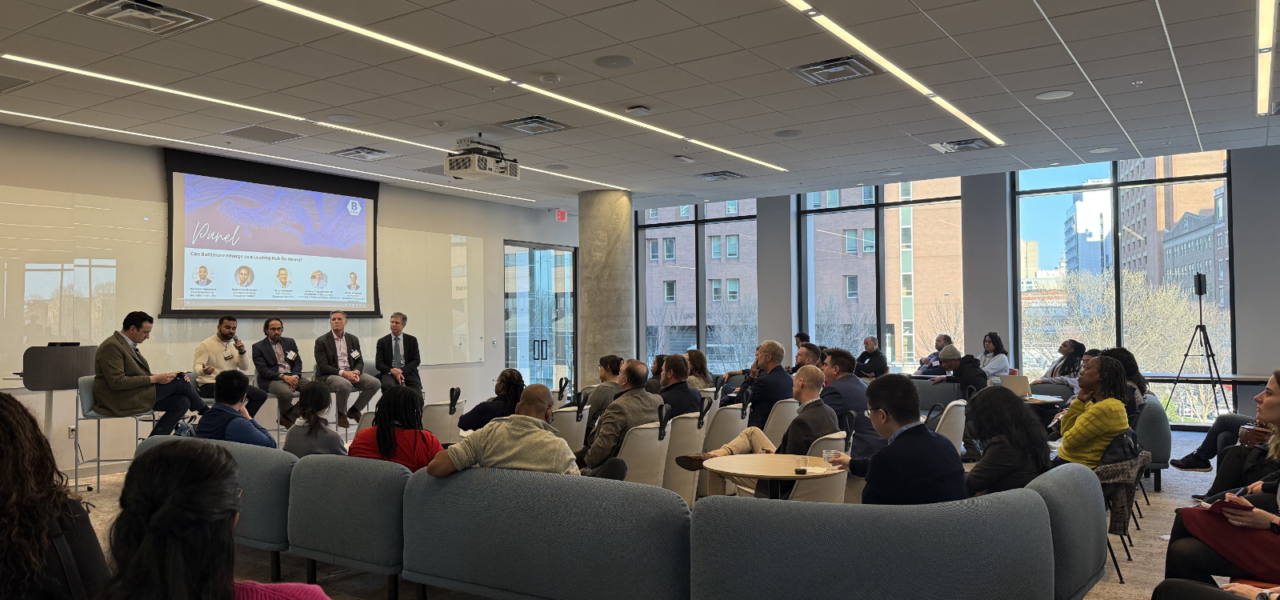
That systemic perspective carried into the panel discussion, Can Baltimore Emerge as a Leading Hub for Neuro?, moderated by Daniel Saragnese of SereNeuro.
Panelists—Mahesh Narayanan (Neuvation Ventures), Santosh Venkatesha (NeuroTech Harbor), Brian Jamieson (Diagnostic Biochips), and Graeme Woodworth (UMSOM Neurosurgery)—highlighted the unique complexity of neuro innovation, where progress depends on the integration of science, engineering, clinical insight, and capital.
Baltimore’s strengths—anchored by institutions like the University of Maryland School of Medicine and supported by emerging translational platforms—position it well within that framework. At the same time, the discussion acknowledged ongoing challenges, particularly around capital access, commercialization pathways, and workforce development.
Several key themes emerged:
- Clinical complexity is the starting constraint. Neurological diseases are difficult to diagnose, measure, and treat, with limited biomarkers and high variability across patients. That complexity carries downstream into every stage of development—from research to trials.As Woodworth emphasized, “The brain doesn’t give up its answers easily—and that makes everything downstream more challenging.”
- Engineering alone isn’t enough. Advances in neural devices and diagnostics must be paired with clinical validation, regulatory navigation, and adoption pathways. Innovation in neuro requires simultaneous progress across technical and clinical domains.Jamieson underscored this reality: “You can build incredible technology, but if it doesn’t fit into clinical workflows and deliver real value, it won’t go anywhere.”
- Capital has historically lagged—but is beginning to respond. Longer timelines and less predictable outcomes have made neuro a more cautious investment area. However, as clearer development pathways and enabling technologies emerge, investor interest is starting to follow.“Historically, neuro has been a tougher investment,” Narayanan shared, “but that’s changing as we start to see more defined pathways and real traction.”
- Translational infrastructure is becoming a key unlock. Platforms like NeuroTech Harbor are helping bridge the gap between academic discovery and commercialization—providing funding, validation environments, and structured pathways that reduce early-stage risk. Venkatesha pointed to the role of structured support: “Our goal is to help de-risk these innovations early so they actually have a chance to become companies.”
- Proximity matters. Baltimore’s concentration of clinical expertise, research institutions, and emerging startups creates a more connected environment for collaboration—shortening the distance between discovery, validation, and deployment.
Neuro innovation rarely hinges on a single breakthrough. More often, progress comes from aligning multiple, interdependent systems—science, clinical care, engineering, and capital. That complexity has historically slowed the field, but it also creates a clear opportunity for regions that can coordinate those elements effectively.
Baltimore is increasingly operating in that direction—not as a finished hub, but as a system coming into alignment. The momentum is building through stronger connections across institutions, platforms, and companies, with continued coordination set to determine how quickly that progress translates into lasting impact.
Startups Reflect Growing Momentum in Neuro Innovation
The Startup Showcase offered a closer look at how that momentum is beginning to materialize at the company level.
- JuneBrain (junebrain.com) is advancing non-invasive retinal imaging to detect and monitor neurological disease, using the eye as an accessible pathway into brain health.
- Impruvon Health (impruvonhealth.com) is applying data-driven approaches to improve clinical decision-making and patient outcomes, including in neurological care.
- Neurava (neurava.com) is developing technologies to better understand and interact with neural systems, supporting the evolution of precision neurotherapeutics.
- SereNeuro (sereneuro.com) is focused on translating neuroscience into clinical applications that improve diagnosis and treatment of neurological conditions.
- Neuroene Therapeutics (neuroenetherapeutics.com) is working to develop targeted therapies addressing unmet needs across neurological diseases.
Together, these companies reflect a range of approaches across diagnostics, therapeutics, and enabling technologies. More importantly, they point to an increasing concentration of activity that begins to resemble a cohesive innovation cluster.
Why This Matters
What stood out throughout the event was the degree of alignment across different parts of the ecosystem.
Public sector leadership is shaping long-term strategy. Infrastructure platforms are supporting commercialization. Investors are engaging earlier in emerging areas. Researchers and clinicians are driving scientific advancement.Startups are translating that progress into tangible solutions.
This level of coordination is what allows ecosystems to move from early potential to sustained growth.
From Insight to Ongoing Momentum
This event in the 2026 Impact to Insight event, Built in Baltimore: Neuro Innovation provided a clear snapshot of where Baltimore stands today: a region with strong fundamentals that is increasingly operating with greater cohesion.
The opportunity ahead is less about adding new pieces and more about continuing to connect the ones already in place.
In a field like neuro—where complexity is inherent and progress depends on integration—that alignment will play a defining role in shaping Baltimore’s trajectory as an emerging center for neuro innovation.