
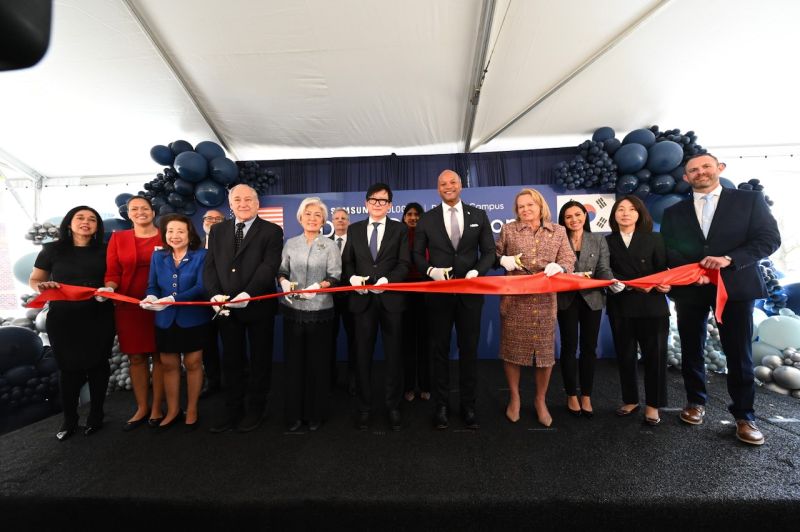
Photo Credit: Montgomery County Economic Development Corporation
The ribbon was cut in Rockville today, but the signal extends far beyond a single facility.
With the official opening of Samsung Biologics’ first U.S. manufacturing site, Maryland didn’t just welcome a new tenant—it reinforced a pattern that has been accelerating across the state: global biomanufacturing companies are no longer testing the region—they’re committing to it.
A Milestone That Signals Momentum
Standing alongside Wes Moore, Marc Elrich, Monique LaRocque Ashton, and John Rim, state and local leaders formally welcomed Samsung Biologics to Montgomery County, marking the opening of the company’s first U.S. manufacturing facility and celebrating a milestone that extends far beyond a single site.
What looked like a ceremonial moment was something more: a visible confirmation that Maryland is no longer competing for biomanufacturing relevance—it’s consolidating it.
The investment:
- Retains more than 500 jobs
- Adds 60,000 liters of drug substance capacity
- Establishes a foundation for future expansion
“This represents a meaningful step in expanding our U.S. manufacturing footprint. The addition of the Rockville site strengthens our ability to operate a geographically diversified manufacturing network, and we are thrilled to officially welcome more than 500 colleagues at the site to the Samsung Biologics family,” said Samsung Biologics President and Chief Executive Officer, John Rim.
A Wave, Not a One-Off
Samsung Biologics is entering a market already reshaped by a rapid succession of global manufacturing moves.
In June 2024, Bora Pharmaceuticals announced it would acquire an Emergent BioSolutions sterile manufacturing facility in Baltimore-Camden—its first such site—marking a significant expansion of its CDMO capabilities in North America.
In March 2025, Syngene International followed with the acquisition of its first U.S. biologics manufacturing facility from Emergent in Baltimore-Bayview, expanding its global footprint and bringing total single-use bioreactor capacity to 50,000 liters.
Momentum extended into advanced therapies in November 2025, when Nature Cell announced plans to establish a 100,000-square-foot manufacturing facility in Baltimore, expected to create 500 jobs and anchor stem cell research and production in the region.
That same month, AstraZeneca committed a $2 billion investment across Frederick and Gaithersburg—one of the largest life sciences expansions in Maryland’s history—supporting 2,600 jobs and significantly expanding biologics manufacturing capacity.
Individually, each move reflects company-specific strategy.
Collectively, they reveal something more important: a clustering effect around biomanufacturing infrastructure that is accelerating—not emerging.
This aligns with earlier BioBuzz reporting that first identified international biomanufacturers selecting Maryland as a U.S. entry point—a signal that has now matured into a sustained trend.
Why Rockville—and Why Now
Montgomery County has long served as a cornerstone of the BioHealth Capital Region, offering:
- Dense biotech clustering
- Proximity to the U.S. Food and Drug Administration
- Established workforce pipelines
- Existing, manufacturing-ready infrastructure
For Samsung Biologics, acquiring and upgrading an existing campus enables immediate entry into the U.S. market—without the delays of ground-up construction.
For Maryland, it reinforces a growing advantage: speed to capacity.
As Jared Smith noted, the company’s decision reflects “the confidence global industry leaders have in our business environment,” pointing to the broader impact on innovation, collaboration, and economic growth.
The Core Narrative: Infrastructure Is Catching Up to Demand
For years, innovation in biologics, cell therapy, and advanced modalities has outpaced manufacturing capacity.
Now, capital is flowing to close that gap.
What’s changing is where that infrastructure is being built—and how quickly.
Samsung Biologics joining AstraZeneca, Syngene, Bora, and Nature Cell signals:
- Global manufacturers are localizing production closer to U.S. markets
- CDMOs are expanding geographically to meet client demand
- Regions with existing infrastructure are outpacing those starting from scratch
Maryland is increasingly becoming one of those regions.
Why It Matters
This is both a validation moment and a stress test.
- For companies: The region is emerging as a viable hub for end-to-end development and manufacturing
- For talent: Demand for bioprocessing, quality, and advanced therapy expertise will accelerate
- For the ecosystem: Clustering creates compounding advantages—attracting suppliers, startups, and capital
But growth at this pace introduces new constraints.
Workforce depth, facility readiness, and infrastructure scalability will determine whether this momentum can be sustained.
What Comes Next
Biomanufacturing doesn’t grow linearly—it compounds.
Where global CDMOs land, clients follow. Where anchor investments are made, supply chains cluster. Where multiple international players converge, ecosystems accelerate.
Samsung Biologics’ arrival is not the start of Maryland’s biomanufacturing story—it’s confirmation that the region has entered a new phase.
The next chapter will be defined not by whether companies choose Maryland—but by how fast the region can scale to meet them.