
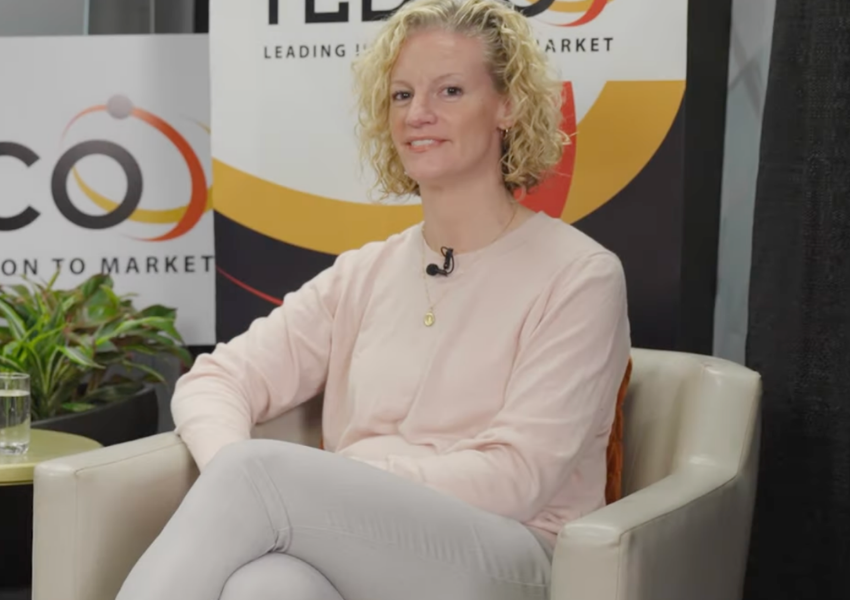
AIN Ventures co-founder Emily McMahan discussed the firm’s focus on dual-use deep technology and veteran-led startups in the DMV region, offering founders practical advice on navigating the government market at the 2025 TEDCO Expo.
Emily McMahan’s path to venture capital runs through West Point, two combat deployments, a government contracting firm, and a veteran entrepreneur incubator she built from scratch. That background is not incidental to the fund she now helps run. AIN Ventures, which she co-founded with Sherman Williams, invests specifically in dual-use deep technology and veteran-led startups, and the team’s credibility in that space comes directly from having lived in it. At the 2025 TEDCO Expo, McMahan sat down with BioBuzz to talk about the fund, the DMV region, and what founders should understand before trying to sell to the government.
What AIN Ventures Is
AIN Ventures is a pre-seed and seed-stage fund investing at the intersection of deep technology and dual use. The firm focuses on six sectors: space technology, life sciences, civic technology, sustainability tech, disaster technology, and defense technology. It also invests in veteran-led startups more broadly, regardless of sector, when founders demonstrate what the team describes as leadership, determination, and grit.
The firm is headquartered in New York but McMahan is based in Arlington, Virginia, and the DMV is central to the fund’s deal flow. Before AIN, she ran Capitol Post, a business incubator focused on military veterans and their spouses, and before that served as CFO of Halfaker and Associates, a federal technology services firm. Her co-founder Williams is a former Naval Intelligence Officer and Kauffman Fellow who spent six years in healthcare technology M&A before moving into investing.
AIN also operates the Academy Investor Network, a separate syndicate of graduates from the five publicly funded U.S. service academies. The two vehicles are related but distinct: the syndicate brings a specific alumni community together around deals, while the fund invests more broadly across civilian and veteran founders alike.
Watch the full interview here:
What “Dual Use” Actually Means
McMahan explained that dual use is more than simply “military and civilian.” The Department of Defense has the largest government budget, she noted, but dual-use applies across the whole of government. A company might start with a civilian commercial product and later find product-market fit in a federal agency that has nothing to do with defense. Or a company incubated inside a government program might eventually pivot to commercial markets. Both directions count.
For Maryland specifically, McMahan pointed to life sciences and cybersecurity as the two sectors that rise to the top within AIN’s thesis. The state’s combination of federal installations, agencies, and research institutions, including NIH, NIST, NCI, Fort Detrick, and Aberdeen, creates a density of potential government customers and partners that is hard to find elsewhere.
What McMahan Looks for in a Founder
At the pre-seed and seed stages, where AIN invests, the team comes first. AIN looks for alignment between the founder and the problem they’re solving, typically grounded in direct industry or government experience. Technology differentiation and the presence of a scalable market matter, but ultimately, it’s the team’s ability to execute, adapt, and grow that drives investment decisions.
The fund sees a notable share of founders coming out of government who spotted a problem from the inside and are trying to solve it. That profile, she said, tends to produce strong product intuition and credibility with the eventual customer base.
Advice for Commercial Founders Considering Government
McMahan’s practical advice for founders new to the government market centers on two things: education and customer research. The compliance frameworks, procurement timelines, and agency processes that govern government sales are learnable, but they can be intimidating if you have never encountered them. She recommended founders treat that education as a foundational step, not an afterthought.
Understanding who the actual customer is within government, and what their buying process looks like, is equally important. The timelines are longer than commercial sales cycles, which is one reason the dual-use model is appealing: government contracts, including SBIR and STTR programs, can extend a company’s runway while the commercial product continues to develop. McMahan pointed to TEDCO’s FedTech program as one resource specifically designed to help companies navigate that transition.
At events like the TEDCO Expo, she noted, the true value isn’t in any single conversation: it’s in the cumulative connections that arise whenfounders, investors, and ecosystem builders share the same space.
If you want to see the latest in innovation ecosystems firsthand, register for the 2026 TEDCO Innovation Expo today.