A newly opened innovation hub puts its model to the test as early-stage biomedical startups are evaluated for commercial and defense deployment readiness.
Just weeks after opening its doors, the HJF Innovation Lab @ Montgomery County (HIL) is already showing how its model functions in practice.
The Henry M. Jackson Foundation’s newest innovation hub is not designed as a traditional startup co-working space. It operates as a proving ground, where early-stage biomedical companies are evaluated not only for scientific merit, but for their ability to operate across two of the most demanding sectors in healthcare and national defense.
That dual-use focus sits at the core of the Foundation’s broader Innovation Ecosystem Initiative, which is designed to more tightly connect startups with federal stakeholders, clinicians, and defense end users. The objective is not simply to accelerate innovation, but to reshape how it is translated from concept into operational use.
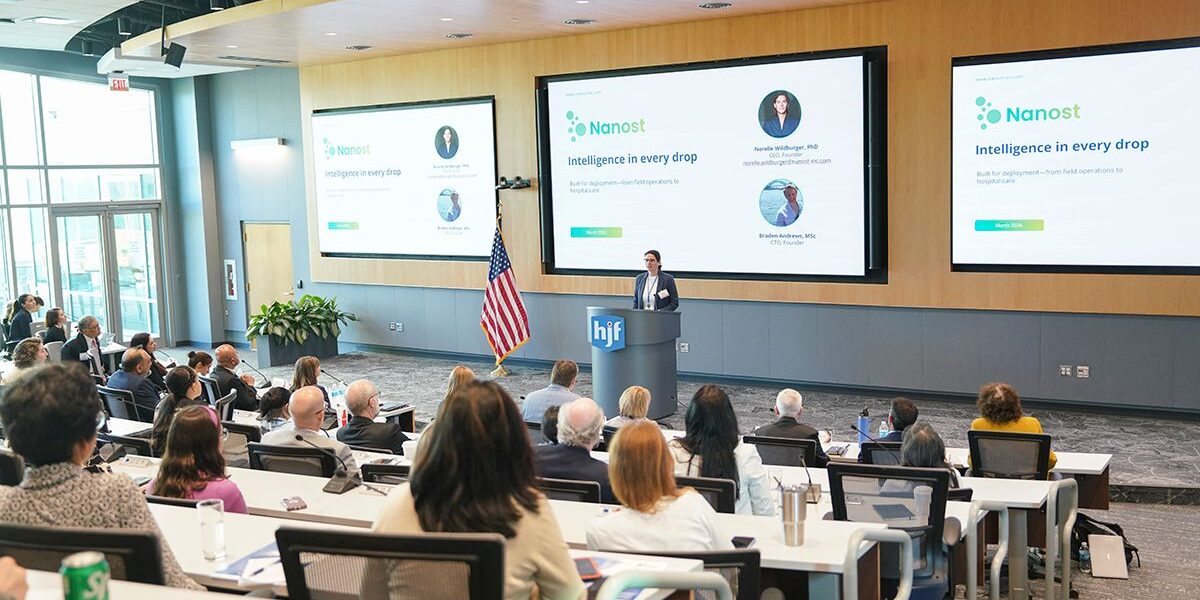
The April 14 BioHealth Pitch Showcase & Networking Event offered an early look at that model in practice—less a traditional pitch event than a working session in which companies seeking Lab residency presented technologies designed for both civilian and military applications.
A Structured Model for Dual-Use Evaluation
The Showcase featured four startups selected through an internal process beginning with closed-door review sessions with the Innovation Advisory Committee (IAC) before advancing to a public-facing presentation format.
The structure is deliberate. Companies are evaluated on technical readiness, business fundamentals, and strategic alignment before being surfaced to a broader audience of stakeholders and potential partners.
The result is a pitch environment focused less on early ideation and more on technologies approaching validation, scale, and potential deployment.
Taken together, the presentations reflected a consistent shift: dual-use is being treated less as a downstream application and more as an upfront design constraint.
Nanost Brings Field-Ready Diagnostics Into Focus
Nanost, led by their CEO and founder, introduced a portable blood diagnostics platform designed for settings where traditional lab infrastructure is limited or unavailable.
The system is built for high-pressure environments, including emergency departments, rural care settings, and military field medicine. It uses a handheld reader and disposable cartridge system to convert a fingerstick of blood into quantitative diagnostic results in roughly 15 minutes.
At scale, the platform is designed to operate without cold-chain logistics, with consumable costs projected under two dollars per test. While traumatic brain injury is the initial clinical focus, the system is positioned as a broader diagnostic layer rather than a single-indication tool.
The approach reflects a broader shift toward deployability as a core design constraint, particularly in environments where time and infrastructure directly determine clinical outcomes.
AI-Powered Mental Health Intake Aims to Expand Clinical Capacity
Mentaily, an AI-driven clinical decision support platform focused on mental health intake and triage, introduced their system designed to streamline psychiatric evaluations through a structured, AI-guided interface.
The platform generates standardized clinical summaries aligned with DSM-5 frameworks, reducing the administrative burden associated with initial assessments. Intake workflows that typically take hours can be completed in under 30 minutes while still producing structured outputs for triage, longitudinal tracking, and care prioritization.
The system has demonstrated strong alignment with psychiatric evaluations in clinical studies, including performance in risk detection scenarios involving first responder populations.
It is already being deployed in institutional and defense-adjacent environments, including NATO-affiliated care settings and programs linked to military healthcare systems.
Caleo Biotechnologies Targets One of Pharma’s Costliest Bottlenecks
Caleo Biotechnologies, led by CEO and founder Samaneh Kamali, PhD, is addressing one of drug development’s most persistent inefficiencies: the limited predictive value of traditional preclinical models.
The company’s “organ-on-dish” platform uses patient-derived cells to recreate disease-relevant tissue environments in 3D, designed to better reflect human biology in fibrotic and inflammatory conditions where animal models often fail to translate.
The system preserves disease-specific cellular complexity and has demonstrated correlation with clinically relevant biomarkers and tissue behavior. It is being expanded across multiple indications, including lung, liver, and wound-related fibrosis.
Caleo is pairing early pharmaceutical pilot programs with longer-term integration into drug discovery pipelines, positioning the company at the intersection of preclinical modeling and translational medicine.
Turning Pain Into Data: AI Meets Neurophysiology
AlgiSense, co-founded by Zeyno Dodd, is developing an EEG-based pain intelligence platform aimed at addressing the subjectivity of pain reporting in clinical care and research.
The system analyzes neural signal patterns to generate probabilistic assessments of pain states, along with structured classification outputs and interpretive rationale grounded in published research.
The goal is to reduce variability in clinical trial endpoints, improve longitudinal tracking of pain conditions, and support more consistent decision-making in both research and clinical settings.
Use cases include clinical trials, military trauma care, post-surgical recovery, and chronic pain management—particularly in environments where patient reporting is inconsistent or incomplete.
An Early Signal of a More Structured Innovation Pipeline
Across the Showcase, a consistent pattern emerged: dual-use considerations are being embedded at the earliest stages of development rather than introduced after validation.
The HJF Innovation Labs and its broader Innovation Ecosystem Initiative are structured around that premise—shaping technologies for commercial and mission-critical applications in parallel, rather than screening for it later in development.
As Katie Bratlie, Director, Innovation Ecosystem & Labs, and the IAC continue to guide early-stage engagement, the Labs are functioning less as a convening space and more as an evaluation layer, assessing technical readiness, operational relevance, and end-user applicability in parallel.
What is taking shape is not simply a pipeline of startups, but a structured filter for determining which technologies are ready to move from development into deployment across both civilian and defense settings.