
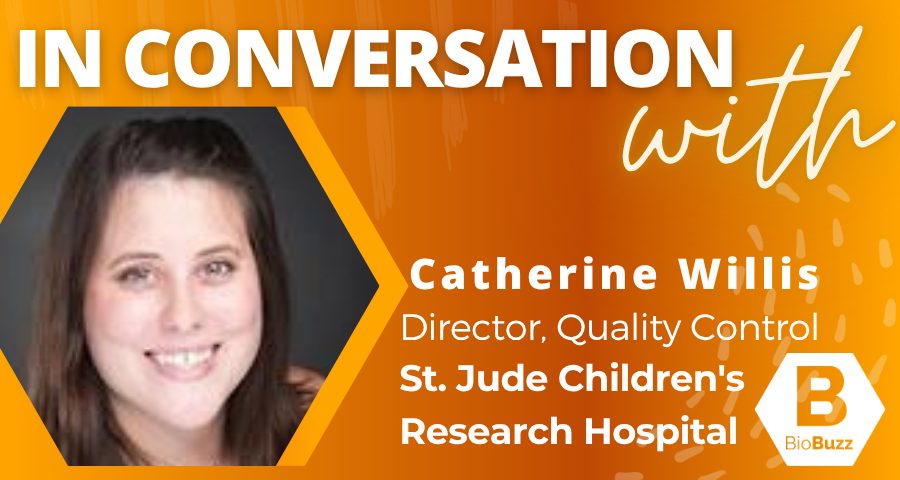
Cat Willis on the responsibility and reality behind releasing advanced therapies
Introduction
In advanced therapies, innovation does not reach patients on its own. No matter how promising the science, no matter how advanced the process, every therapy must pass through a final decision point before it leaves the facility. That decision sits with Quality Control.
For Catherine “Cat” Willis, Director of Quality Control at St. Jude Children’s Research Hospital, that moment carries a weight that extends far beyond the lab. It is not just about whether a test passes or fails. It is about whether a therapy moves forward—or stops. “Without it, the product would stay in your facility,” she said, underscoring the role analytics plays in determining whether a therapy can reach the patient waiting for it.
What People Don’t See in QC
One of the most persistent misconceptions about Quality Control is that it operates at the end of development. In practice, it begins much earlier and continues long after a product is released. For Willis, QC is not a checkpoint—it is a continuous presence across the lifecycle of a therapy, requiring sustained attention, consistency, and adaptability as conditions evolve.
“There’s a longevity that you have to have with a product,” she explained. “You’re there from the beginning all the way through a clinical trial… our job doesn’t just finish once the test is over. It just continues.” That continuity becomes especially important in advanced therapies, where variability is inherent and maintaining consistency requires more than standardized procedures. It requires systems that can hold over time.
That challenge is often tied to timing. “Maintaining consistency is difficult with project timelines,” Willis noted, pointing to the need for early alignment between analytical development and manufacturing. Without that coordination from the start, teams risk losing the time needed to build assays that are not only functional, but reliable under real-world conditions.
Balancing Speed with Responsibility
Speed is often treated as an advantage in biotech. In QC, it carries a different meaning. At St. Jude, the therapies Willis supports are frequently developed for patients with limited options, where timelines are not just operational; they are tied directly to patient eligibility and survival.
“These patients are relapse refractory… this is their hope,” she said.
That reality creates a constant tension between urgency and responsibility. Moving too slowly can delay treatment. Moving too quickly without sufficient rigor introduces risk. The balance between those two forces cannot be improvised at the end of development—it has to be built in from the beginning.
“You can’t just tack it on at the end and say, ‘now we need some analytics,’” Willis emphasized. “It starts early in the process.” Robust assays, validated methods, and a clear understanding of results are what allow teams to move quickly without compromising safety.
When It Becomes Real
For much of its lifecycle, Quality Control operates behind the scenes. The work is technical, structured, and often removed from the patient experience it ultimately supports. But there are moments when that distance disappears.
Willis recalled one of the most defining experiences of her career—watching a therapy her team helped release move from the lab into the clinic. “We were able to watch the product… go from our facility over to the hospital,” she said. “And we were able to watch the infusion for that patient.”
After years of ensuring quality and consistency, she saw the full system come together in a single moment. “You can see the hope on the patient’s face… and the parents that were standing in the room,” she said. What had been a series of controlled processes and analytical decisions became something immediate and human.
The Bottom Line
Willis’s perspective reflects a broader reality across advanced therapies. Quality is not a final step. It is a continuous system that determines whether innovation reaches patients—or stops short of them.
As therapies become more complex and timelines more compressed, the expectations placed on QC will continue to grow. But the role itself remains unchanged. To ensure that when a therapy leaves the facility, it is ready—not just scientifically, but safely—for the patient on the other side.
Because in the end, QC does not just release a product.
It releases the possibility for treatment to become real.