Three years and a $100 million Bisciotti gift after launch, Blackbird Laboratories opened its Baltimore BioHub with a three-year scorecard, a room full of coastal investors, and a first company that ran the full length of its model.
For three years, Blackbird Laboratories has been making a quiet argument about Baltimore — that a city long celebrated for its science and just as long overlooked as a place to build companies could become a genuine engine of biotech venture creation. On the morning the organization threw open the doors of its new BioHub, that argument stopped being theoretical.
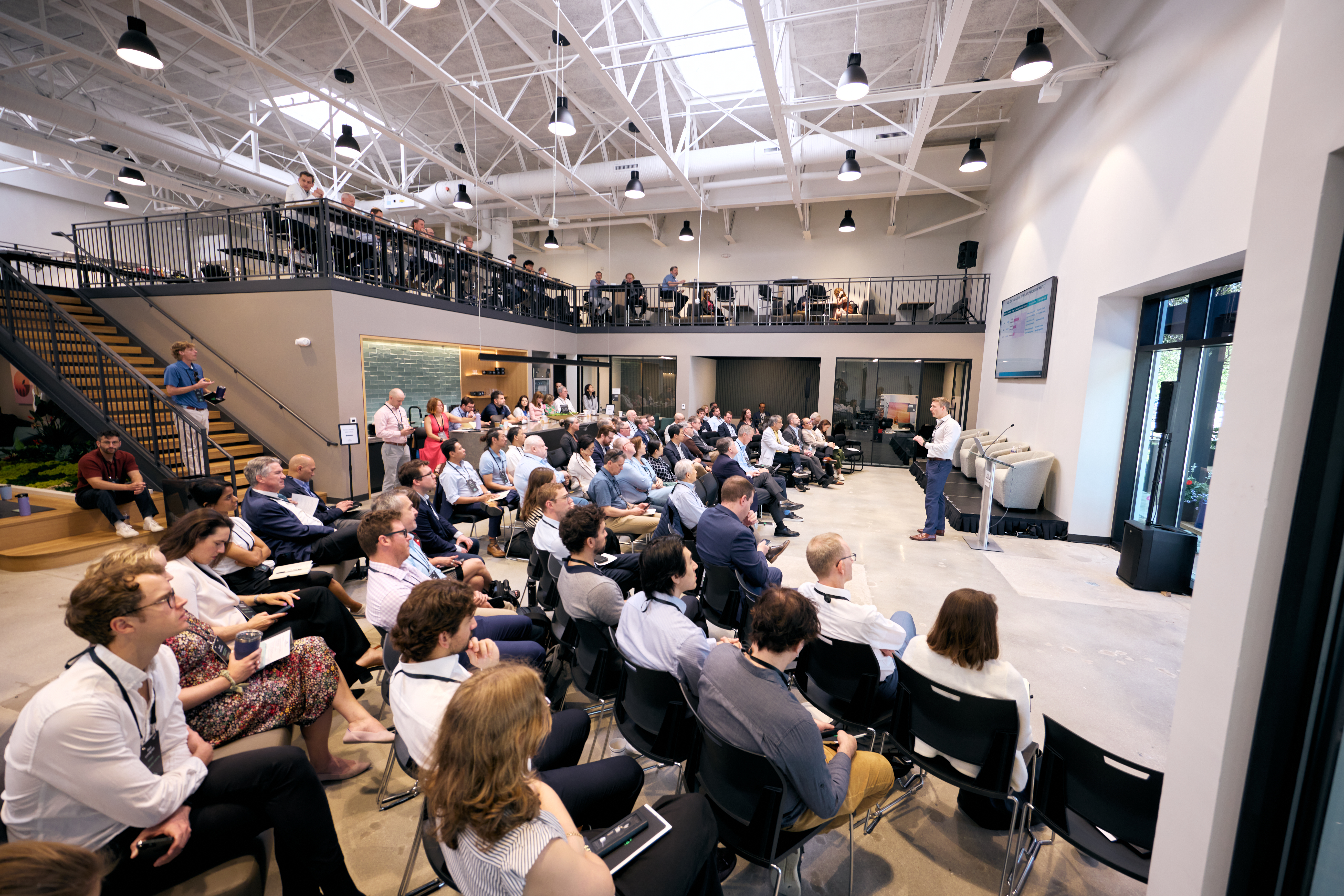
Some 100-plus investors, founders, and academic partners filed into the 42,000-square-foot incubator at City Garage on Baltimore Peninsula — the former municipal bus depot at 101 W. Dickman Street that Blackbird has converted, with help from a $2 million Maryland Build Our Future grant, into a wet-lab home for early-stage life science companies. The event doubled as a grand opening and a three-year report card. And by the time the Ravens-owned shuttle bus pulled up to ferry guests to the evening reception, Blackbird had made its case in front of the audience it most needs to convince: the people who back companies at this stage for a living.
Three Years, By the Numbers
Blackbird CEO Matt Tremblay set the tone in his opening remarks, walking the room through what the organization has actually done since it launched in 2023 with a $100 million founding gift from the Stephen and Renee Bisciotti Foundation, the family office of Ravens owner Steve Bisciotti.
The structure itself is unusual. Blackbird operates two platforms: Blackbird Laboratories, a 501(c)(3) nonprofit, makes milestone-based grants to university partners and writes precedent-seed-stage impact investments; Blackbird BioVentures, its for-profit sibling, is a dedicated investment vehicle with what Tremblay described as $500 million in state capacity to invest through exit. The nonprofit de-risks the science; the venture arm carries it forward.
The traction numbers were the headline. Of the 22 projects Blackbird has initiated, five have “graduated” — their IP licensed into newly formed companies that Blackbird went on to back alongside other investors. The organization has made 22 investments in all, 17 of them new company starts, with BioVentures contributing 14 of those at initial check sizes of $1 million to $5 million and the ability to follow on.
Tremblay framed the milestone less as a victory lap than as a data point. “At this point we’ve deployed enough funding,” he told the room, that the team now has a real sense of the attrition and capital requirements needed to scale the model — and to plan the decade ahead. That long time horizon, he argued, is what makes Blackbird unusual. The runway afforded by the Bisciotti gift lets the organization contemplate genuinely ambitious goals — a 10-year vision of roughly 50 locally created startups — on a timeline most funds simply don’t have.
A Room Full of Believers
The most telling endorsement of Blackbird’s work wasn’t anything Tremblay said. It was who showed up to say it.
The investor panels read like a coastal who’s-who that had, notably, traveled to Baltimore. Christy Wyskiel, senior advisor to the president of Johns Hopkins for innovation and entrepreneurship, opened the venture session by grounding the regional opportunity: Hopkins companies have raised $5 billion in venture capital over the last decade and logged 45 exits in that span, from a university that has been the nation’s top recipient of NIH research funding for 45 consecutive years. Her assessment of Blackbird was blunt — the organization has “built an ecosystem here that is on rival now with some of the best ones in the United States,” as moderator Adair Newhall, a partner at StepStone Group, put it.
The praise kept coming from people with no obligation to offer it. Frank Nestle, the former Sanofi chief scientific officer now running Deerfield Management’s 3DC drug-discovery engine, said he knew firsthand “how hard it is to set up a system like that.” Travis Young, who oversees translation at Scripps Research’s Calibr and worked alongside Tremblay during his Scripps years, delivered perhaps the sharpest compliment.
“What you built here in just such a short period of time, it looks like what we built over 10 years.” — Travis Young, Scripps Research / Calibr
Ryland Sumner, who oversees Point Field Partners, the Bisciotti family office, opened the afternoon by emphasizing how long and collaborative the road has been, with relationships at Hopkins tracing back years before Blackbird existed. Christian Schubert, global head of AbbVie Ventures and the afternoon’s moderator, captured the prevailing mood while keeping it honest: it’s “quite impressive what’s been built here,” he said, while reminding the room that “discovering new medicines is really, really hard. It’s probably one of the toughest jobs in the world.”
The panels themselves were a statement of reach. Alongside Schubert, Nestle, and Young sat Reed Jobs, founder of the oncology-focused fund Yosemite; the morning’s venture panel paired Newhall with Deborah Palestrant of 5AM Ventures, Rich Lim of Cure Ventures, and Fei Shen of Boehringer Ingelheim. These are investors who, as Lim noted, “really don’t currently invest in Baltimore” by default — and who flew in anyway. That is the soft infrastructure Blackbird is building: a Rolodex of national co-investors and syndicate partners who now have a reason to look at Charm City.
Early Proof Points
A model is only as convincing as the companies it produces, and the showcase devoted its afternoon to them. The pillar example — the one that most completely validates the Blackbird thesis — is Aletira Therapeutics, the first company to travel the entire length of the model, from nonprofit research grant to seed round to a bench inside the BioHub.
What makes Aletira the proof point Blackbird was built to produce is how completely it activates the model. The nonprofit arm funded the translational work to mature the Hopkins IP; the organization served as an Entrepreneur-in-Residence home for founding CEO Geoffrey Lynn between his last company and this one; Blackbird Laboratories participated in the seed round; and the company now operates out of the BioHub itself. Four integrated touchpoints, one company — the loop closing end to end for the first time. Lynn’s own trajectory sharpens the signal. He previously founded Avidea Technologies, incubated at Johns Hopkins FastForward and acquired by Vaccitech (now Barinthus Biotherapeutics) in a $40 million deal in late 2021. That arc — a Baltimore-incubated company, a strategic exit, and a second company founded locally rather than in Cambridge or South San Francisco — is precisely the founder flight path the region has historically lost.
Other showcased companies showed the pipeline filling in behind Aletira. Tremblay pointed to the neuropsychiatric NewCo Blackbird built with the Lieber Institute for Brain Development and partnered with Third Rock Ventures — a program targeting GPR52, a receptor few were discussing when the work began and that more of the field is now chasing as a route to all three symptom domains of schizophrenia. Lieber CEO Daniel Weinberger, whose institute draws on brain donations from more than 5,000 individuals, called the partnership “transformative”; Third Rock’s Walt Kowtoniuk described jumping onto “a moving train” of drug-discovery maturity, the product of a focused, nine-month, $2 million medicinal chemistry campaign Blackbird ran to reach a lead-quality molecule. A development candidate is expected later this year.
A different flavor of proof point came from Adventris Pharmaceuticals, developing an off-the-shelf KRAS cancer vaccine born out of decades of work at Johns Hopkins, including that of cancer-vaccine luminary Liz Jaffe. CEO Jen Lesser Herbach and physician-scientist co-founder Mark Yarchoan walked the room through a platform pairing engineered, cross-reactive antigens with a next-generation trans-amplifying RNA vector — an approach Yarchoan said produced roughly 30-fold stronger immune responses against KRAS than a traditional vaccine, with a first patient slated to be dosed about a year out. Adventris, raising a syndicate-backed Series A, plans to graduate into the BioHub. Together, the three trace the full range of the Blackbird thesis: one company that has already run the loop, one mid-build through it, and one arriving from the surrounding ecosystem.
A Community Engineered Around the Mission
These companies don’t operate in isolation, and that is by design. The most strategically revealing part of the showcase was Tremblay’s summation of the BioHub’s first resident companies — because each was selected to contribute a shared capability that strengthens every other tenant in the building.
EPOCH Epigenetics, founded by former DARPA program manager Eric Van Gieson, is commercializing a diagnostics platform that measures the body’s epigenetic response to disease rather than hunting for scarce circulating tumor DNA. Its contribution to the ecosystem is its CLIA-certified laboratory, which Van Gieson is making available in principle to other nascent diagnostics companies in the incubator — letting them pilot regulated assays and generate revenue without building their own clean lab. Myologica, a muscle-focused preclinical CRO led by Ramzi Khairallah, built a compact, cost-efficient vivarium behind the Blackbird space and intends to extend that animal-study capacity, on a flexible service basis, to every company in the building. And the National Center to Accelerate Cures — a federally backed collaboration among Blackbird, the Tucson-based Critical Path Institute, and the Arrowpoint Labs foundation, introduced by Maryland Innovation Initiative executive director Abi Kulshreshtha — is working to advance the regulatory acceptance of non-animal “new approach methodologies,” giving resident companies an inside track to models that could one day compress their preclinical timelines.
Tremblay tied the threads together in a single line, cataloguing what a young company moving into the BioHub now has at its disposal: a CLIA diagnostics capability through EPOCH, an in-house vivarium through Myologica, an early window into next-generation preclinical models through the National Center, and — a nod to EPOCH co-founder and 27-year SEAL Team 6 veteran Neil Hermansen — “Naval Special Warfare level HR and candidate vetting.” It is a strikingly deliberate stack of shared resources for a three-year-old organization, and it reflects the deeper logic of the Blackbird approach: rather than leasing space, the organization is recruiting tenants who each commit a piece of infrastructure to the mission, so that the whole becomes far more than the sum of the desks.
The Opening and What It Signals for Baltimore
Tremblay was candid about the personal irony of the day. When he left Scripps three years ago, one of his jobs had been overseeing roughly a million square feet of lab space, and he’d promised himself he would never do that again. “But here we are,” he said. In forming two investment and project-funding entities, the team realized it needed a physical place to anchor the community of startups it was building.
That place is now real. The BioHub sits 15 minutes from the airport, train stations, and Blackbird’s university partners, within commuting distance of suburban Maryland’s deep life-science workforce. Roughly 80% of the space is built out, enough to eventually house more than 100 researchers. Four companies have moved in; another five have signed on, bringing the total to nine over the coming months.
The decade-long bet is far from won. But the grand opening made clear it is being taken seriously by the people whose judgment matters most — and that Blackbird has, in three years, assembled the connective tissue Baltimore had been missing and just opened the building where it comes together.