
Photo Credit: EwingCole
EDITORS NOTE: This article was updated on August 1, 2026 to reflect several errors in the originally published story as listed at the bottom of the article.
A regional roundup of the labs, plants, and campuses redefining what a responsible life sciences footprint looks like — and why ISPE’s Chesapeake Bay Area chapter put sustainability on the map before almost anyone else.
The BioHealth Capital Region is known for the therapies it makes. Increasingly, it is worth watching for how it makes them.
Across Maryland, the buildings where biologics, cell therapies, vaccines, and diagnostics get developed and manufactured have quietly become some of the most environmentally ambitious facilities in the country — net-zero towers, LEED Platinum laboratories, ISO-certified energy systems, and product lines re-engineered to strip out plastic and waste.
It is not an accident, and it is not only a corporate ESG story. It is an engineering story — which is exactly why the region’s pharmaceutical engineers got there early.
The International Society for Pharmaceutical Engineering’s Chesapeake Bay Area (ISPE-CBA) chapter stood up a dedicated Sustainability Committee years ago — one of the first such committees in the nation for ISPE. In a region that ranks among the top three U.S. biopharma clusters, that head start gave Maryland’s manufacturers a forum to compare notes on energy, water, waste, and green facility design long before “sustainable manufacturing” became a boardroom mandate.
The committee is Co-Chaired by Jennifer Bullock Dir. Of Environmental Sustainability at AstraZeneca, and Matt Dillon, Application Specialist at PureFlow.
We spoke to Dillon about this topic and he shared, “Maryland has a lot of talented people and companies doing meaningful work around sustainability. Our role as a committee is to bring those people together, highlight what they’re accomplishing, and create opportunities for others in the life sciences community to learn from them.”
Why this matters now
Two developments make 2026 the right moment to take stock.
First, one of Maryland’s own facilities is up for ISPE’s highest honor. Kite, a Gilead Company, has a Frederick expansion named a 2026 ISPE Facility of the Year (FOYA) submission finalist, recognized specifically for sustainable facility design in a T-cell factory expansion — a project built around energy efficiency and waste reduction paired with green design. And AstraZeneca’s own commercial cell therapy facility in Rockville was named a 2026 FOYA category winner, with sustainability cited as a priority throughout its design, construction, and operations.
Second, the money is following. AstraZeneca announced a $2 billion investment in November 2025 to expand its Maryland footprint — including a significant expansion of its Frederick biologics facility and a new Gaithersburg clinical manufacturing site, supporting 2,600 jobs — growth the company says will be built to the highest environmental standards.
The region isn’t just talking about sustainability. It’s building it, at scale, right now.
What follows is a tour of that footprint in six moves — how it shows up in the buildings themselves, in the energy systems that run them, in the way facilities are engineered, in the products that ship out the door, in the next generation of biology being designed to be clean from the start, and finally in the discipline of being able to prove any of it. Different companies lead in different places. Read together, they map a region that has quietly made sustainability an engineering standard rather than a slogan.
Dimension 1 — The built environment: net-zero towers and platinum labs
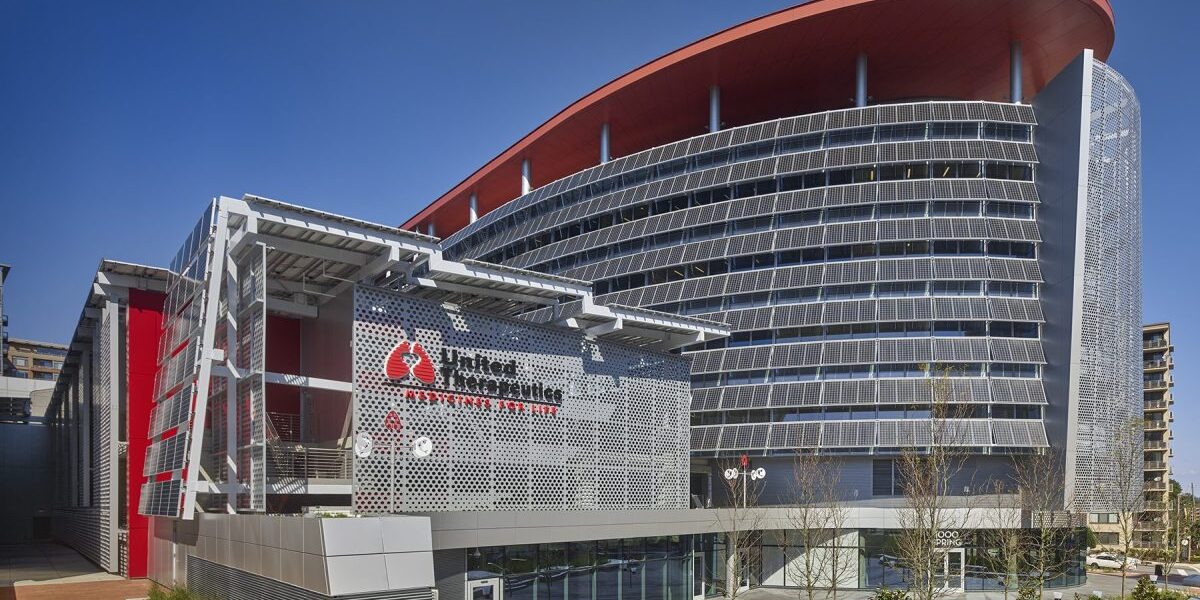
United Therapeutics — Unisphere, Silver Spring. The region’s signature statement. The Unisphere is billed as the largest net-zero commercial building in the United States, certified LEED Platinum — and later LEED Zero — and designed so that all the electrical and thermal energy it consumes is renewably generated on-site over the course of a year. The building was recognized by Engineering News-Record among its 2019 Best of the Best Projects. Company lore holds that when engineers warned CEO Martine Rothblatt that a net-zero building in downtown Silver Spring would be extraordinarily hard to pull off, her answer was, in effect: figure it out. They did.
Universities at Shady Grove — Biomedical Sciences & Engineering Building, Rockville. Proof that the standard extends to where the workforce is trained, not just where product is made. The 220,000-square-foot BSE facility earned LEED Platinum — the highest USGBC rating, and one that is notoriously difficult to achieve for laboratory buildings, which are energy hogs by nature. For the pharmaceutical-engineering audience, the most relevant honor is the one that speaks their language: the I2SL Sustainable Laboratories Award for New Construction (2022) from the International Institute for Sustainable Laboratories, alongside NAIOP, AIA, and a USGBC National Capital Region Community Leader Award. Biophilic design, abundant daylighting, a green roof, high-efficiency lab exhaust, and restored wetland anchor a building that doubled as a regional workforce engine.
“Laboratories and manufacturing facilities have unique requirements that can make sustainability challenging,” shared Dillon. “Projects like this give our members an opportunity to see what is possible and learn from the people who actually designed and built them.”
Dimension 2 — Operational decarbonization: energy systems that pay for themselves
AstraZeneca — The region’s deepest, most quantified sustainability program. The Gaithersburg campus (formerly MedImmune) became the first biomedical facility in the world to earn the U.S. Department of Energy’s Superior Energy Performance certification — reaching the Silver level in 2014 after improving energy performance 8.5% over three years and cutting energy costs by roughly $420,000 a year — and was later re-certified at Gold under the ISO 50001 energy-management standard, as part of AstraZeneca’s Ambition Zero Carbon initiative. It’s a rare biomedical example of a plant treating energy as a managed, audited system rather than a utility bill.
“What AstraZeneca has accomplished shows the value of setting clear goals and consistently measuring progress. Sharing examples like this helps others see what is possible and consider what may work within their own facilities,” commented Dillon.
Dimension 3 — Sustainable manufacturing & facility design: the ISPE frontier
Kite, a Gilead Company — Frederick County. The cleanest fit for the ISPE lens, and now a national award contender. Kite’s cell-therapy plant in Urbana, in Frederick County along the I-270 corridor, opened in 2021 and earned LEED Silver certification, built to LEED and BREEAM criteria: no CFC-based refrigerants, 88% of construction waste diverted from landfills (about 1,300 tons), and exterior lighting designed to a fraction of the allowable limit. That same T-cell factory now carries the ethos into a 2026 ISPE FOYA submission finalist for sustainable expansion — putting a Maryland facility on ISPE’s global stage for exactly the discipline the Chesapeake chapter championed early.
Dimension 4 — Green product innovation: sustainability past the loading dock
QIAGEN — Germantown. A reminder that a facility’s footprint doesn’t end at its walls — it ships in every box. QIAGEN’s QIAwave line re-engineers sample-prep kits to cut plastic by up to 63% and cardboard by up to 42% versus standard kits. The company has pledged net-zero by 2050 (a target validated by the Science Based Targets initiative), holds “Prime” status from ISS ESG, and builds its Germantown manufacturing site to LEED or BREEAM standards — with LEED Gold certification at its Hilden and Frederick facilities. For a diagnostics industry that runs on single-use consumables, designing waste out of the product itself is arguably the harder — and more scalable — win.
MilliporeSigma — Rockville. The other half of the supplier story, and arguably the most documented product-sustainability program in the region. The U.S. and Canada Life Science business of Merck KGaA opened a ~$286 million biosafety testing facility at Rockville’s Traville Gateway campus in October 2024 — consolidating four buildings into one 250,000-square-foot hub, retaining roughly 600 workers and adding about 500 jobs. Its sustainability weight, though, sits in the products that ship out of it: the company-wide SMASH Packaging program (now in its 2.0 phase) has run more than 100 improvement projects that have cut more than 400 metric tons of emissions annually. Its Greener Cooler is replacing styrofoam cold-chain shippers at U.S. sites. MilliporeSigma took home a 2024 Sustainability Leadership Award from the Business Intelligence Group for embedding sustainability across the business. Paired with QIAGEN, it makes the point plainly: the two companies supplying the tools the whole cluster runs on are designing waste out at the source.
Novavax — Gaithersburg. The vaccine maker has built sustainability metrics into its operations, but its most distinctive move is upstream: sustainable saponin sourcing for its Matrix-M adjuvant, drawn from the bark of the Chilean soapbark tree (Quillaja saponaria) — a supply-chain sustainability story most vaccine coverage skips entirely.
Dimension 5 — The next frontier: biology that’s sustainable by design
BrightWave. The forward-looking counterpoint to the anchor campuses. BrightWave secured a $1 million TEDCO award — matched by $2 million from Actual VC — to expand what it describes as Maryland’s first fully integrated algae biomanufacturing facility, built on precision-controlled photobioreactor systems. It sits alongside a small cohort of Maryland companies (RoosterBio’s platform explicitly frames itself around a sustainable regenerative-medicine industry) betting that the next generation of bioproduction can be climate-aligned from the first design choice rather than retrofitted later.
Dimension 6 — The disclosure layer: making sustainability auditable
Not every sustainability story is a building or a product. Some are about proof — and in a cluster full of manufacturers now subject to tightening disclosure rules, the firms that make sustainability auditable are their own category.
PQE Group — Rockville (US HQ). The quality-and-compliance consultancy — women-owned, founded in Florence in 1998, with its US headquarters established in Rockville in 2015 and now eight offices nationwide — released its 2025 Sustainability Report in July 2026, its third consecutive and second covering full global operations across 22 countries. For the first time it was built on an ESRS double-materiality assessment, with greenhouse-gas emissions disclosed under the ISO 14064-1:2019 standard across Scopes 1, 2, and 3. The pointed part: PQE chose to keep reporting voluntarily even after the EU’s “Omnibus” package eased CSRD mandates and pushed back deadlines — founder and CEO Gilda D’Incerti framed the move as choosing to lead rather than simply comply. The dual value is what makes it relevant to every engineer in the ISPE room: PQE both discloses its own footprint and helps life-science clients still bound by CSRD demonstrate compliance. The firm has also been named “Best Life Sciences Company in Maryland” by the Stellar Business Awards. In a region racing to build green, PQE represents the less-visible discipline of being able to prove it.
The honest-mention tier
Not every notable name has a marquee facility award, and the roundup is stronger for saying so plainly. Supernus Pharmaceuticals (Rockville) carries third-party ESG ratings from firms like Sustainalytics but no standout facility recognition or major public sustainability announcement to date. Catalent, Emergent BioSolutions, Thermo Fisher, and GSK all operate significant Maryland footprints and carry corporate sustainability commitments, though their most-publicized green milestones tend to sit at the enterprise level rather than at a specific Maryland site. Watch this tier: as the FOYA-finalist bar rises, site-specific recognition tends to follow.
The pattern across the region is consistent: sustainability has migrated from the sustainability report into the engineering specification. Net-zero energy, ISO-audited management systems, waste-diverting construction, and re-designed consumables aren’t badges anymore — they’re becoming table stakes for building or expanding in Maryland.
That shift didn’t happen in a vacuum. It happened in a cluster dense enough to compare notes, with an engineering community that organized around the problem early. The ISPE-CBA Sustainability Committee‘s national-first head start looks, in hindsight, less like foresight and more like inevitability — the natural output of a region where the people who design the plants have been in the same room, comparing what works, for years. (BioBuzz serves as ISPE-CBA’s official media partner.)
The buildings are the visible part. The coordination behind them is the story.
Dillon embodied that message in closing, “The goal is to bring the right people together, share what is working, and help develop a regional culture where sustainability is considered from the beginning. Maryland already has some great examples of this in action, and those stories are worth sharing.”
Photo Credit: EwingCole
Corrected Errors:
AstraZeneca’s credited Potomac Edison’s Energy Solutions Program with a $1 million award, $500,000 in annual savings, and a 5,222-ton CO2 reduction was misreported. We have removed and replaced the information with corrected and verified data.