Across peptides, oligonucleotides, and antibodies, the constraint on program speed has quietly moved — from the molecule to the method, and to the small number of scientists who can make a method survive the trip from development into QC.
Every pipeline chart tells the same story. The molecule is the milestone. Phase transitions, readouts, approvals — the science that gets celebrated is the science that makes the therapeutic.
Ask the people who actually move those programs, and a different story surfaces.
Increasingly, what stands between a promising biotherapeutic and a filing is not the molecule. It is whether the analytical method behind it can be trusted, transferred, and defended.
The molecule is the headline. The method is the schedule.
As pipelines diversify across peptides, oligonucleotides, and complex biologics, a single quality-control bench is now asked to control three unrelated impurity chemistries at once. The analytical toolbox does not fail so much as it strains — and the strain shows up as rework, delayed transfers, and methods that behave differently in the lab that inherits them.
None of which is a new observation in these pages. At BioBuzz’s Insights to Impact event in Philadelphia this spring, hosted at Minaris Advanced Testing’s Navy Yard headquarters, analytical and quality leaders from Catalent, AskBio, Castle Creek Biosciences, St. Jude Children’s GMP, and Minaris arrived at the same conclusion from the cell and gene therapy side: analytics is strategy, not overhead. Weeks later, Minaris’s Joe Newcome put it flatly in conversation with BioBuzz — “Having a well thought-out, built release panel is what’s driving turnaround times.”
What has changed is where that pressure is landing.
The same logic is now arriving on the benches that run peptides, oligonucleotides, and antibodies — a different set of chemistries, a different rulebook, and a workforce that cannot simply be reassigned from one to the other.
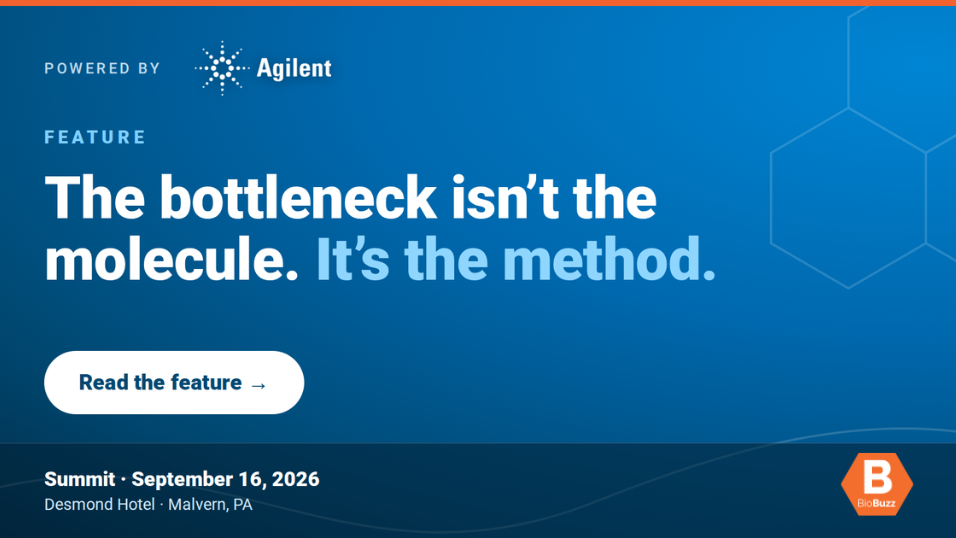
That strain is the premise behind the Biopharma Analytical Innovation Summit, set for September 16 at The Desmond Hotel in Malvern — a full day built for the late-stage R&D, formulation, and QC scientists who work at exactly that seam, staged in the middle of the Greater Philadelphia biocluster that supplies most of them.
Analytical opportunities across three modalities
The pressure is real, but it is not uniform. Each modality breaks the toolbox somewhere different.
Peptides
The GLP-1 wave turned peptide characterization into a volume problem on top of a science problem. Deletion sequences, diastereomers, and oxidation variants routinely co-elute with the main peak, which means a clean-looking chromatogram is not the same as a clean molecule. Peptides also adsorb to metal flow paths, quietly eroding recovery and reproducibility — the kind of drift that stays invisible until a method is moved to another instrument, in another lab, and stops behaving.
Oligonucleotides, conjugates, and mRNA
Two different problems get conflated here, and it is worth separating them. The first is stability: synthetic oligonucleotides degrade in characteristic ways, and forced-degradation work is how formulation and analytical teams map those pathways before a stability study finds them. The second is separation: shortmers, longmers, and depurination products co-elute in a single chromatographic dimension, which is why orthogonal and two-dimensional separations have moved from specialist tools to working necessities. Manual sample preparation compounds both, injecting analyst-to-analyst variability into a method that will eventually have to run identically on someone else’s bench.
Proteins and antibodies
An antibody is not one measurement — it is aggregation, charge variants, size variants, and glycosylation, each answered by a different technique. The Multi-Attribute Method (MAM) consolidates much of that attribute monitoring into a single high-resolution MS measurement, and it is genuinely powerful. But it measures at the peptide level; it does not see higher-order structure or aggregation. Consolidation is not the same as coverage, which is why orthogonal confirmation still decides what a release decision can rest on.
Practitioners in the region have made the point independently. Asked at the BioBuzz Insights to Impact panel how close the field is to a push-button “QC lab in a box,” the room was collectively skeptical: fold enough technologies together and a single misbehaving assay becomes something a team must untangle from four others rather than isolate cleanly.
Analytical’s role with regulators
For years, method development was something a company did on its way to the filing. That framing no longer holds.
ICH Q6B has long expected biologic specifications to rest on complementary, mutually confirming methods. Then, in November 2023, ICH adopted Q14 and Q2(R2), which together treat an analytical procedure as a lifecycle rather than a deliverable: an analytical target profile defined up front, a documented analytical procedure control strategy, and validation designed against fitness for intended purpose.
The consequential detail is what the enhanced approach buys. Development knowledge generated that way can be submitted to regulators in CTD format as evidence a procedure is fit for purpose — and it opens the door to established conditions and risk-based reporting, so that later changes to a method can be managed without a full prior-approval submission every time.
Analytical development is now something a company files on — and, done well, something it earns regulatory flexibility from.
For a QC or analytical development lead, that reframes the budget conversation entirely. Method robustness is no longer a quality nicety argued for on principle. It is a lever on how quickly a company can change a method, transfer a product, or scale a process after approval.
Though the flexibility cuts both ways, as BioBuzz’s own reporting has already surfaced. Christopher Larson, VP of QC at Castle Creek Biosciences, told the Insights to Impact panel that when guidance stops mandating a practice, analytical work that was once compulsory starts competing for funding — and the CFO becomes harder to convince. Newcome made the complementary point: as frameworks loosen, the burden of defining, justifying, and validating an approach shifts back onto the organization. Flexibility is not a discount. It is an invoice for rigor, payable in advance.
The Role of Analytical Talent
There is a second bottleneck, and no instrument fixes it.
The scientists who can build a peptide impurity method, defend an oligonucleotide stability-indicating assay, and then shepherd either through transfer into a GMP quality-control lab are not interchangeable with generalists. That expertise is modality-specific, substantially tacit, and carried by people rather than SOPs.
Greater Philadelphia concentrates the problem. Drug developers, CDMOs, and testing labs sit within an hour of one another, which means the same scarce analytical talent is shared, mobile, and continuously bid for across the region. When an experienced method-transfer scientist leaves, the institutional memory of why a method was built that way tends to leave with them.
Which is the uncomfortable part: analytical capability behaves less like equipment and more like a supply chain. It has to be sourced, developed, and retained on purpose.
From bottleneck to advantage
The economics run opposite to the way most programs budget them. Jennifer Hayne of Catalent was candid at the BioBuzz panel that raising analytics with investors draws a lackluster response — while early analytical investment remains among the most reliable ways to de-risk a program later: shorter comparability exercises, faster tech transfer, fewer late-stage surprises. It is, in the most literal sense, the bottleneck nobody budgets for.
The teams that have figured it out tend to do the same handful of things. They design orthogonality in early, rather than bolting it on after an unexpected out-of-specification result forces the question. They invest in instrumentation and software that make attribute monitoring routine instead of heroic. They automate sample preparation to strip out the variability a transfer will otherwise expose. And they treat method transfer as a designed, staffed, rehearsed step — not an email with an SOP attached.
Do that, and analytical development stops being where programs lose months. It becomes where they buy them.
What that looks like on September 16
The Biopharma Analytical Innovation Summit is organized around three modality tracks—peptide therapeutics; oligonucleotide, oligo-conjugate, and mRNA therapeutics; and protein and antibody therapeutics—with the United States Pharmacopeia’s Dr. Edmond Biba and Dr. Julie Zhang anchoring the compendial perspective as a speaker and panelist, respectively, in the protein therapeutics track. Other industry experts will lead the Oligo and Peptide tracks. Agilent will also conduct live instrument and software demonstrations throughout the day, rather than presenting slides, including demonstrations of three platforms that debuted at ASMS and HPLC 2026.
For scientists working the R&D-to-QC seam, the draw is less any single technology than the chance to see the same problem worked through in three chemistries in one room — and to ask the standards side directly what it will expect.
“Strong analytical development capabilities are a key determinant of the speed, quality, and commercial success of pharmaceutical and biotherapeutic product launches” . Manu Grover, Agilent Technologies
| Be part of the 2026 Biopharma Analytical Innovation Summit — September 16, 2026 The Desmond Hotel · Malvern, PA · Greater Philadelphia REGISTER FOR THE SUMMIT HERE |