
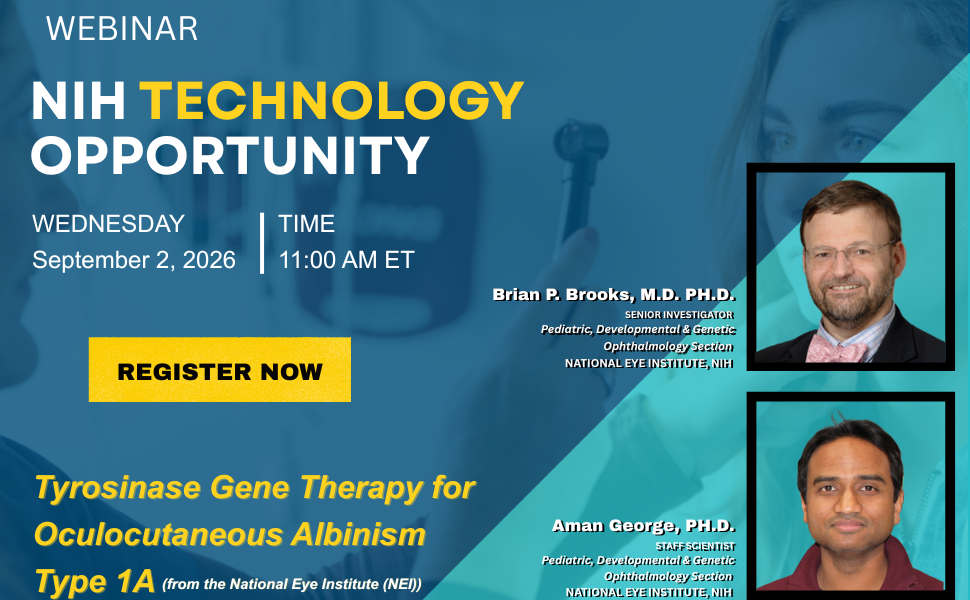
Drs. Brian P. Brooks and Aman George, of the National Eye Institute’s (NEI’s) Pediatric, Developmental & Genetic Ophthalmology Section, developed a novel gene therapy treatment for OCA that introduces a corrected copy of the human TYR gene to the eye’s RPE layer and induces melanin production, thereby reversing OCA’s effects on the eye. The NEI is looking for a licensee or co-development partner to commercially develop this technology for the OCA patient population.
About the Technology
The gene therapy method developed by Drs. Brooks and George introduces a corrected copy of the human TYR gene to the RPE layer via an adeno-associated viral (AAV) vector (AAV-TYR construct). Studies with OCA rat models and OCA1A patient derived RPE organoids show that the AAV-TYR construct increased melanin production, demonstrating the construct’s therapeutic potential to increase melanin production in vivo and in affected patient cells.
Competitive Advantages
- Addresses medical need with no treatment options
- Suprachoroidal injections
- less invasive
- outpatient / office-based setting
- Potential one-time injection
Commercial Applications
- Gene therapy for OCA1A
- Therapy for other TYROSINASE enzyme deficient eye disease
- Platform for AAV gene therapy for retinal pigment epithelium cells
Who Should Attend?
- Business development professionals
- Drug & therapeutic development professionals
- Biotech/pharma/academia researchers
- Investors and entrepreneurs
Why Attend?
- Assess co-developing the technology
- Interact with the inventor, ask questions and provide feedback
- Learn how to partner with the NIH