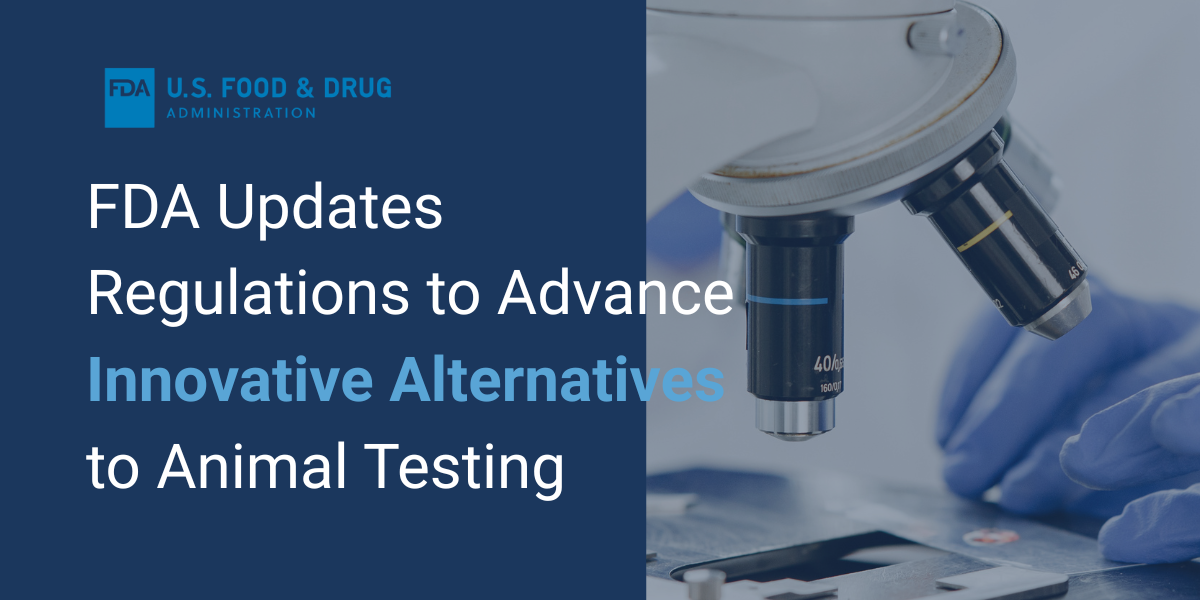
The U.S. Food and Drug Administration issued a direct final rule on September 21, 2026 that updates its regulations to clarify that non-animal methods can be used, where appropriate, for testing the safety of drugs and biological products intended for human use before they’re tried in humans. The update reflects advances in science and technology that have expanded testing options in human drug development, including methods using human cells, organs-on-chips, computer models, and other advanced technologies.
Acting FDA Commissioner Kyle Diamantas, J.D., said: “This new rule supports the Trump Administration’s push to explore ways to complement, or where appropriate, replace animal studies with methods that may better predict how medicines will actually affect people. It gives scientists and drug developers greater flexibility to use the testing approach that best addresses their scientific question. Our goal is not to replace one rigid approach with another. It is to support rigorous, modern science — including animal studies when they remain appropriate and validated alternatives when they can provide the evidence needed to protect patients.”
What the Rule Actually Changes
The rule replaces terms like “animal tests” and “animal studies” with “nonclinical tests” and “nonclinical studies,” with related terms including “preclinical” and “in vitro” also replaced. It defines “nonclinical test” and “nonclinical study” in line with the Food and Drug Omnibus Reform Act of 2022 (FDORA), which recognizes both newer non-animal methods and traditional animal studies as possible ways to provide the evidence needed to begin studies in people. The rule removes language that could suggest animal testing is the only acceptable way to generate safety information for regulatory decisions on products intended for human use. It does not eliminate or prohibit animal studies, change evidentiary standards, or impose new costs or requirements on drug developers.
A New Database, and Where This Fits Into FDA Strategy
To demonstrate practical application, the FDA also launched a database featuring specific uses of New Approach Methodologies (NAMs), with an initial release of 25 examples drawn from publicly available FDA review materials. Developers may use NAMs to generate safety information when the methods are adequately validated and appropriate for the specific product and regulatory question. The rule and database are among several actions HHS and the FDA are taking to advance drug development using NAMs, and align with Pillar 1 — Innovation and Global Leadership — of the FDA’s Public Health Pillars. The agency also says this complements Operation TrialBlazer, the HHS initiative to modernize clinical research and accelerate development of life-saving treatments, noting that clearer terminology and regulatory expectations can reduce avoidable uncertainty as sponsors develop nonclinical evidence and prepare clinical trial applications.
Public Comment and Process
The FDA is inviting public comment on the rule from clinicians, parents, caregivers, the scientific community, industry, and others. The agency published both a direct final rule and a companion proposed rule simultaneously: if the FDA receives significant adverse comments on the direct final rule, it will withdraw it and continue rulemaking through the standard notice-and-comment process using the companion proposed rule, allowing the rulemaking to proceed efficiently under either scenario. For additional information, the FDA points to the Federal Register notice for the direct final rule, the companion proposed rule, the agency’s Direct Final Rule Procedures, and its “Reducing Animal Testing in Nonclinical Studies: Year One Progress and the Path Forward” report.
About the FDA
The FDA, an agency within the U.S. Department of Health and Human Services, protects public health by assuring the safety, effectiveness, and security of human and veterinary drugs, vaccines, and other biological products for human use, and medical devices. The agency is also responsible for the safety and security of the nation’s food supply, cosmetics, dietary supplements, radiation-emitting electronic products, and regulation of tobacco products.