The Women’s Health Nexus on November 5th, 2026 was developed by an ER physician-turned-investor to help build the ecosystem around women’s health and advocate for the sector as one of healthcare’s most under-invested markets.
BETHESDA, Md. — Women make up just over half the U.S. population and drive the large majority of household healthcare decisions. Yet women’s health companies still capture only a sliver of healthcare venture capital.
Women’s Health Nexus 2026 was built to close that gap. On November 5, 2026, the one-day summit brings clinicians, founders, investors, health system leaders and policymakers together at Congressional Country Club in Bethesda — with 40+ investors and 50+ women’s health companies in the room.
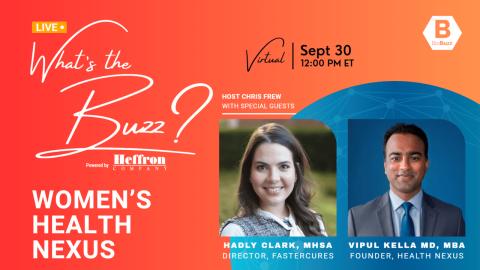
Ahead of the event, BioBuzz founder Chris Frew hosted two of the people behind it on episode 61 of What’s The Buzz: Dr. Vipul Kella, an emergency physician, general partner at PhiCap Fund and founder of Women’s Health Nexus, and Hadley Clark, director at the Milken Institute’s FasterCures, who will speak on the event’s oncology panel.
From the Bedside to the Boardroom
Kella has spent 20 years in emergency departments — rural hospitals, critical access sites, trauma centers and academic medical centers. At the bedside, he said, the gap between how men and women receive care becomes impossible to ignore.
He recalled a postpartum woman in her late 20s who arrived with chest pain and was initially treated as an anxiety case. Within hours she was deteriorating and headed to the cath lab with spontaneous coronary artery dissection — tears in the heart’s vessels that most of the care team had never seen.
The lesson stuck: diagnostic playbooks built largely around male physiology miss how disease presents in women.
Now wearing an investor’s hat, Kella sees the same gap in the capital markets. He cited less than 5% of private funding going to women’s health companies, and less than 1% to female-founded ones. (Event organizers put women’s health at 2.3% of healthcare venture capital in 2024.)
“It’s not just a marketing ploy… It’s actually a very smart and strategic area to be in.” — Dr. Vipul Kella
He also pushed back on a narrow definition of the field. Women’s health, Kella argued, goes well beyond fertility and reproduction — into cardiovascular disease, bone health, behavioral health and more. That wider map is where the under-funded opportunity sits.
Three Business Days — and Why That Shouldn’t Be Remarkable
Clark has worked in oncology for more than a decade, most of it at the Milken Institute, where she oversees the organization’s cancer work at the intersection of health technology and policy.
Last year, the work became personal. Clark was diagnosed with breast cancer just before turning 40. Her OB-GYN listened, recommended a mammogram, and a biopsy confirmed the diagnosis in three business days. The cancer was caught early. Today she is cancer-free.
“My story shouldn’t be remarkable — and the fact that it is tells us a lot about where women’s health still has to go.” — Hadley Clark
Early-stage breast cancer, she noted, is one of the few areas where the system works as intended — the product of decades of research, funding, advocacy and investment. Other conditions haven’t had that attention:
- Endometriosis still takes 7 to 10 years to diagnose.
- Ovarian cancer has no reliable screening test, so it is often found late.
- Heart disease is the leading killer of women, yet its symptoms are frequently missed.
Every one of those gaps, Clark said, can be closed the same way breast cancer’s was — if the industry chooses to invest.
Where the Opportunity Is
Both guests pointed to specific places where innovation and capital can move outcomes.
Earlier, easier detection. Clark highlighted liquid biopsy — finding cancer through tumor DNA circulating in the bloodstream — along with biosensors that read breath, saliva and urine. After COVID made at-home testing routine, she sees an opening to bring that convenience to cancer, Alzheimer’s and other conditions caught too late today.
Care that reaches women where they live. Kella still practices in rural emergency rooms, where hospital closures are accelerating. For women in remote or underserved areas, a cancer diagnosis, a chronic condition or a pregnancy too often means delayed care. Remote monitoring and virtual engagement can turn one or two touchpoints a year into continuous management.
A path to get paid. New CMS programs are pushing toward value-based care, rewarding companies willing to take on whole populations and their outcomes. For founders, Kella said, that reimbursement pathway helps de-risk the business — answering the first question every investor asks.
Chronic conditions outside the traditional box. Endometriosis, autoimmune disease, behavioral health and pelvic conditions often send women back to the ER again and again with no good system for ongoing care. Kella called these some of the largest unmet needs — and cost-saving opportunities — in the market. AI trained on broader, more representative patient data could sharpen diagnosis and management for all of them.
More Than a Meetup
Kella designed Women’s Health Nexus to go “two or three layers deeper” than the typical conference. The format puts clinicians, executives, founders, funders and policymakers on the same stage, because each owns a piece of the puzzle. The goal is for every attendee to leave with concrete ideas and real opportunities.
Year one produced tangible results. Attendees came in as limited partners in Kella’s fund, helping close a large part of it. Founders assembled teams with people they met in the room.
Year two raises the bar. Organizers plan to turn the day’s policy discussions into white papers and formal recommendations, and to launch ongoing cohorts — so the work doesn’t end on November 5. The program also features a pitch competition for selected women’s health companies.
For Clark, that follow-through is what sets the event apart: the ideas will keep building impact for women’s health long after the day itself.
Join Women’s Health Nexus 2026
| Date | Thursday, November 5, 2026 |
| Location | Congressional Country Club, Bethesda, Md. |
| Format | One day of panels, a pitch competition and curated networking |
| In the room | 40+ investors, 50+ women’s health companies, plus clinicians, health system leaders and policymakers |
| Register | luma.com/whn2026 |
If you’re building, funding, researching or supporting the future of women’s health, this is a room you’ll want to be in.
Register for Women’s Health Nexus 2026 →
Watch the full conversation: Chris Frew’s interview with Dr. Vipul Kella and Hadley Clark is available on the BioBuzz YouTube channel. Both guests welcome follow-up on LinkedIn.
What’s The Buzz is made possible by BioBuzz sponsor Heffron, the Mid-Atlantic mechanical contractor and service provider behind many of the region’s labs and biomanufacturing facilities.
#WomensHealthNexus #WHN2026 #WomensHealth #HealthInnovation #DigitalHealth #BioBuzz