Five lessons from ATCC, the nonprofit biological standards organization, on building a company inside a connected life sciences ecosystem
On October 22, 2026, BioBuzz Community Connect #8 brought together the BioHealth Capital Region at PIC MC on Montgomery College’s Germantown campus as part of DC Startup & Tech Week.
What made the gathering notable was not simply who was in the room, but what the room represented: scientists and industry leaders alongside educators, founders, government officials, investors, talent leaders, and students. In a life sciences ecosystem, those connections are not peripheral to growth. They are part of the infrastructure that makes growth possible.
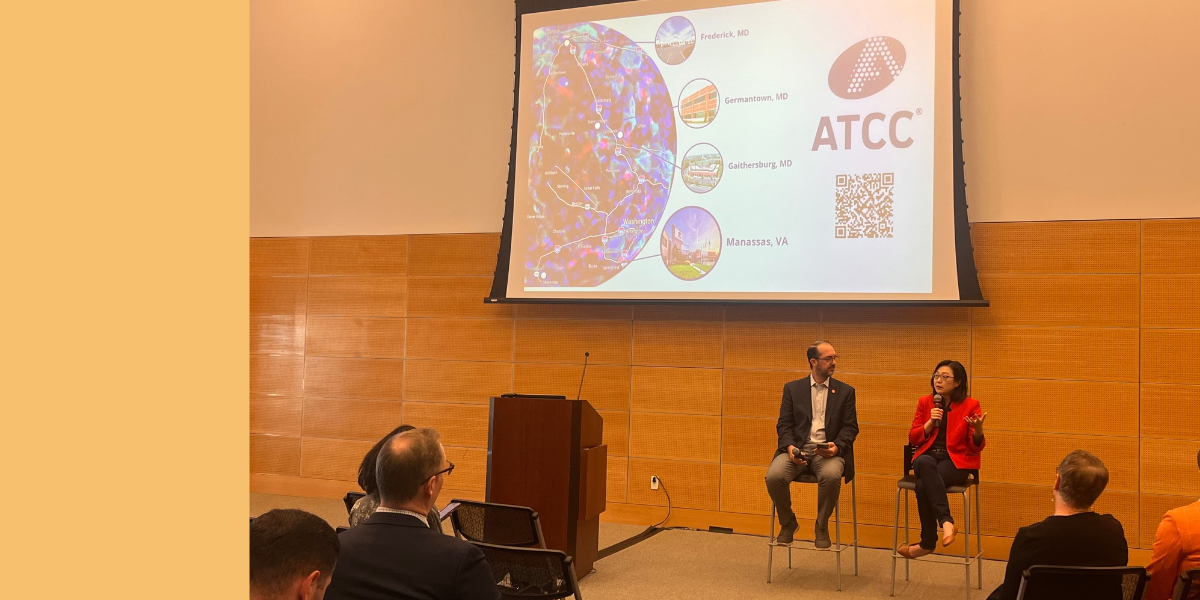
That conversation came into focus during a fireside chat with Ruth Cheng, President and CEO of ATCC, moderated by Chris Frew, CEO of BioBuzz.
For more than a century, ATCC has operated behind the scenes of biological discovery, providing biological materials, standards, models, and controls used by researchers and companies around the world. Today, the nonprofit has a presence across the BioHealth Capital Region, with operations on both sides of the Potomac River in Virginia and Maryland and partnerships spanning industry, government, and academia. Cheng therefore sees the region from two perspectives: as the leader of an organization investing in it and as someone who has made the region her home for more than a decade.
Her perspective raises a broader question for companies thinking about where — and how — to grow:
What does it take to build with an ecosystem, not just in one?
Across Cheng’s comments, five principles emerged — from choosing ecosystems over real estate to championing the future workforce, putting collaboration over competition, investing in relationships early, and leading change with trust.
1. Choose ecosystems, not just real estate
A location decision is rarely just about space. For ATCC, the value of the BioHealth Capital Region comes from the concentration of people, customers, institutions, and expertise around it.
ATCC’s latest investment illustrates that equation. A new 50,000-square-foot biomanufacturing facility on its Manassas campus, designed for BSL-2 and BSL-3 work, will add about 75 jobs over the next couple of years and bring ATCC’s advanced manufacturing capacity to about 290,000 square feet. Cheng said the organization chose to invest because it values the region’s workforce.
The advantages extend beyond talent. ATCC’s customers and federal partners — including NIH, FDA, and NCI — are nearby, as are major biopharma companies such as AstraZeneca. For Cheng, that creates an unusual concentration of research, development, manufacturing, and policy within the same regional ecosystem.
Even specialized expertise becomes part of the equation. Cheng said she did not come to ATCC with a background in federal contracting and instead relied on people within the organization and leaders it brought in who understood that world.
The takeaway: Before asking where space is cheapest, ask where the people, partners, customers, and expertise you will need are already concentrated.
2. Champion the future workforce
For companies operating in specialized industries, talent cannot be treated as something to acquire only when a position opens. ATCC’s approach starts much earlier.
The organization works closely with George Mason University, located across the street from its Manassas headquarters, and with the Universities at Shady Grove in Maryland. Through a partnership there, students work part-time at ATCC while continuing their studies.
The distinction is intentional. Rather than relying solely on a short summer internship, the program gives students a longer runway inside the organization. They are treated as employees and gain experience while still in school.
Cheng sees value in building relationships across the career spectrum, from students beginning their careers to experienced professionals and executives joining ATCC later in their careers.
The model is less about filling a future job opening than creating familiarity between institutions, employers, and the people who will eventually move between them.
The takeaway: Strong talent pipelines are built through sustained relationships with educational institutions, not one-off recruiting efforts.
3. Put collaboration over competition
For ATCC, the Potomac is a geographic boundary, but not an operating boundary.
The organization’s R&D Innovation Center draws on scientific talent in the Maryland corridor, while its main repository in Virginia requires a different set of capabilities. Rather than viewing those locations as competing, ATCC uses them to complement one another.
The same applies to its people. Cheng’s leadership team includes residents of both Maryland and Virginia, and they cross the river regularly because the work requires it. ATCC hires across the broader region as well.
That reality creates an interesting tension: companies increasingly operate across the region, while economic development can still be organized around state boundaries.
Cheng sees an opportunity in changing that dynamic. She pointed to the recently formed Potomac regional alliance and its shared economic development goals as a positive step, while calling for conversations that are “more collaborative than competitive.”
Her point was not that one side has all the answers. It was that the region has more to gain by learning from its different strengths.
“From an economic development perspective, we can all also learn from each other’s strengths.”
The takeaway: Build around the ecosystem your organization actually uses, not the political boundaries drawn around it.
4. Invest in relationships early
Infrastructure matters, but so does the informal infrastructure of a region: the people who answer a call, make an introduction, share what they have learned, or sit down to work through a problem.
Cheng described the BioHealth Capital Region as a place where those relationships are accessible. CEO dinners, Montgomery County EDC connections, economic development partners, and informal conversations all create opportunities for leaders to learn from one another.
“Nothing replaces that sit-down chat or cup of coffee,” she said.
For Cheng, that network becomes especially valuable when conditions are difficult. Collaboration is no longer simply a nice feature of an ecosystem; it is a competitive advantage. “Collaboration is more important than ever.”
She sees the same dynamic in the region’s reputation for moving slowly. Having relocated from Boston more than a decade ago, Cheng said the pace depends on the situation and on whether people are willing to sit down and work through issues together.
She pointed to ATCC’s complex Manassas construction project, which has remained on time and on budget despite a slight delay, as an example of what can happen when partners address challenges directly rather than allowing them to become friction points.
The takeaway: Relationships create speed. The time to build them is before you need someone to solve a problem.
5. Give people a reason to move with you
Building inside an ecosystem also means being willing to change as the ecosystem changes.
At ATCC, Cheng is leading transformation inside a 101-year-old organization while also navigating changes in the science around it. She credited employees and external partners with helping the organization adapt, while emphasizing the importance of transparency and preparation.
Over the past two years, ATCC has undertaken significant internal changes, including a major systems implementation. Cheng’s approach has been to prepare employees for what is coming rather than allowing change to arrive unexpectedly.
That same principle applies to ATCC’s scientific direction. The organization is maintaining its core collection while expanding into primary cells, stem cells, and advanced 3D disease models. Its work on novel pediatric brain cancer models is one example of that shift.
As biology becomes more complex, Cheng sees another need emerging: standards for new areas such as synthetic biology and AI-driven biology, including foundation models that design proteins.
ATCC’s role, in her view, is not simply to follow where science is going, but to help make emerging science more reliable.
“We’re here to provide standardization and validation to move that forward more quickly.”
The takeaway: Change is easier to sustain when employees, partners, and customers understand where you are going — and trust the reason for getting there.
The ecosystem is the infrastructure
ATCC exists to provide shared standards that allow scientists in different laboratories to trust the biological materials and results they are working with. Cheng’s vision for the region applies a similar principle at a larger scale: shared goals can help organizations, institutions, and governments turn separate strengths into a more connected whole.
When Frew asked what it will take for the region to continue keeping and growing organizations like ATCC, Cheng returned to the same idea: shared goals and collaborative action.
And ultimately, she said, the region’s greatest asset may be its people. “From a people perspective, the region has a lot to offer.”
The challenge is not necessarily creating an ecosystem from scratch. Much of what a strong life sciences region needs is already here — the institutions, scientific talent, companies, infrastructure, and expertise. The opportunity is to connect those pieces more deliberately.
That is what it means to grow with a region, rather than simply grow in it.