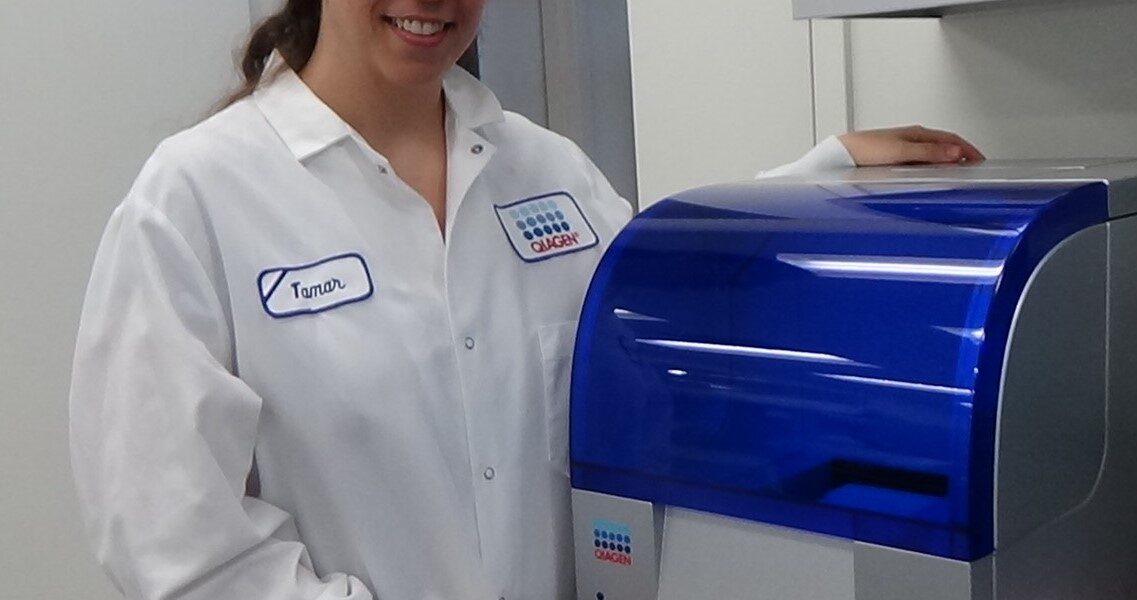
Most people don’t dance their way into a 17-year career in biotech—but Tamar Vardi did. Today, Tamar is a longtime Applications Lab scientist at QIAGEN’s Germantown site, helping researchers troubleshoot complex workflows and adopt cutting-edge automation.
QIAGEN, a global leader in sample-to-insight solutions, develops the instruments, chemistries, and software that power diagnostics, discovery, and molecular research around the world, with US headquarters in Germantown, MD. Tamar is part of the QIAexperience Center, what was historically known as the Applications Lab — a small, highly technical team of QIAexperts that helps customers master complex workflows, validate instrumentation, and solve unusual sample-prep or automation challenges. The group functions as a hands-on, expert-driven environment where scientists can test ideas, explore QIAGEN’s technology, and get real-world guidance from specialists who have seen thousands of distinct applications. It’s part customer education, part problem-solving SWAT team, and part innovation engine within QIAGEN.
In a candid conversation with BioBuzz, Tamar shared the early influences that shaped her love of science, the unexpected turn that brought her to QIAGEN, and the hard-earned career wisdom she now passes on to others. Below are five of her most powerful lessons—practical, actionable, and refreshingly human.
1. Your Network Still Matters—Even in the Age of AI
Before she had a title at QIAGEN, Tamar had a pamphlet from her university career center. It said: Do informational interviews. Take as many interviews as you can—even the ones you don’t want.
It became the most important job-search advice of her life.
While job hunting after working in both research labs and environmental education, Tamar shared casually at an Israeli folk dancing class that she was looking for work. Someone replied, “You should talk to my friend at a biotech.” While Tamar knew wasn’t interested in research jobs that would be reliant on ephemeral research funding, she was curious what a biotech job would look like, AND she remembered the pamphlet: always take the interview.
That informational interview turned into a formal interview for a job she thought she didn’t want, held at 9 a.m. “in the middle of nowhere Maryland.” She almost didn’t go.
“But as soon as they described the role,” she recalls, “I realized this job combined education and science—and had no research aspect. It was perfect. And none of that was in the job description.”
Her advice:
- “Even with AI and all the technology today… contacts are still the best way to get a job.”
- Informational interviews open doors you didn’t know existed.
- People can advocate for you in ways a résumé algorithm never will.
She still mentors job seekers the same way today.
2. Always Say Yes to the Interview (Especially the Ones You Don’t Want)
Tamar is adamant: the interview you think you don’t need might be the one that changes everything.
She took the QIAGEN interview only because her career center told her to practice interviewing—even for roles you’re not chasing. That advice flipped her career trajectory.
“If I hadn’t gone, I never would’ve learned how different the actual job was from the job description,” she says. “The reality didn’t match the paperwork at all.”
In an industry where titles and descriptions are notoriously misleading (“There are five different jobs here with ‘engineer’ in the title, and none of them hire engineers”), insight from real humans matters more than ever.
Her advice:
- Take the interview—even if the job sounds wrong.
- Use interviews to learn—not just to get hired.
- The role that fits you best might be the one you’re convinced isn’t for you.
3. There Are Far More Biotech Career Paths Than You Think
When people ask what it’s like to work at a biotech company, Tamar laughs. “It depends. Are you talking about our service lab? QC? QA? R&D? PCR? Technical support? Field scientists? Automation?”
The list is long—and most job seekers only know a fraction of it.
“There are so many jobs that you don’t know exist,” she explains. “Careers like doctor or engineer have linear paths. But in biotech, there are a thousand careers you’ve never heard of, so they don’t feel linear at all.”
Her own group, the Applications Lab, is a perfect example—part customer educator, part technical troubleshooter, part cross-functional problem-solver. It didn’t look like a traditional “scientist” role and didn’t match any job description she’d seen.
Her advice:
- Don’t limit yourself to the roles you already know.
- Talk to people inside companies to learn what jobs actually do.
- If you get your foot in the door, you can pivot into roles you never knew existed.
4. The Best Way to Stand Out Isn’t on a Résumé—It’s in How You Show Up
When asked how candidates can communicate transferable skills, Tamar doesn’t start with technical abilities.
“If I know you and you’re communicative, caring, passionate, thorough—right off the bat I want to hire you. I don’t really care what your experience is.”
She emphasizes that getting hired often comes down to professionalism and follow-through in the small moments: the thank-you email, the clear communication, the lack of typos, the responsiveness.
“You don’t have to say you’re detail-oriented,” she notes. “You can just be detail-oriented, and people will pick up on it.”
Her advice:
- Show—not tell—your communication and reliability.
- Be prompt, polished, and thoughtful.
- The intangibles matter more than buzzwords.
As AI tools reshape hiring pipelines, one thing won’t change: people still hire people who demonstrate care.
5. Career Growth Isn’t Linear—It’s About Finding the Right Fit Over Time
Tamar has been in the same role for 17 years—a rarity in modern biotech. But she’s the first to admit her situation is unusual.
“I’ve been enormously lucky,” she says. “We have stable people, ever-changing science, and a job that’s never boring.”
For others, growth has looked different. Some colleagues moved into technical sales for higher pay or less travel. Others moved into QA, QC, or fully remote expert roles. Many scientists shift across departments once they understand the company’s full ecosystem.
She argues that growth in biotech rarely looks like a ladder.
“It’s not linear,” she says. “It’s about seeing your options and figuring out where you fit best as your life changes.”
Her advice:
- Don’t expect a straight-line career path.
- Use your first biotech job to learn the landscape.
- Staying open to lateral moves can lead to more fulfilling work.
Her own niche—education + science without research—wasn’t something she knew to look for. It emerged only after she got inside.
A Career Built on Curiosity, Connection, and Saying Yes
What stands out most about Tamar’s story is that nothing about it was predetermined. She didn’t follow a formula. She didn’t map out a 20-year plan. Instead, she followed her interests, stayed open to possibility, and built relationships that revealed opportunities she couldn’t have imagined.
Her career advice is refreshingly grounded:
- Talk to people.
- Try things.
- Show up fully.
- Follow your curiosity.
- And always—always—take the interview.
For job seekers navigating today’s biotech landscape, Tamar’s journey is a reminder that careers aren’t discovered through job boards alone. They’re uncovered through conversations, serendipity, and the courage to show up—sometimes even at a dance class.