As China accelerates and the clock ticks down, ATCC and the NSCEB gathered policymakers, scientists, and industry leaders to push for trusted standards, a stronger workforce, and a private-first approach to the bioeconomy.
The atrium at ATCC was already full by the time the first speaker stepped up. Sunlight streamed in across a crowd that was unusually diverse for a biotech event—policy staffers, national security leaders, researchers, startup founders, corporate executives, and university partners—each finding a seat with a quiet sense of anticipation. Everyone in the room seemed to understand that this was not a routine gathering.
ATCC CEO Ruth Cheng welcomed them with the poise of someone who knows that history and urgency can share the same moment. “Welcome,” she said, “to what I believe is one of the most important stops on the National Security Commission on Emerging Biotechnology’s roadshow.”
ATCC is celebrating a century of trusted science, but Cheng made clear the celebration was secondary. The future—fast, AI-enabled, globally competitive, and increasingly fragile—was the reason this room was full. And it was the reason the Commission chose ATCC as a stage to accelerate national action.
The NSCEB, a congressional commission created to chart America’s path in the age of biology, has issued a landmark report detailing 49 recommendations and six pillars to strengthen the nation’s bioeconomy. At its core is a call for coordinated action—linking industry, government, academia, and communities—to ensure the U.S. remains competitive as global rivals like China rapidly accelerate, and in some areas surpass the US – and this roadshow event was part of their national grassroots effort to ensure the messages from their report being acted upon.
A Candid Conversation About the Future the U.S. Risks Losing
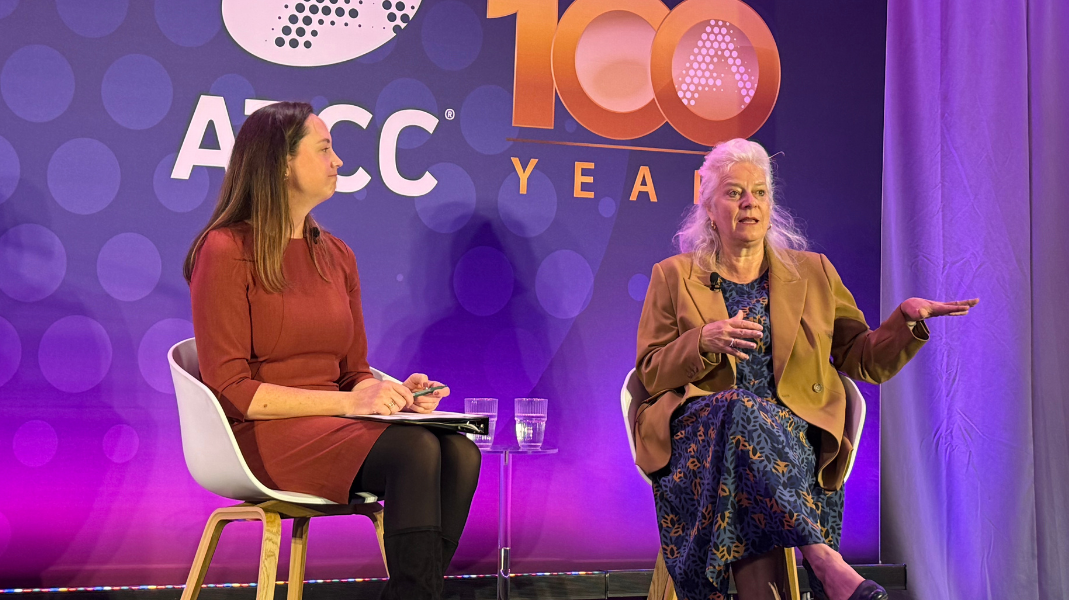
When Caitlin Frazer, Executive Director of the NSCEB, and Dawn Meyerriecks, one of its commissioners, took their seats for a fireside-style conversation, the room shifted as collective attention was focused on the conversation. Leaders rarely speak as candidly as these two did.
Frazer explained the origin of the Commission’s current roadshow tour: “We refused to file a report and walk away. We had to convince people—across the country—to feel the same urgency we feel.”
That urgency centers on a threat many Americans cannot see but policymakers are starting to recognize: China’s coordinated, 20-year effort to dominate global biotechnology. In the Commission’s analysis, China is outpacing the U.S. in biomanufacturing capacity, infrastructure investment, regulatory modernization, and the integration of AI with biological design. This reality fueled one of the starkest statements of the morning: policymakers have only three years to act, and one of them has already passed.
Against that backdrop, Meyerriecks emphasized something that surprised some in the audience: the Commission intentionally promotes a “private–public” model—not the traditional public–private one. The U.S., they argued, cannot compete with countries deploying top-down national strategies unless it plays to its greatest strength: private-sector innovation and capital.
“America works best,” Meyerriecks said, “when we come together as a nation to do something hard.”
But this time, she added, the private sector must lead—with government enabling, de-risking, and coordinating.
It was a subtle but powerful reframing. Not government-led innovation, but government as ballast—with industry as the engine.
The conversation turned vivid when Frazer described visiting a Belgian steel plant that used biomanufacturing to turn industrial off-gases into ethanol at commercial scale. The trip reset her thinking: this wasn’t science fiction; it was working industrial biotechnology. “I thought: members of Congress are going to want this in their state,” she said.
Her point was unmistakable: biotechnology is no longer just a lab discipline—it’s a manufacturing economy, and the U.S. risks forfeiting it.
But the greatest barrier, the pair warned, is the U.S. regulatory system—fragmented, unpredictable, outdated, and, at times, discouraging enough to push companies offshore. Investors are equally wary. A billion-dollar facility cannot be financed on regulatory uncertainty, Meyerriecks argued. And yet, that is exactly what innovators face today.
The Commission’s answer—now introduced in Congress—is the National Biotechnology Initiative Act, which would create a White House-level coordination office to give biotechnology a strategic home with authority to align agencies, modernize regulation, and accelerate commercialization.
It is bold—but in their view, necessary.
The Workforce That Determines Whether the U.S. Leads or Falls Behind
If regulation and infrastructure are the system-level bottlenecks, the workforce is the human bottleneck—and perhaps the most consequential of all. The conversation turned surprisingly emotional when Meyerriecks invoked Carl Sagan’s warning that the U.S. has built a society dependent on technology that almost no one understands. The room nodded along.
Her proposed solution was just as bold as the problem: a free national STEAM education pathway through the country’s land-grant universities, enabling any student—two-year or four-year—to pursue biotechnology and adjacent technical fields without financial barriers.
Frazer built on that idea with the concept of bio-literacy, the belief that Americans must understand biotechnology the way they understand smartphones—not at the engineering level, but well enough to use, trust, and regulate it responsibly.
“We are all computer literate,” she said. “We must become biologically literate too.”
This wasn’t simply a pitch for education reform. It was a recognition that the U.S. cannot lead in the age of biology if most Americans cannot see, understand, or trust the technologies determining global competitiveness.
The connection back to ATCC was unmistakable. Trusted materials, transparent standards, and reproducible science aren’t just scientific virtues—they are what make a bio-literate society possible.
As the morning drew to a close, Frazer reminded the room that the Commission is temporary—its mandate ends next year—but the work must continue. “We need partners to carry this forward,” she said.
And Meyerriecks delivered the line that echoed long after the event ended:
“Democracy works when we the people own it. And I’m looking at a room full of people who want to own this.”
For a moment, that room at ATCC felt less like an event and more like a turning point—a coalition assembling just in time.
The race is on.
The window is narrow.
But if the energy in that room was any indication, the United States is not done fighting for leadership in the age of biology.
National Security Commission on Emerging Biotechnology Report.
The Commission’s report lays out six pillars for action and makes 49 recommendations that urges swift action to protect U.S. National Security. Full details can be found at www.biotech.senate.gov/final-report
Six Recommendation Pillars include:
- Pillar 1: Prioritize biotechnology at the national level
- Pillar 2: Mobilize the private sector to get U.S. products to scale
- Pillar 3: Maximize the benefits of biotechnology for defense
- Pillar 4: Out-innovate our strategic competitors
- Pillar 5: Build the biotechnology workforce of the future
- Pillar 6: Mobilize the collective strengths of our allies and partners