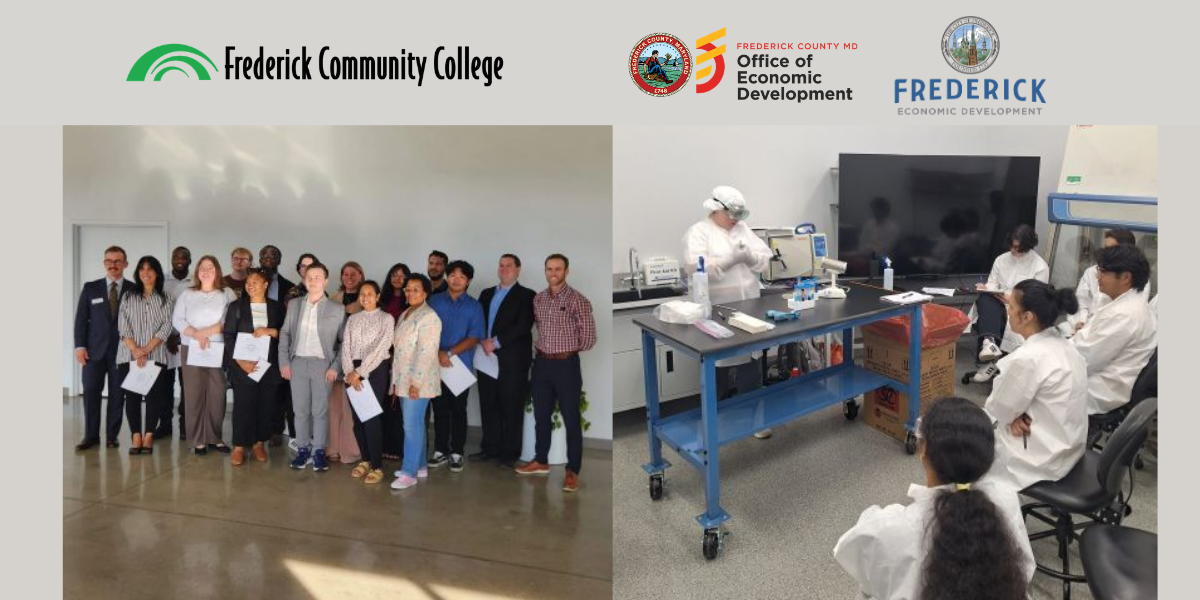
When we write about boot camps, the story usually centers on the students and the organizers who make them happen. This time, we wanted to hear from the person who helps shape the experience from the front of the room.
Meet Alexandra Bezilla, primary instructor for Frederick Community College’s fall 2026 Biotech Boot Camp, the program’s eighth cohort. Bezilla taught both the morning and evening sections full time, and her students came from every direction: active college students, working professionals, people displaced by layoffs, stay-at-home parents.
“One thing brought every single person together: the desire to transition or break into biotechnology manufacturing,” she said. “It’s crazy how these types of classes can bridge the gaps of background and circumstance to unite in a singular goal. I think the world needs more of that in general. “
What the Biotech Boot Camp is
The Biotech Boot Camp is a free, four-week, hands-on training program run by Frederick Community College’s Continuing Education and Workforce Development division. Applications are handled by the Maryland Manufacturing Extension Partnership (Maryland MEP), a nonprofit funded by industry and the State of Maryland. No prior experience is required.
Participants learn the regulatory side of the industry, safety and PPE for biomanufacturing spaces, aseptic technique, accurate pipetting and documentation, and professional communication. They can also test for BCSI micro-credentials in safety-hazard assessment, documentation and SOPs, aseptic technique at the lab bench, and small-volume metrology.
The program also builds job readiness: group resume and interview prep, industry guest speakers, and networking. Graduates who complete the program are guaranteed an interview with local or regional biotech companies. Industry sponsors include AstraZeneca, Kite (a Gilead company), Precision for Medicine, Thermo Fisher Scientific and ValSource.
Why it matters: a model for bridging the gap
The Boot Camp was built to solve a specific problem: Frederick’s biotech employers were growing faster than the local pool of trained entry-level workers. The program launched in January 2022 as a joint effort of Frederick Community College, Frederick County Workforce Services, the City of Frederick Department of Economic Development, and the Frederick County Office of Economic Development.
According to the City of Frederick, that partner team jointly designed the curriculum with input from local companies, funded the program, recruited participants and employers, and coordinated interviews before and after each session. Maryland MEP joined as a partner and sponsor in 2023. The model earned a Silver Award for Partnerships with Educational Institutions from the International Economic Development Council in 2022.
Speaking with BioBuzz at TEDCO’s Entrepreneur Expo 2026, Solash Aviles Montanez, senior business development manager for life science and technology at the Frederick County Office of Economic Development, pointed to the county’s partnership with Frederick Community College as one of the models that has worked especially well. She credited the Boot Camp with building a true pipeline: one that doesn’t just prepare students and send them off, but gives them an endpoint where they can be employed.
The instructor at the front of the room
Every program is shaped by the people who run it, and what stands out in talking with Bezilla is how grounded she is. She brings about a decade of biotech industry experience, spanning scientific project management, quality control microbiology, and GxP training and education. She had supported earlier Boot Camp cohorts in smaller roles before stepping in as primary instructor for Boot Camp #8, teaching both sections full time.
“I wasn’t prepared for how close I’d grow to each person’s drive and ‘why’ for being in the program,” she said. Students arrived with very different levels of skill and experience, and she had to present the material so everyone could engage with it at their own level. Her goal went beyond lab technique.
“I wanted to really inspire and create a sustainable energy that students can relate to and propel forward with,” she said, “something employers want to see but have a hard time finding in entry-level applicants.”
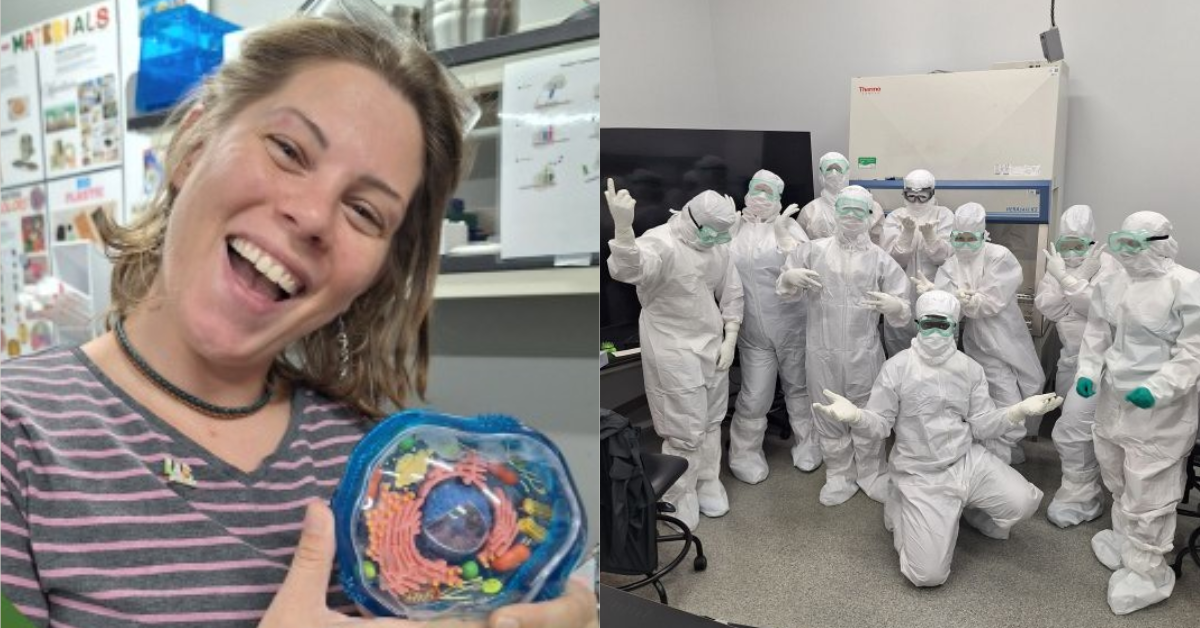
That is why her approach matters beyond one classroom. Frederick’s biotech workforce isn’t built by curriculum alone. It’s built by people who believe they belong in it and feel supported getting there. A course can teach aseptic technique. It takes an instructor like Bezilla, someone who sees the person before the résumé, to turn a room of strangers into a community ready to grow the workforce together.
Four Weeks to Lab-Ready
Asked for a single standout moment, Bezilla said it was hard to pick one. “In many ways, every student went through a transformation throughout the month-long program.”
That transformation started with doubt. In week one, she saw many students unsure they belonged, questioning whether they were smart enough or had enough STEM background. Over the following weeks, by staying connected to why they wanted a biotech career, “that uncertainty became targeted curiosity and that fear became excitement for what the future holds.”
A big part of that shift was realizing how much they already brought with them. “The misconception that if you don’t have a STEM degree you won’t make it in biotechnology manufacturing got punctured pretty quickly,” she said. The class taught students to connect what they already know to what they want to learn, which she calls an important part of job seeking and of building confidence.
The hands-on skills showed the same arc. Almost no one had performed the aseptic bench inoculation workflow before the program, a skill tied to one of the BCSI micro-credentials. By week four, students were executing it with confidence, and the same was true of aseptic gowning. “Going from never having done it before to being comfortable performing it is kinda crazy given the timeframe,” Bezilla said. “That gave me a lot of pride in their progress.”
She also credits the program’s real-world exposure. Seeing students talk confidently with employers and industry experts reminded her how important it is to get them “out of their comfort zone and into real-world events, conversations and places.”
The ripple effect
Bezilla has stayed in touch with most of the cohort through LinkedIn and email since the program ended in late September. “I see the ripple effect of this program already taking effect,” she said. Graduates have joined local industry organizations, attended industry events, and kept pursuing biotech roles, and some have already been hired.
For her, the lasting result is less a skill than a mindset. “One of the greatest joys I receive from this kind of work is seeing a spark of curiosity get lit within someone, and watching that person carry the torch and keep the flame going and growing,” she said. That willingness to keep learning is exactly what she wants to see more of in entry-level hires.
“Not only did these students learn the foundations of cGMP biotechnology manufacturing,” Bezilla said, “they learned a lot about themselves and developed that future vision.”
Nearly five years in, the Boot Camp’s success is usually measured in placements and partnerships. But behind every graduate who walks into a cleanroom for the first time is someone who helped them believe they belonged there.