At a moment when early-stage biotech capital is tighter, timelines are longer, and traditional funding pathways are under strain, the National Institutes of Health is quietly challenging one of the most persistent assumptions in life sciences: that its role ends with grants.
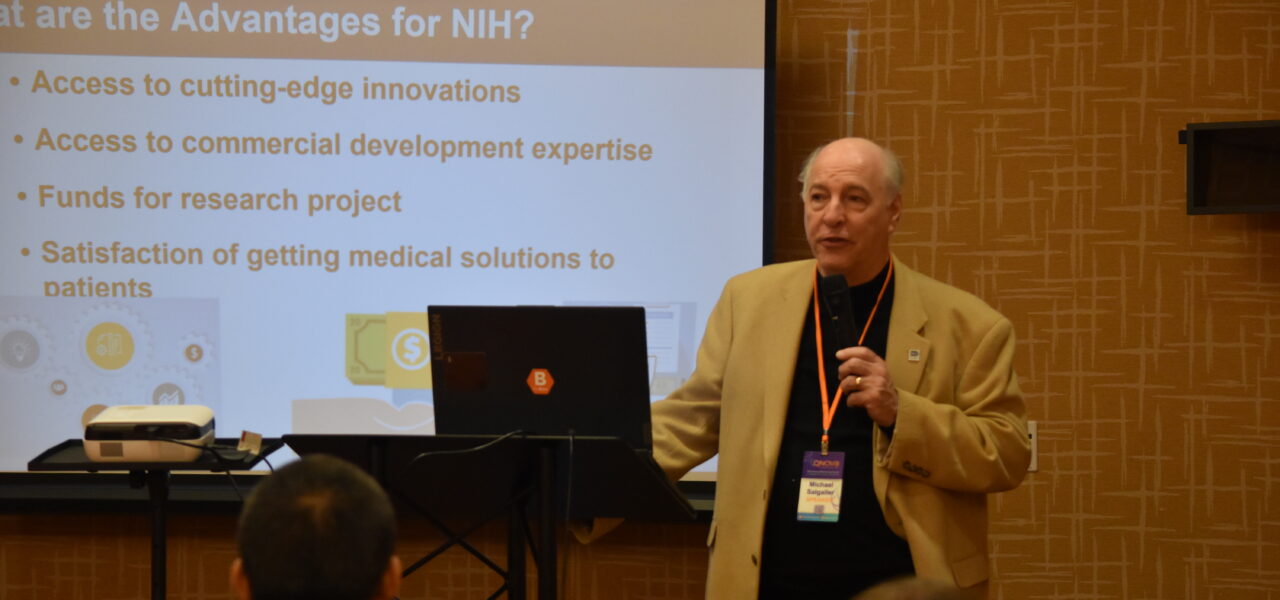
That message took center stage during the QNova Life Sciences Partnering Forum in a session titled Beyond SBIRs: NIH as a Development Partner, led by Michael Salgaller of the NIH Office of Technology Transfer and Vladimir Popov of the Frederick National Laboratory for Cancer Research. Together, they laid out a model of federal engagement that looks far less like academic sponsorship—and far more like a strategic development partnership.
NIH Beyond Academia—and Beyond Grants
For many founders, NIH remains synonymous with academic science and highly competitive grant funding. Salgaller made clear that this perception no longer reflects reality.
NIH operates with a roughly $47 billion annual budget, more than 27 institutes, and thousands of internal scientists working across the full translational spectrum—from discovery through clinical trials. Critically, its mandate explicitly includes economic development: translating taxpayer-funded research into commercial products, jobs, and companies.
What often goes unrecognized is how companies can engage NIH without applying for SBIRs or competing for extramural funding. Through licensing and collaborative research agreements, NIH and affiliated federal labs can provide non-dilutive, in-kind support that ranges from early validation studies to IND-enabling work and even clinical trials.
Rather than awarding cash, NIH spends money on a company’s behalf—deploying its infrastructure, expertise, and capabilities to advance a product toward market. In an environment where capital efficiency increasingly determines survival, that distinction is not academic.
A Different Kind of Non-Dilutive Capital
This model differs fundamentally from both grants and contract research.
NIH does not operate as a CRO and does not conduct sponsored research. Instead, collaborations are structured around shared scientific goals and negotiated responsibilities, often designed to resolve a specific technical, regulatory, or disease-area bottleneck that a company cannot efficiently address alone.
For startups, the practical implications can be substantial. NIH collaborations unlock access to specialized animal models, reagents, software, cell lines, and regulatory expertise—often at cost. When companies use NIH-developed research tools and generate new intellectual property internally, that IP belongs entirely to the company.
Overhead is another differentiator. With the exception of one institute, NIH’s overhead rate is effectively zero—dramatically lower than most academic institutions. When companies do contribute funding, those dollars are directed entirely toward advancing the project rather than sustaining institutional infrastructure.
Licensing Without the Cap Table Consequences
NIH’s licensing approach further reflects its development-first posture. The agency does not take equity, and licensing terms are structured around reasonable milestones and royalties rather than upfront financial extraction.
Companies collaborating with NIH also receive right of first refusal on exclusive licenses to jointly developed technologies. And unlike university environments, NIH cannot spin out competing companies—eliminating a risk that many founders only discover after capital has already been deployed.
A frequently cited example is Rakuten Medical, which began by licensing National Cancer Institute technology, leveraged SBIR funding, collaborated with NIH on preclinical and clinical development, and ultimately advanced products to regulatory approval while raising more than $500 million in private capital. The case underscores how NIH engagement can complement—rather than replace—traditional venture pathways while materially reducing development risk.
The Federal Lab Ecosystem: An Underused National Asset
Popov expanded the lens beyond NIH to the broader federal laboratory ecosystem. The United States is home to more than 300 federal labs across agencies including the Department of Health and Human Services, Department of Defense, Department of Energy, and NASA—representing an estimated $480 billion annual federal R&D investment.
Many of these labs offer licensable technologies, unique capabilities, and collaboration models similar to NIH’s. Through the Federal Laboratory Consortium (FLC), companies can identify technologies, facilities, and points of contact by region and technical domain.
Taken together, these labs represent a parallel innovation infrastructure—one designed not to compete with industry, but to de-risk innovation where commercial markets struggle to go alone.
Inside Frederick National Lab: A National Resource with Regional Impact
As the only national lab under the Department of Health and Human Services, the Frederick National Laboratory for Cancer Research occupies a unique position in the ecosystem. Fully funded by the National Cancer Institute, the lab employs roughly 2,300 people and operates as a government-owned, contractor-operated facility.
Its capabilities span cancer biology, genomics, proteomics, imaging, AI-enabled drug design, digital pathology, vaccine manufacturing, and clinical trial support. The lab also operates externally facing programs—such as nanotechnology characterization and formulation support—designed explicitly to generate FDA-ready data for companies.
For startups and growth-stage biotechs, these programs can compress development timelines that would otherwise require years of internal buildout, offering validated infrastructure and regulatory-aligned workflows that are difficult to replicate independently.
Looking Ahead
As venture capital concentrates later, development costs rise, and translational risk grows harder to absorb, NIH’s partnership model offers a different kind of leverage—one rooted in infrastructure, expertise, and execution rather than ownership.
For companies in the BioHealth Capital Region and beyond, this represents an underutilized pathway to advance pipelines, validate technologies, and conserve capital without surrendering control. For professional service firms and ecosystem intermediaries, it also presents a tangible way to support clients by connecting them to federal capabilities that materially accelerate development.
The infrastructure already exists. The expertise is already funded. The open question is how many founders and operators are prepared to engage NIH not as a funding source—but as a true development partner.