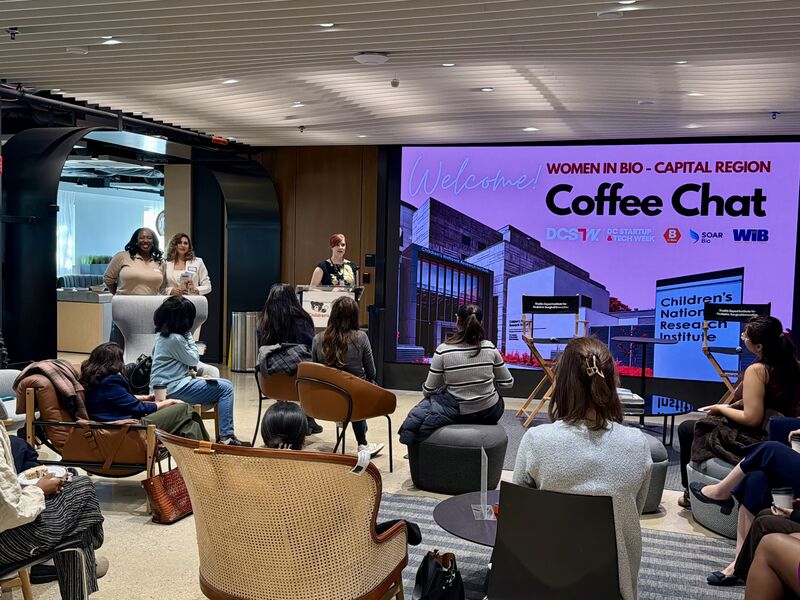
At a Women in Bio–Capital Region event during DC Tech and Startup Week, Kirsten Bowland shared how mentorship, relationships, and hands-on experience carried her from academic research into the business of building biotech companies.
For scientists hoping to move beyond the lab, the next opportunity doesn’t always come through a job posting. Sometimes it starts with a conversation over lunch. That was true for Kirsten Bowland, who spoke at the Women in Bio–Capital Region Coffee Chat on October 21 at Children’s National Research & Innovation Campus.
Looking Beyond the Lab
Bowland earned a PhD in Cellular and Molecular Medicine at Johns Hopkins University, where she researched CRISPR-Cas9-based gene therapy for pancreatic cancer. She loved building things, from molecules and assays to experiments and ideas, and she grew curious about building companies. Graduate school had given her deep technical skills, but she knew business required a different set. So she went where she could learn it firsthand: a startup.
Her first role was at a cell therapy target discovery company on the Children’s National campus. When that company relocated, Bowland didn’t start a traditional job search. She leaned on the community she had built. Over lunch, she asked someone she recognized from the building whether he knew of anyone hiring. He was hiring himself.
That conversation led to contracting work with three campus companies, helping startups fill needs they couldn’t yet cover with full-time hires. It also showed her how shared spaces turn everyday encounters into real opportunities.
Connecting Science to Strategy
Those experiences led her to SOAR Bio, which develops multiple companies in parallel through a lean, multidisciplinary team. On any given day, Bowland might run experiments, purify proteins, review data, prepare investor presentations, or weigh in on go/no-go decisions. Instead of simply carrying out assignments, she helped shape why projects moved forward and what came next. The pace was demanding, but that was the appeal: she was learning how scientific companies actually operate.
Mentors Who Pushed Her Forward
Throughout her journey, mentors made the difference. She spoke about mentors who challenged her, encouraged her to move beyond her comfort zone, and trusted her with responsibilities that stretched her capabilities. Their support helped her progress while learning to navigate unfamiliar situations.
That influence continued as she moved into the startup environment. Being given opportunities to work beyond her formal level allowed her to learn through experience and see how different parts of a business fit together. Mentorship, as her story suggests, does not have to mean providing someone with a prescribed career path. It can mean offering a challenge, making an introduction, sharing experience, or trusting someone to take on a responsibility they have not handled before.
These actions can have a lasting effect, particularly for early-career scientists who may have strong technical foundations but limited exposure to the realities of building a company.
An Ecosystem Built Through People
Life sciences innovation depends on scientific discovery, funding, infrastructure, and the ability to bring new technologies toward commercialization. Yet Bowland’s experience highlights another essential ingredient: the relationships that help people navigate the journey.
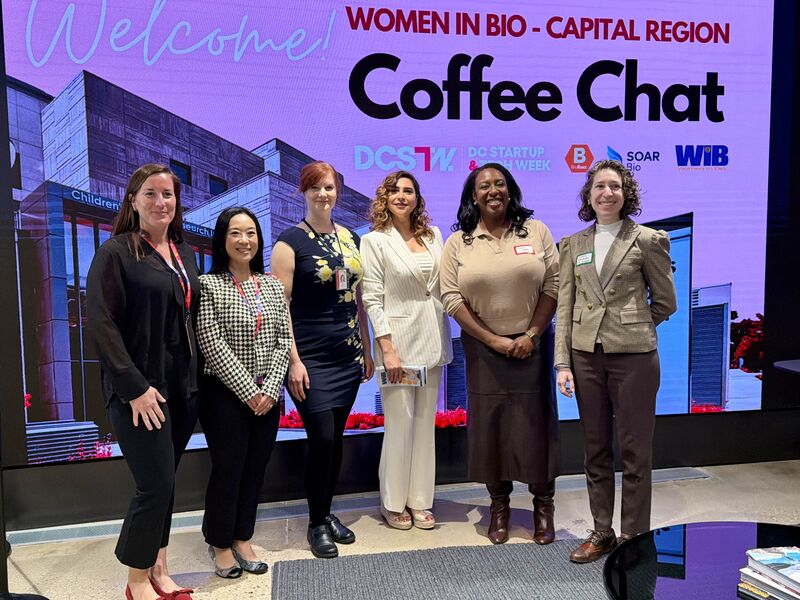
A conversation over lunch became a contracting opportunity. A network of colleagues helped her find new directions when a company departed. Mentors encouraged her to take on challenges that expanded her skills. And a multidisciplinary startup environment gave her the chance to connect scientific work with business strategy.
These experiences offer a practical lesson for the BioHealth Capital Region. Building a strong life sciences ecosystem is not only about attracting companies or providing facilities. It is also about creating opportunities for people to connect, share expertise, mentor emerging talent, and participate in the growth of new ventures.
Sometimes, the next step in building a biotech company begins with an idea in the laboratory. Sometimes, it begins with someone willing to open a door—or with a conversation over lunch.