By Chris Frew
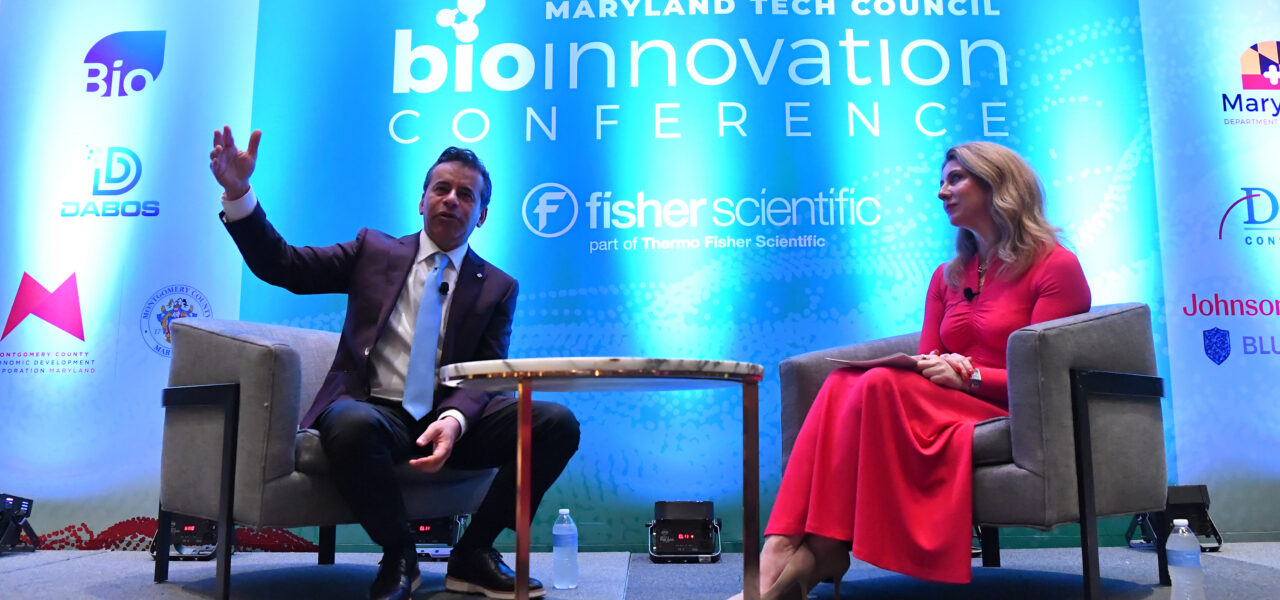
At the Maryland Tech Council’s 2025 BioInnovation Conference, Dr. Marty Makary sat down for an unfiltered fireside chat with Novavax VP and Chief Corporate Affairs and Advocacy Officer, Silvia Taylor, to outline nothing less than a reinvention of the U.S. Food and Drug Administration. For an agency that regulates products accounting for more than one-fifth of the American economy, the stakes could hardly be higher.
Makary, a first generation immigrant who was once told he was “not college material,” is an accomplished Johns Hopkins surgeon and researcher who now leads an agency that touches 20% of the US economy. For Makary, the mandate is clear: a transparent, modern, and fast FDA. He spoke of an FDA that must be both the gold standard of safety and efficacy and a nimble partner in driving cures forward.
From cutting red tape with artificial intelligence to confronting chronic disease at its roots, his vision is as sweeping as it is personal.
Cutting Red Tape, With AI in Tow
When Makary calls the FDA’s application process an “arms race,” he isn’t exaggerating. Submissions can exceed 100,000 pages—not because science requires it, but because companies fear missing a single detail. Reviewers drown in paperwork. He related the current process to the analogy of having to reapply to college every single year. “Imagine if Freshman year, sophomore year, junior year—you had to fill out the same 64-page application over and over. It makes no sense. Yet that’s what we’re doing with drugs.” He intends to streamline this with common sense new processes.
AI and digital transformation is also high on the agenda. Within days of being sworn in, he commissioned an AI tool called Elsa to help reviewers organize and summarize applications. What once took days now takes hours. By midyear, the tool was deployed agency-wide, ahead of schedule and under budget. “This AI tool is doing in six hours what used to take two or three days,” one reviewer told him.
But Makary knows efficiency isn’t just about technology; it’s about culture. For decades, the FDA has operated as a constellation of semi-autonomous fiefdoms, with biologics in one center, monoclonal antibodies in another, and digital health tools scattered across divisions. “It’s empire-building,” he said. His answer: consolidation and teamwork. Shared IT, legal, and legislative resources are being centralized, and center directors who once guarded their turf are now required to sit down together. “It had never really happened before,” he noted. The goal is straightforward: less duplication, fewer silos, and faster, more predictable outcomes for companies and patients.
Modernization also extends outside FDA walls. Makary launched a seven-city CEO listening tour, hearing directly from biotech leaders. The message was consistent: better communication, quicker responsiveness, fewer unnecessary steps. He is acting on that feedback with the National Priority Pilot Program, which allows companies to submit most data while trials are still running, so that once results arrive, FDA can decide within weeks instead of nearly a year. For patients awaiting therapies for Type 1 diabetes, pediatric blindness, or PTSD, those weeks could mean the difference between hope deferred and lives transformed.
A Refocus on the Root Causes for America’s Silent Epidemics
If speeding up cures is Makary’s mission on the drug side, his crusade in public health is no less ambitious. He argues that America’s greatest health crisis is not a lack of treatments but the systemic neglect of root causes.
“Forty percent of kids now have a chronic disease. Sperm counts have dropped by half in the past fifty years. Early-onset Alzheimer’s has tripled,” he said. “These aren’t willpower problems. They are the predictable outcomes of choices we’ve made as a society.”
His sights are set on the food supply. Under his leadership, the FDA has banned nine petroleum-based dyes linked to attention deficit disorders. He wants healthier school lunches, SNAP reforms that allow states to steer federal dollars toward better nutrition, and an end to what he calls the “fifty-year war on natural saturated fat”—a dogma, he argues, never supported by data.
The stakes are generational. Childhood obesity, unique in its scale to the United States, is a direct consequence of ultra-processed foods. The epidemics of infertility, polycystic ovarian syndrome, and metabolic disorders, he says, are not mysteries but self-inflicted wounds. “We can’t medicate our way out of a chronic disease epidemic,” Makary said. “We have to fix what’s driving it.”
Leveling the Playing Field for Innovators
Makary has a soft spot for small biotech companies, many spun out of academic labs like the one he once ran at Johns Hopkins. “They’re nimble, agile, and quick to innovate. But the system is built for big companies,” he said.
He is pushing reforms to tilt the field back toward fairness: lowering user fees that disproportionately burden startups, publishing rejection letters so companies can see how reviewers think, and reducing paperwork that overwhelms first-time applicants. Inspections, too, are being reimagined. “A scheduled inspection overseas with three weeks’ notice is a joke,” Makary said. Surprise inspections are now the standard.
Transparency, for him, is about predictability—the currency that sustains small companies as they raise capital and plan trials. “When the goalposts move, small companies can’t survive,” he said. “My job is to make sure everyone knows where the goalposts are.”
That commitment extends to the FDA’s internal culture. Makary speaks with reverence about the agency’s thousands of scientists, describing them as overwhelmingly dedicated. “Ninety-nine percent of them are honestly trying their best,” he said. His role, he argues, is not only to support them with resources but to clear away the silos and bureaucratic fiefdoms that have long slowed progress.
By marrying modernization with transparency, Makary hopes to reshape both the perception and the reality of the FDA. An agency once derided as opaque and slow-moving could become, under his tenure, a partner in innovation without sacrificing scientific rigor.
A Vision in Motion
Makary’s style is direct, sometimes unpolished, but always transparent. He hosts podcasts, speaks directly to camera, and accepts interviews almost daily. The reason is simple: “People deserve to know exactly how we’re thinking,” he said.
The portrait that emerges is of a reformer determined to make the FDA both faster and stronger, one who believes America’s chronic disease crisis is as urgent as its need for breakthrough cures. For an agency long viewed as a bottleneck, it is a radical reframing.
“I want to see cures within the next year or two,” Makary told the BioInnovation audience. “And I believe we can do it.”
One of the truly remarkable opportunities that the Maryland Tech Council offers its members are programs such as this one at their annual BioInnovation Conference that offer access to high profile government and industry leaders for unfiltered and authentic insights into the policies and trends that are shaping the industry. Stay tuned for more on this year’s BioInnovation Conference.