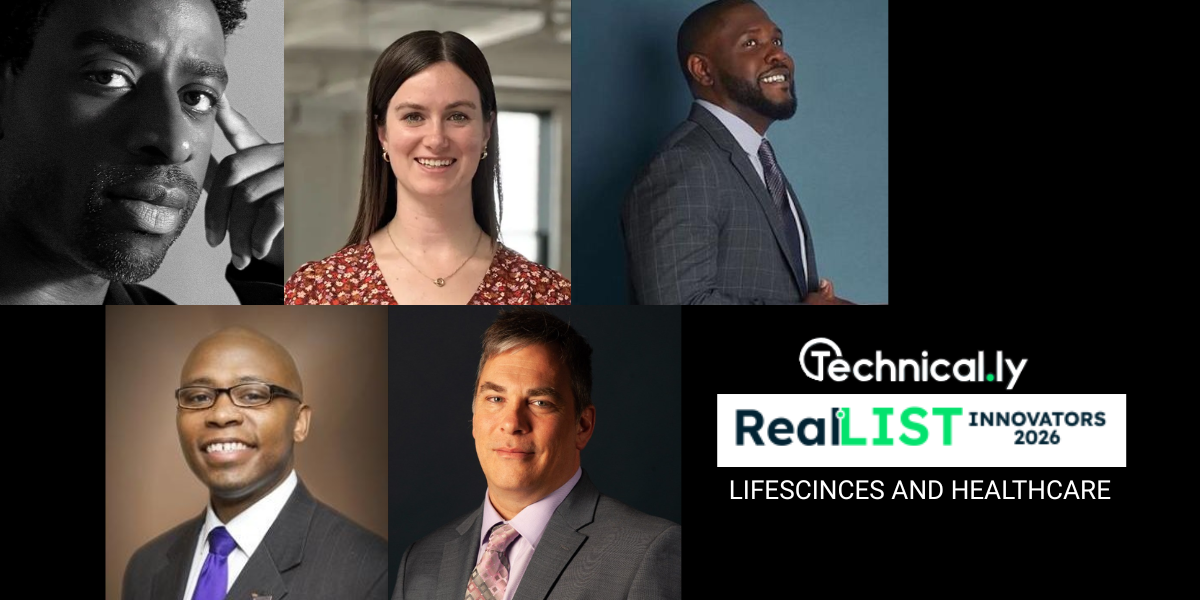
Technical.ly released its RealLIST Innovators 2026 Maryland list last week, naming 15 inventors, scientists, and engineers shaping the state’s tech future, selected through a mix of the outlet’s own reporting and community nominations. Five of this year’s honorees have direct ties to life sciences and healthcare. As the BioHealth Capital Region pushes to cement Maryland’s place among the nation’s top life sciences hubs, home to more than 1,800 life sciences companies and 70 federal labs. This year’s list is a reminder that the brainpower behind that push is homegrown. At BioBuzz, we keep coming back to this same point: we believe the people are the foundation this region is actually built on, and we’re celebrating the ones building it.
- Kelsey Abernathy, CEO, Early Charm Ventures. Abernathy’s path is a talent-pipeline story: she first connected with Early Charm, a Baltimore venture studio in Pigtown with a 14-year track record of over 100 products, as a graduate student at the University of Maryland, Baltimore who interned there while it was still a small operation. She went on to launch her own venture, an algae-based air purification startup called AlgenAir, before returning to Early Charm full-time in 2023 and being named CEO in April 2026. Her stated priority now is expanding the studio’s biomanufacturing work, including an algae-based initiative called BrightCharm: “I want to continue expanding those capabilities and reaching into the biomanufacturing side of things.”
- Yusuf Henriques, Founder, IndyGeneUS. Henriques founded IndyGeneUS, a genomics startup building a blockchain-secured repository of clinical and genomic data with a focus on African diaspora populations, after his identical twin daughters were diagnosed with a rare inherited retinal disease. He’s been direct about why representation matters to science itself: “I don’t see how you can have precision medicine without equity and inclusion.” IndyGeneUS, which has raised nearly $2 million in pre-seed funding and partners with Johnson & Johnson’s JLABs and the Aurum Institute, is responding to a real gap: people of color make up only 2% to 16% of U.S. clinical trial participants, and fewer than 2% of sequenced genomes worldwide are African.
- Christopher Adrian Johnston, Founder, DUA. Johnston lost his father to cancer during high school, and his Johns Hopkins PhD thesis became the basis for DUA, the cancer biotech startup he founded this year around “velocity receptors,” engineered proteins that help CAR T-cell immunotherapy reach solid tumors that have historically resisted it. “If you imagine us as the therapy cell, the velocity receptors are like our feet,” Johnston said. “They help us get to where we need to go.” Of DUA’s name, which means “tree” in Ghanaian, he said: “My goal with DUA is to grow hope and peace, both of which my father had in short supply in his final days.”
- Christopher Skipwith, Chief Science Officer, Astek Diagnostics. Skipwith is a concrete example of what regional life sciences infrastructure looks like in practice. Astek is developing a rapid, highly accurate UTI diagnostic platform, work it’s expanding into urine, CSF, effluent, and blood analysis, and the company is housed at the University of Maryland BioPark, which describes itself as “positioned in the heart of the Mid-Atlantic’s life science corridor.” That’s not just branding: the BioPark is a working biomedical research campus on UMB’s grounds, home to global firms, startups, and university spinouts alike, and Astek’s presence there is the kind of institutional plumbing that turns individual founders into a durable regional cluster.
- Joshua Killen, multidisciplinary artist and designer. Killen’s route into this list runs through healthcare IT rather than the lab bench. Before becoming a full-time visual artist, he spent nearly a decade, from 2008 to 2016, as an Epic© Certified IT Consultant, training physicians, nurses, pharmacists, and health information management professionals on electronic health record systems inside hospital institutions, exactly the kind of clinical-technology infrastructure work that rarely gets recognized alongside lab science but keeps healthcare systems running. He holds a BFA in New Media from Salisbury University, earned summa cum laude in 2023, and now works across sculpture, painting, 3D design, photography, and XR development. His inclusion is a reminder that Maryland’s healthcare and life sciences ecosystem isn’t built solely by founders and scientists; it also runs on the technologists who spent years training the clinical workforce on the systems that make modern medicine possible.