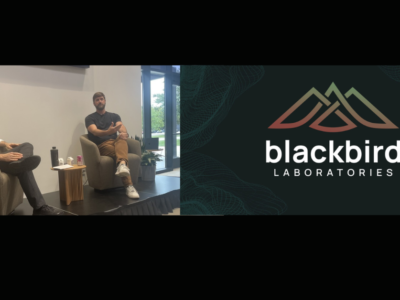
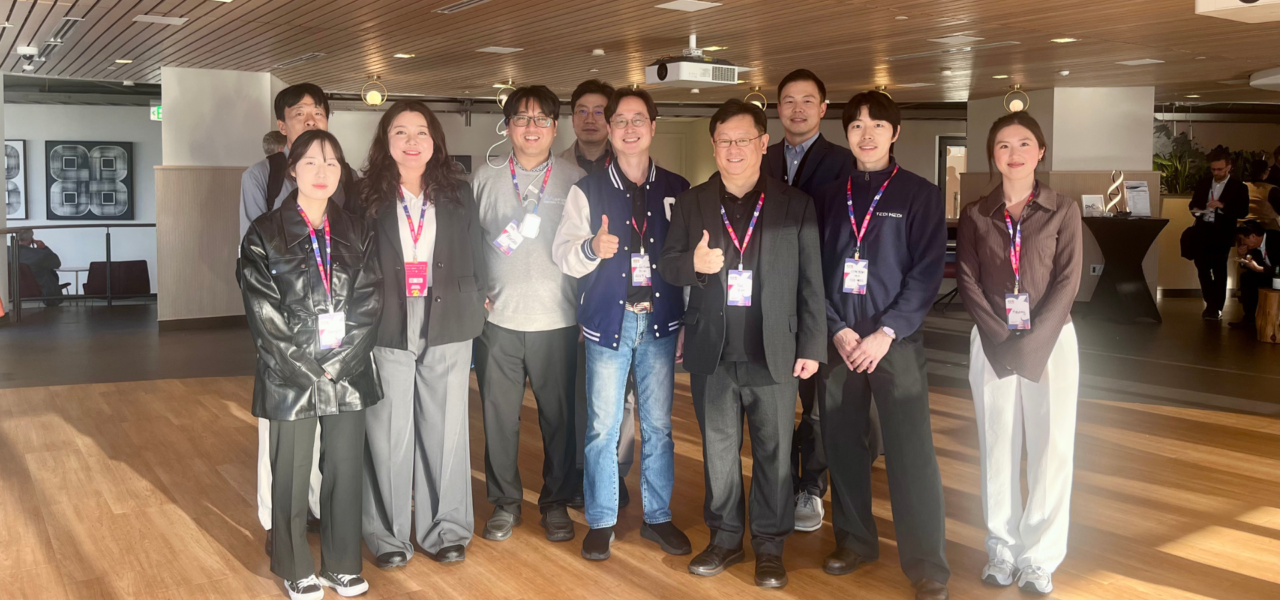
During DC Tech Startup Week, BioBuzz and PwC hosted Insights to Impact at PwC’s headquarters on October 13. Through WayFounder, we invited four Korean startups and their teams to join us.
WayFounder is a cross-border accelerator and angel investor group based in Tysons Corner, Virginia. It works with international startups that are ready to enter, grow, and build meaningful business relationships in the U.S. market. Each year, it supports a selected group of global startups as they turn their technology into tangible business outcomes.
All four companies work in health tech and the health sciences, covering longevity research, rapid diagnostics, sleep, and mobility testing. Yet each founder brought a different story, from university labs to MIT to nearly two decades in medical devices. What they shared was an energy to build and a deep curiosity about how things work here: who to meet, what the market needs, and how to turn a breakthrough into a business.
Throughout the event, we had the chance to connect with the founders and hear about their journeys and what drives them
Yumi Kim, ieumBio: From Longevity Research to Drug Discovery
For Yumi Kim, curiosity is at the heart of her work. The founder and CEO of ieumBio is building a faster way to find treatments that could help people age more healthily.
Kim began this work as a researcher at the Max Planck Institute for Biology of Ageing in Germany, then returned to Korea as a principal investigator at UNIST. Frustrated by the slow pace of grant-funded research, she founded ieumBio two years ago. Her approach uses a small, short-lived fish that ages much like humans do, so it can produce in about two years the kind of longevity data that traditional studies take decades to build.
Over the years, Kim noticed growing interest from the U.S. When she looked at the data, she was surprised to see that nearly half of the company’s audience was coming from America. That gave her a clear reason to explore the market and see where those connections could lead.
For Kim, one of the most exciting parts of startup life is the range of ideas she encounters outside academia. That same curiosity is shaping ieumBio’s next step: building a database to identify the most promising approaches to healthier aging.
Her advice to young scientists comes from her own experience. She once saw academia as the only path. Now, she encourages others to consider what they can build beyond it.
“There’s another path of your life,” she said. “You can make it by yourself, and you need to be brave.”
Jae Gwan Kim and Tae Kim, TEDi MEDi: two friends, one idea
Co-CEOs Jae Gwan Kim and Tae Kim are a true dynamic duo: two professors and good friends who bring different strengths to the table and share one mission, to help people sleep better. TEDi MEDi began as a conversation over a drink, when one friend’s research on using light to boost the body’s energy sparked an idea in the other: could light improve sleep?
“Let’s try,” they decided. Promising early results and a university startup grant pushed them to form a company, and five years later they’re still building.
They see the U.S. as their first international market, thanks to its large wellness market and an FDA they view as open to innovation. At DC Tech Startup Week, the founders came to learn how the U.S. market works, build relationships, and explore potential partnerships.
Their advice for future founders: talk to customers first to confirm the market really needs your idea, and then don’t wait too long. “If you have an idea, then just start,” one of them said. “Once you get involved, you will find a way.”
Jong Nam Park, UniqDot: from MIT research to his own venture
Jong Nam Park trained at the forefront of quantum dot research. At MIT, he worked in the lab of a scientist who went on to share the 2023 Nobel Prize in Chemistry for discovering and developing these tiny semiconductor particles. Alongside his academic career, he found the courage to build something of his own.
The idea for UniqDot came from an everyday object: a pregnancy test. Those tests use gold nanoparticles that change color when they detect a target. Park realized quantum dots were simply smaller particles with far better properties. In 2015 he proposed swapping one for the other, and the Gates Foundation, which was looking for new ways to detect malaria, gave him a grant.
The test combines three advantages: it can detect multiple diseases at once, provide quantitative results rather than a simple yes-or-no, and identify concentrations roughly 1,000 times lower than conventional gold-based tests.
UniqDot has since scaled up its quantum dot production and earned approval in Korea for a multiplex COVID-19 test. The pandemic drove him, Park said, along with the millions of people in developing countries who still suffer from malaria.
The company’s name combines “Q-dot” with “uni,” meaning one. Next, Park wants to bring the technology to the U.S., where one possible use is testing for several drugs at once in about 15 minutes.
Park is also a university professor, and he encourages his students to think creatively. His advice: learn the fundamentals first, then find a way to connect them to something innovative. Follow that creative path, he said, and success will follow.
Minsoo Kang, Medical Solution System: 18 years of focus and boundless energy
Minsoo Kang brings remarkable energy to every conversation. The CEO of Medical Solution System has spent nearly two decades specializing in his field, and he describes his mission simply: to save lives.
His company makes the AWT-100, a device that automates the walking tests doctors use to assess patients with heart, lung, and neurological conditions. Many of these tests are still done by hand with a stopwatch. The AWT-100 measures them automatically and more accurately, and it can help flag early warning signs that are easy to miss.
Kang’s U.S. plans are ambitious. The company already works with physicians at UC Davis Medical Center, has been in talks with Stanford, and is pursuing FDA clearance. He hopes to base the company’s headquarters in the U.S. His reasoning: Korea’s market is foundational, while the U.S. sets the standards.
To get there, he is looking for a U.S. partner who can help the business on the ground. Events like DC Tech Startup Week, he said, are exactly where to find them. He even reconnected with a U.S. medical device founder he had first met in Korea.
His advice to young founders: go deep before you go big. Real specialization takes years, he said, but it is what gives you the strength to build a meaningful product.
The common thread: energy and curiosity
A longevity scientist, two professor friends, an MIT-trained chemist, and a medical device veteran. On paper, they have little in common. In person, the similarities were obvious.
Every team came with energy to build. And every team came curious: about how the U.S. market works, about the people they met in the hallways, and about the partnerships that could carry their ideas across the Pacific. They asked questions, learnt graciously, and left with new connections.
We wish ieumBio, TEDi MEDi, UniqDot, and Medical Solution System the very best of luck as they bring their solutions to the United States. We look forward to seeing what they build next.