As the QNova LifeSciences Partnering Forum at JPM Healthcare Week from discussions of capital sources and regulatory pathways into its final formal session of Day 3, the focus shifted from where founders can go for support to how they actually convert that support into progress.
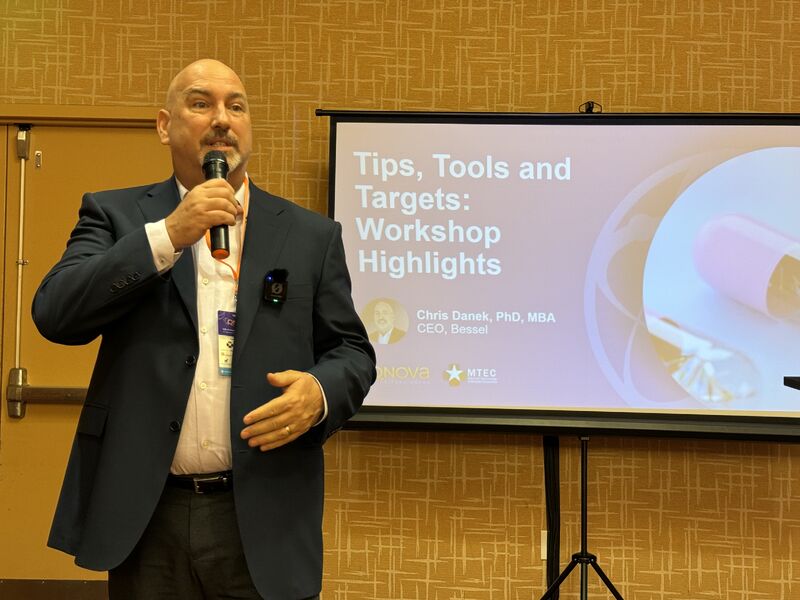
Chris Danek, PhD, MBA, CEO of Bessel, used the closing program not to introduce a new tool or funding mechanism, but to connect the dots across the day—and surface a set of practical insights about what early-stage founders must internalize to move from promise to execution.
One of the clearest themes was a reframing of capital itself. In today’s environment, funding is no longer a milestone to celebrate so much as a resource to deploy with discipline. Danek underscored a reality many founders are feeling acutely: capital is fuel in the tank, but it is not the destination. What ultimately matters is demonstrable progress toward breakthrough impact—technical, clinical, or operational—especially in an era where expectations for early-stage companies have risen sharply.
That perspective echoed earlier conversations about angel investing and non-dilutive capital, reinforcing the idea that founders can no longer rely on a single path to financing. Instead, they must be prepared to assemble multiple, complementary sources of support—each tied to specific milestones and learning objectives rather than abstract runway extension.
Danek highlighted examples where startups successfully leveraged non-traditional capital, including family foundations, to fund pilots that generated real-world proof-of-concept data. In at least one case, those pilots became a bridge to family office investment, leadership hiring, and larger raises—illustrating how early validation, rather than valuation, can unlock momentum.
The insight was not simply that more funding options exist, but that founders who think creatively about capital structure can align mission-driven partners with commercial progress in ways that benefit both sides.
Beyond capital, the session emphasized capability as an increasingly decisive factor for early-stage success. Among the capabilities discussed, artificial intelligence stood out—not as a buzzword, but as a test of execution mindset.
Danek challenged founders to move past passive interest in AI and toward intentional adoption, particularly when paired with domain expertise. He pointed to examples where AI dramatically compressed development timelines, turning multi-month design cycles into weeks when used as a force multiplier rather than a replacement for human judgment.
The implication was subtle but important: teams that fail to integrate modern tools into their workflows risk falling behind not because they lack capital or talent, but because they are slower to operationalize what is already available.
The session also previewed a more interactive workshop format designed to follow the forum—one that brings together investors, operators, and technologists focused on dual-use innovation, applied AI, and practical methods for advancing startups. The emphasis on a workshop, rather than another panel, reflected a broader shift in the ecosystem toward hands-on problem solving and peer learning.
As the formal programming concluded and participants transitioned into partnering meetings, Danek’s remarks served as a quiet synthesis of the day’s signals.
Capital remains critical. Regulatory pathways matter. But increasingly, the differentiator for early-stage life science companies is execution—how founders assemble resources, validate assumptions, adopt new tools, and act with intention in a more demanding landscape.
The takeaway was less about what founders should chase next, and more about how they should operate now: with clarity about impact, discipline around capital, and a willingness to turn insight into action.