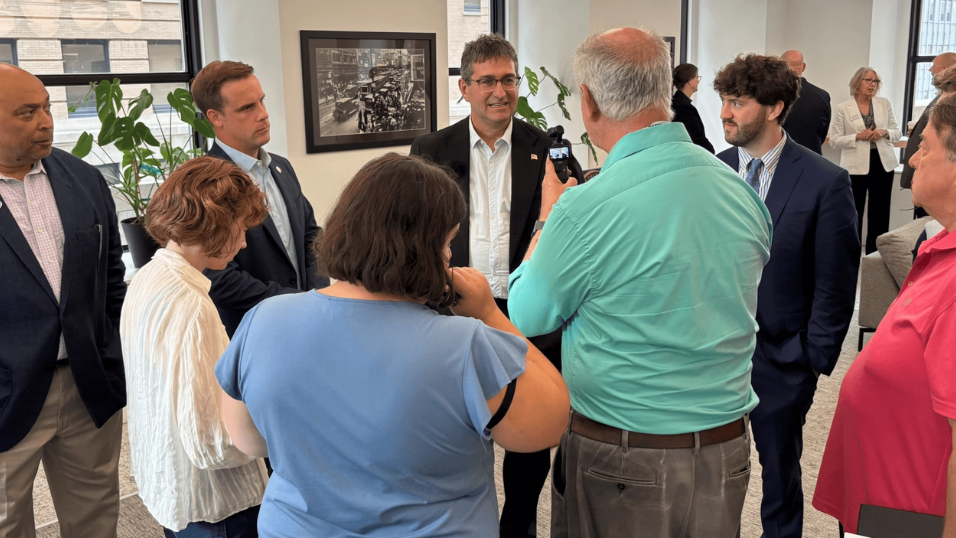
Photo Credits: Delaware Prosperity Partnership
Delaware has launched Innovate Delaware, a new statewide initiative housed inside the Delaware Prosperity Partnership designed to act as a central hub connecting entrepreneurs, researchers, and companies to the resources scattered across the state’s innovation landscape. The effort is explicit about which industries it’s built to grow: financial technology, next-generation chemical products, clean energy, sustainable advanced materials, and biopharma manufacturing, several of which happen to be sectors Delaware already has a genuine, if underleveraged, head start in.
What Innovate Delaware Actually Does
The initiative is organized around four pillars: building a pipeline of scalable science and technology startups, attracting capital and improving venture funding availability, fostering direct connections between corporations, startups, and R&D organizations, and running an “international soft landing” program to draw startups and talent in from outside the U.S. Underneath that strategy sits real infrastructure: a network of partner organizations connected through formal agreements and referral protocols, plus a digital “front door” platform meant to centralize intake and track outcomes so a founder or company doesn’t have to already know which of Delaware’s many support organizations to call first. The Delaware Prosperity Partnership is funding the effort with a $3.1 million operating budget from the state Bond Bill and private investment, with $1.36 million specifically earmarked over two years from the Delaware Strategic Fund to build out Innovate Delaware itself.
Why Life Sciences and Advanced Materials Are the Real Target
The stated goal is to “attract new emerging companies from beyond the region, particularly those in financial technology, next-generation chemical products, clean energy, sustainable advanced materials and biopharma manufacturing, and enrich Delaware’s business environment for those whose work leads to impactful and scalable advancements.” That’s not an arbitrary list for Delaware. The state is already home to Incyte, an oncology-focused drug discovery company based in Wilmington; Prelude Therapeutics, a clinical-stage biopharma developing small-molecule cancer therapies; and DuPont’s Experimental Station, a roughly $200 million R&D campus with more than two centuries of chemistry work behind it. W.L. Gore & Associates, the materials science company behind Gore-Tex, generates $3.7 billion in annual revenue with more than 10,500 employees, largely built on advanced materials science. The University of Delaware’s STAR Campus also hosts NIIMBL, the National Institute for Innovation in Manufacturing Biopharmaceuticals, a $156 million facility specifically focused on biopharma manufacturing innovation.
The talent numbers back up the industry mix, too: roughly 30% of the country’s biochemists and biophysicists work in the Delaware region, about one and a half times the national average, and the state accounts for something like one in six U.S. pharmaceutical industry jobs regionally. Delaware ranks 8th nationally per capita in bioscience patents and 6th in bioscience venture capital concentration. In other words, Innovate Delaware isn’t trying to build a life sciences and advanced materials cluster from nothing, it’s trying to make sure one that already exists actually converts into scalable companies instead of leaking talent and IP to neighboring states.
Why the Ecosystem Support Piece Is the Actual Innovation Here
That’s really the core insight behind this launch. A 2025 Delaware Science & Technology Assessment found that the state’s real advantages, its legal and regulatory structure, its proximity to East Coast capital markets, and its anchor research institutions, have gone underutilized specifically because there hasn’t been connective infrastructure tying them together. Peer states like Pennsylvania, Maryland, Rhode Island, and Connecticut have already made sustained investments in exactly this kind of innovation infrastructure, which put Delaware in a position where having the raw ingredients wasn’t enough to keep pace.
Governor Matt Meyer framed the launch around that gap directly: “Delaware has all the ingredients to lead in innovation. Now we have the infrastructure to turn great ideas into great companies.” Noah Olson, DPP’s Vice President of Innovation, described the four-pillar approach as a systematic fix rather than a single new program: it’s meant to “systematically improve Delaware’s competitiveness in the attraction, development and retention of high-growth companies.” University of Delaware President Dr. Laura Carlson tied the university’s research base directly into the effort, saying the school “stands ready alongside the Delaware Prosperity Partnership” to support the Governor’s innovation economy vision, while Kristen Castell of the Center for Accelerating Financial Equity pointed to the compounding effect ecosystem support is meant to create: “Every founder we attract strengthens Delaware’s reputation as a place where big ideas become real businesses.”
Several other ecosystem leaders, including voices from the Delaware Small Business Development Center, the Pete du Pont Freedom Foundation, and Bronze Valley weighed in on the launch.
Innovate Delaware’s first major initiative, the Delaware Rural Health Challenge, is a reverse-pitch, multi-stage health technology accelerator aimed at identifying gaps in rural healthcare delivery, funded entirely through a $157.4 million CMS/HHS award. It’s a fitting first project for the initiative: a healthcare-adjacent innovation program that depends on exactly the kind of cross-sector coordination, government funding, university research, and private company execution that Innovate Delaware was built to make routine rather than exceptional.