
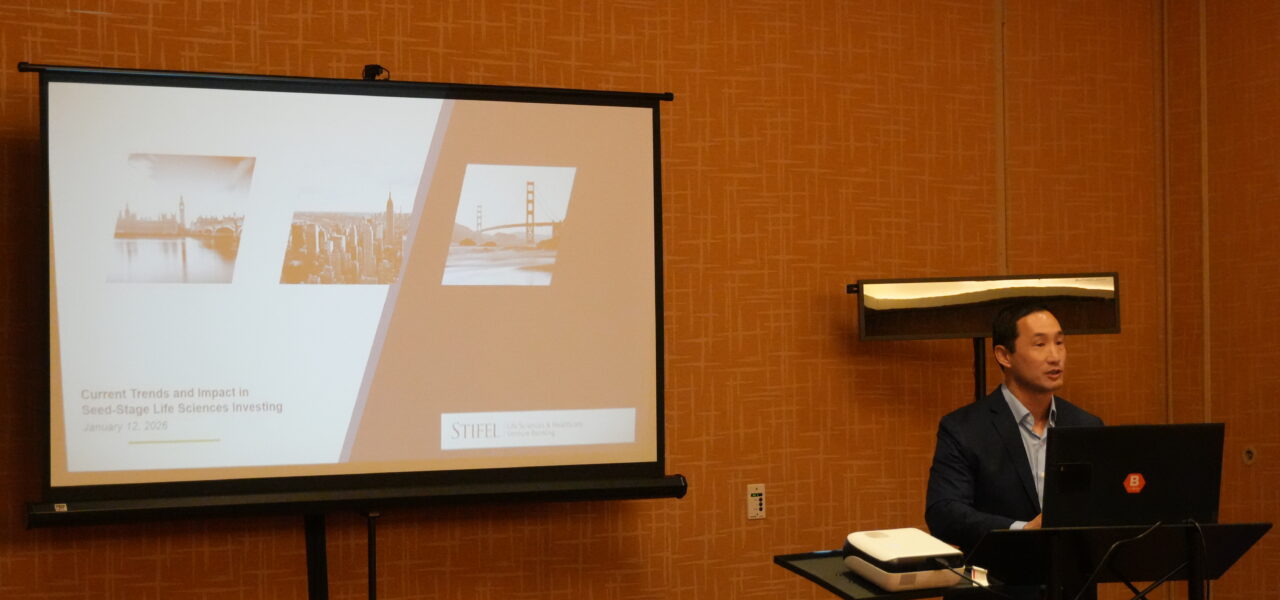
From selective capital to early commercialization, Day One at QNova showed founders how execution now outweighs ambition in life sciences fundraising.
Rather than lingering on macro uncertainty, Day One at the QNova LifeSciences 12th Annual Partnering Forum co-hosted by MTEC during the JP Morgan Healthcare Conference quickly turned toward something more practical: how seed-stage life sciences founders must now adapt their fundraising strategies, capital sequencing, and execution plans in a market that has become far more selective.
That shift followed brief welcome remarks from QNova LifeSciences President Jim Sergi and MTEC President Shawn J. Green, who framed the forum around accelerating innovation while reducing risk, cost, and time to patient impact. From there, the program moved directly into founder-facing realities, beginning with a data-driven outlook from Tim Lew, Managing Director at Stifel, on the current and near-term state of seed-stage life sciences investing.
Lew’s focus was not on why the market changed, but on what founders must do differently as capital cautiously re-enters the ecosystem heading into 2026.
Capital is returning—but expectations have reset at the seed stage
Lew characterized the current environment as a selective recovery rather than a broad rebound. After several difficult years, early-stage capital is flowing again, but at levels closer to pre-COVID norms—not the excesses of 2021.
The implications for founders are significant. What previously qualified as a Series A round increasingly resembles today’s seed round in terms of data expectations, technical validation, and strategic clarity. Investors are asking companies to prove more, earlier, and with greater discipline.
At the same time, non-dilutive funding—once viewed as a stabilizing pillar for early-stage companies—has become less predictable due to shifting administrative and policy dynamics. As a result, founders can no longer rely on a single funding pathway. Capital strategy itself has become a core competency.
The culling period is over—but selection is sharper than ever
Looking across a decade of venture data, Lew described the past few years as a necessary contraction. Many companies did not survive. Those that remain now face a market where investors are narrower in focus, more thesis-driven, and deeply oriented around execution.
This does not mean investors are chasing only near-term returns. Rather, they are prioritizing teams that can demonstrate steady progress, intelligent risk selection, and a clear understanding of what milestones actually unlock the next round of capital.
Execution, Lew emphasized, now outweighs ambition.
Biotech, medtech, and health tech diverge—but expectations converge
Lew walked through how this selective recovery is playing out differently across subsectors, while still converging around common expectations.
Biotech remains the largest pool of venture capital, but also the most volatile. Capital is increasingly flowing toward companies that pair targeted assets with platform foundations, demonstrate regulatory clarity, and show early partnership readiness. Single-asset stories without broader strategic grounding are struggling to gain traction.
Medtech, by contrast, continues to be the most stable segment. Long-term relationships with large strategics, predictable acquisition pathways, and steady capital deployment have insulated the sector from sharper swings. Increasing interest in personalization—enabled by data, manufacturing advances, and AI—is reopening innovation pathways that once stalled under cost and complexity.
Digital health, after a dramatic rise and correction, is stabilizing. Investment interest is returning around provider workflow optimization, AI-enabled diagnostics, revenue cycle management, and patient onboarding—areas where value creation is tangible and measurable.
Across all three sectors, the message to founders was consistent: clarity beats breadth, and progress beats promise.
AI is no longer a narrative—it’s infrastructure
Artificial intelligence surfaced repeatedly during the session, but not as a headline-grabbing trend. Instead, Lew positioned AI as embedded infrastructure reshaping development, commercialization, and scale.
In biotech, AI is accelerating target identification and platform development. In medtech, it is enabling personalization and data-driven decision-making. In health tech, it is moving decisively into operational layers—clinical decision support, diagnostics, speech recognition, and workflow automation.
For founders, the implication is straightforward: AI cannot be bolted on. Investors increasingly expect it to be meaningfully integrated into how companies operate and compete.
Commercial thinking moves earlier—and widens
Another theme that resonated strongly with Day One discussions was the growing importance of commercialization strategy at the seed stage. Understanding reimbursement pathways, buyer dynamics, and adoption barriers is no longer something to defer.
Lew pointed to emerging non-reimbursed wellness markets as one example of how commercialization models are expanding. The widespread adoption of GLP-1 therapies has demonstrated that patients are willing to pay out of pocket for outcomes—opening new pathways for early-stage companies willing to rethink traditional assumptions.
Still, those pathways require discipline. Founders must be able to articulate not just who uses their product, but who pays for it, why, and under what conditions.
What seed-stage founders must get right now
As the first full content session of Day One, Lew’s presentation distilled several actionable takeaways that echoed throughout the forum:
- Capital sourcing must be intentional. Founders need to think multiple rounds ahead and build investor relationships early, not transactionally.
- Execution matters more than risk-taking. Progress, not bravado, earns confidence.
- Strategic partnerships take time. They signal credibility, but only if cultivated early.
- Conviction outweighs projections. ROI is not the pitch—it is the result of disciplined execution.
- Commercial pathways must be understood early. Reimbursement, pricing, and adoption are now seed-stage concerns.
Lew summarized the moment succinctly: early-stage companies will not win in 2026 by taking more risk, but by proving faster which risks are worth taking.
Why it matters
Together, the opening sessions of Day One at QNova painted a picture of an ecosystem recalibrating around realism rather than retreat. Capital is present, but selective. Innovation remains strong, but expectations are higher. And success increasingly depends on founders who can align science, strategy, and execution early.
For seed-stage companies, the message was not discouraging—it was clarifying. The path forward may be narrower, but it is better defined.
As the Forum moved deeper into its agenda, the tone established early remained consistent: build deliberately, partner strategically, and execute relentlessly.
If Day One was any indication, the value lies not in predicting where the market will go next—but in preparing founders to operate effectively in the market as it exists today.