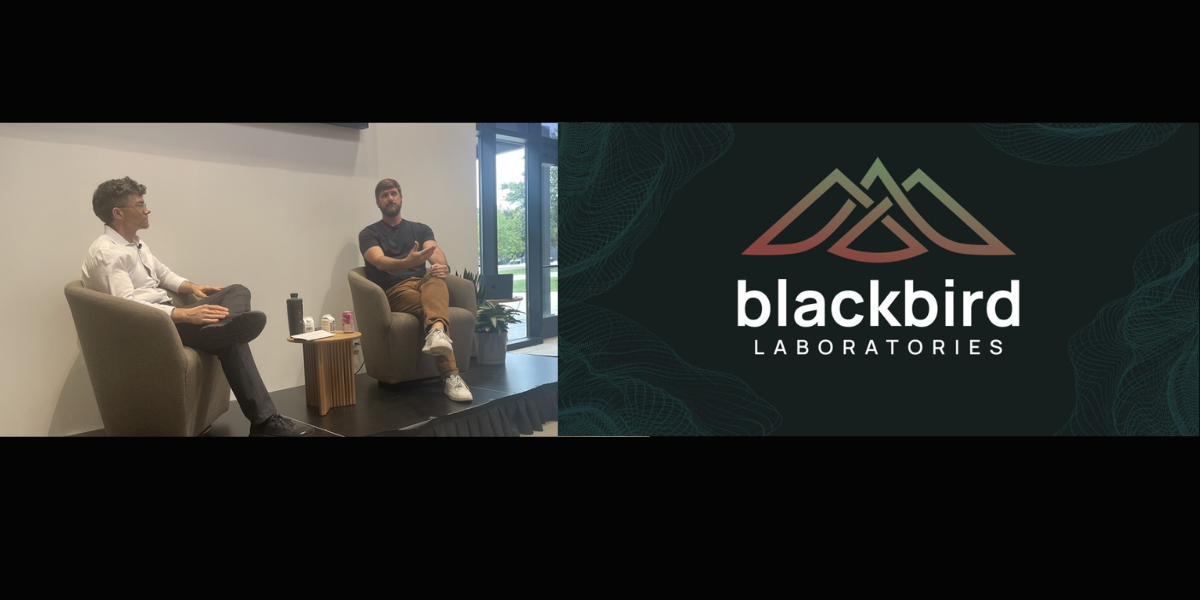
A new monthly discussion series from Blackbird Laboratories is bringing experienced biotech entrepreneurs, executives, scientists, and operators to Baltimore’s emerging life sciences community. The inaugural Blackbird Forum featured serial entrepreneur Nick Culbertson in conversation with Blackbird CEO Matt Tremblay, Ph.D., exploring the lessons behind building and scaling healthcare companies.
Building a biotech company takes more than a promising scientific idea. Founders must identify meaningful problems, understand their customers, navigate commercialization, and make difficult decisions about how to turn innovation into a sustainable business. For Baltimore’s next generation of biotech builders, learning from people who have already faced these challenges can offer valuable perspective.
That is the idea behind Blackbird Laboratories‘ new Blackbird Forum, a monthly discussion series designed to bring the experiences of established entrepreneurs and industry leaders directly to Baltimore’s emerging life sciences community.
Hosted at Blackbird BioHub, the series features curated fireside chats and panels with founders, executives, scientists, and operators who understand what it takes to build and scale a biotech company. Each session offers an opportunity to explore the lessons, challenges, and decisions behind company-building with people who have experienced them firsthand.
Blackbird Forum is part of a broader effort to strengthen Baltimore’s life sciences ecosystem and support the development of new biotech companies. In a previous feature, BioBuzz explored how Blackbird Laboratories is helping cultivate the region’s biotech community and support emerging innovation. Read more in Cultivating Baltimore’s Biotech Ecosystem With Blackbird Laboratories.
Rather than focusing exclusively on scientific breakthroughs or business success stories, Blackbird Forum creates space to discuss the realities of entrepreneurship: how founders
identify opportunities, make strategic decisions, overcome obstacles, and move ideas toward commercialization.
The inaugural session introduced that approach through a conversation between serial entrepreneur Nick Culbertson and Matt Tremblay, Ph.D., CEO of Blackbird Laboratories. Their discussion explored the practical considerations involved in building healthcare companies, from identifying unmet needs to understanding customers and navigating the complexities of bringing products to market.
A Monthly Forum for Baltimore’s Biotech Community
Blackbird Forum is designed to create an ongoing opportunity for Baltimore’s entrepreneurs and life sciences professionals to learn from experienced company builders. By bringing a different entrepreneur or industry leader into the conversation each month, the series can expose participants to a range of perspectives on the decisions and challenges that shape biotech businesses.
For scientists and researchers, these discussions offer insight into what happens beyond the laboratory when a discovery begins its journey toward becoming a product or company. For aspiring founders, they provide a chance to learn about the business considerations that accompany innovation. For entrepreneurs already building companies, hearing how others have approached similar challenges can offer fresh perspectives on their own decisions.
The monthly format also makes knowledge-sharing a recurring part of the community. Each discussion can address different aspects of company-building, from validating a business idea and finding customers to developing a team, managing financial challenges, and navigating growth.
By bringing together people with different backgrounds and experiences, Blackbird Forum can help connect scientific expertise with the practical knowledge needed to build successful businesses. It also gives emerging entrepreneurs an opportunity to learn from the experiences of established founders without having to navigate every challenge themselves.
Inside the Inaugural Session: From Innovation to Commercialization
The inaugural Blackbird Forum featured serial entrepreneur Nick Culbertson in conversation with Tremblay, bringing an entrepreneurial perspective to the practical challenges of building healthcare businesses.
One central theme was the importance of starting with a clearly defined problem rather than becoming attached to a particular product or technology. A promising idea may be scientifically
interesting, but its commercial potential depends on whether it addresses a genuine unmet need and provides meaningful value to the people expected to use it.
For founders, this means understanding who experiences the problem, how it is currently addressed, and what would make a new solution worth adopting. Validating demand early can help entrepreneurs determine whether they are solving a problem that customers recognize and are willing to invest in addressing.
These questions are especially important in healthcare, where developing a technology is only one step toward successful adoption.
Understanding the Healthcare Customer
The discussion also explored the challenges of selling into healthcare systems. Hospitals and other healthcare organizations operate within complex purchasing environments, with multiple stakeholders influencing whether a new product is adopted.
Entrepreneurs must understand not only whether their technology works, but also who will use it, who controls purchasing decisions, how it fits into existing workflows, and whether its benefits justify the cost of implementation.
A product may offer a compelling technical solution yet struggle commercially if it does not align with the needs or priorities of its intended customers. Understanding these considerations early can help founders make more informed decisions about product development, positioning, and commercialization.
The same principle applies to emerging healthcare technologies, including artificial intelligence tools. While AI may offer opportunities to improve clinical workflows, reduce costs, or address inefficiencies, its potential must translate into meaningful real-world value. Organizations need clear reasons to adopt a new technology, and entrepreneurs must be able to explain and demonstrate the benefits.
These lessons underscore the relationship between innovation and adoption: scientific or technical promise matters, but so does a clear understanding of the market in which a product must succeed.
Building a Company Beyond the Science
Beyond product development and commercialization, entrepreneurship requires founders to navigate financial pressures, changing market conditions, and the challenges of building and motivating a team.
These responsibilities can be particularly demanding in biotech, where scientific development and company growth may require sustained resources and careful planning. Founders must
balance the work of advancing a product with the broader task of creating a viable business around it.
That includes making decisions about where to invest time and money, understanding the needs of customers and partners, and adapting when an initial strategy does not produce the expected results.
For early-stage entrepreneurs, hearing from people who have navigated these decisions can provide a more realistic picture of what building a company entails. The lessons are not necessarily about finding a single formula for success, but about learning how to evaluate opportunities, anticipate challenges, and make decisions with incomplete information.
These practical insights reflect the kind of knowledge Blackbird Forum aims to make accessible: not just what entrepreneurs build, but how they make decisions, respond to obstacles, and work to bring their ideas to market.
Connecting Experience With Baltimore’s Biotech Future
The launch of Blackbird Forum adds a recurring opportunity for Baltimore’s life sciences community to connect around the realities of entrepreneurship. By hosting monthly conversations at Blackbird BioHub, Blackbird Laboratories is creating a setting where emerging builders can learn directly from people who have worked through the challenges of building and scaling companies.
The forum also speaks to the importance of sharing entrepreneurial knowledge across the regional life sciences ecosystem. Developing promising science is essential, but so is building the business expertise, relationships, and resources that help turn research into companies and sustain those companies over time.
For students and early-career professionals, the series offers a closer look at the people and decisions behind biotech entrepreneurship. For scientists considering commercialization, it provides an opportunity to learn more about the transition from research to business. And for founders already navigating the industry, it creates space to hear new perspectives and reflect on their own experiences.
The inaugural session with Culbertson offered a first look at the practical conversations the series can bring to Baltimore’s biotech community, highlighting the importance of identifying real problems, understanding customers, and building a sustainable business around innovation.
As Blackbird Forum continues each month, new guests will bring additional experiences and perspectives to the discussion. For Baltimore’s founders, scientists, students, and aspiring entrepreneurs, the series offers an ongoing opportunity to learn from those who have navigated the path before them—and to apply those lessons as they build the next generation of life sciences companies.