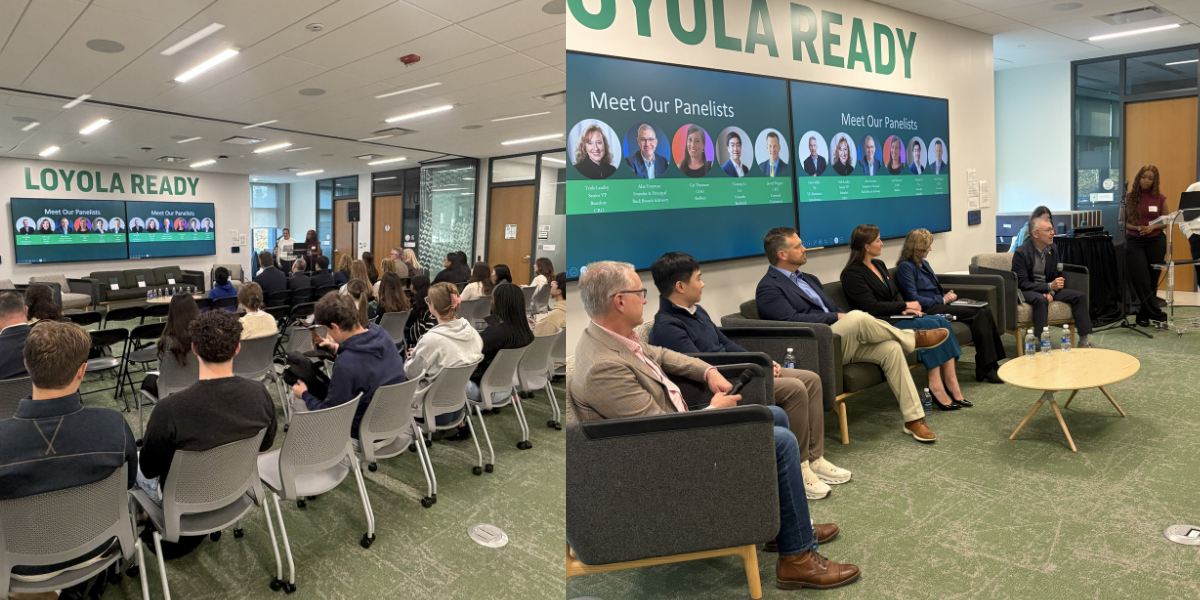
Ask most college students what a career in life sciences looks like, and they’ll picture a lab coat, a microscope and a bench full of samples. On Oct. 22, six industry professionals spent an evening at Loyola University Maryland taking that picture apart.
Hosted by Loyola’s Rizzo Career Center, the panel brought together six leaders from across the region’s life sciences landscape: Christopher Miller, vice president of biometrics at AstraZeneca; Tommy Li, co-founder of BioBuild; David Wagner, CEO of Covered Commerce; Trish Landry, senior vice president at Beaufort CRO; Alan Freeman, founder and principal counsel of Buck Branch Advisory; and Cat Thoreson, chief operating officer of BioBuzz.
Between them, their careers spanned drug development, clinical research, entrepreneurship, business and law, and they talked about those careers with unusual candor. Their roles and starting points were very different, but their stories kept arriving at the same conclusion: there is no single path into Bio-Health, and not every path starts at a lab bench.
The lawyer in the room
No one made that case more directly than Alan Freeman, founder and principal counsel of Buck Branch Advisory. Freeman is a corporate lawyer. His work rarely happens in a lab, but every growing life sciences company depends on it, because he helps companies build the legal structures they run on.
He didn’t sell the job as glamorous. Clients expect their lawyer to be a lifeline at all hours, he explained, and their needs often come before your own. Work-life balance is hard to come by, and he spoke openly about the stress that comes with it.
But he was just as clear about the payoff. In litigation, he said, winning is fun. In corporate work, the reward plays out over years, as you watch the companies you helped structure grow.
For students worried that they’d be out of place among scientists, he offered a simple reassurance: doctors and scientists are just like any other client.
As a student headed to law school, I found that message hit home. The Bio-Health industry needs people who can handle contracts, regulation and risk just as much as it needs people who can run experiments. For anyone on a non-science track, that means there is a place in this industry.
Seeing yourself in someone else’s story
For students on the science track, the evening offered a different kind of clarity.
Natalie, a Bio-Health major concentrating in biotechnology and biopharmaceuticals with a minor in business, came in with a clear goal: a career in clinical research. She connected most with Trish Landry, senior vice president at Beaufort CRO, but she said the real value of the evening came from hearing every panelist’s journey and seeing how pieces of each could apply to her own.
What she took away wasn’t technical advice. It was a mindset: don’t feel underprepared, take the opportunities that come your way and put yourself out there.
Freeman’s advice resonated with her too, even though law isn’t her path. That may have been the clearest sign of the evening’s impact: lessons from one corner of the industry reached students headed somewhere entirely different.
Asked how she’d explain life sciences to someone who had never heard of the field, Natalie described it as “the innovations and research that are advancing our scientific knowledge,” put to work helping people, even as forces like AI reshape how everything works. She summed up the evening in one word: “insightful.”
What students took away
- There’s no single route in. Science, law, business and policy all have a place in Bio-Health.
- The work has trade-offs. Careers in the industry can be demanding, and the most valuable advice came from the panelists willing to say so.
- Say yes and show up. Take opportunities as they come, don’t wait to feel fully prepared and follow up with the people you meet.
What’s next
If the evening had one assignment, it was this: show up. For students ready to take that advice, the next step is simple. Reach out to a panelist whose path sparked your interest, get involved with the BioCatalyst community, and keep an eye on upcoming Rizzo Career Center events. The industry came to Loyola for one night. Now it’s up to students to keep the door open.