“I was told that if I left my PhD, my scientific career would be over.”
You could have heard a pin drop.
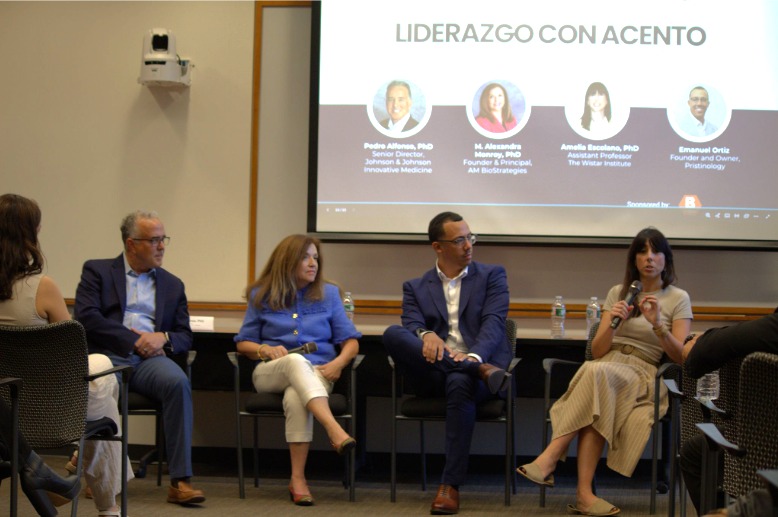
The room had been full of laughter only moments before. Students, postdocs, faculty, entrepreneurs, and industry professionals were listening to four successful Hispanic leaders describe their careers. But when Dr. Amelia Escolano shared that story, the conversation shifted. This wasn’t going to be another panel celebrating polished résumés and career milestones. It was going to be about everything that happened behind them.
That was exactly the vision behind Leadership with an Accent: Hispanic Voices Transforming STEM, organized by Ciencia con Acento in collaboration with Penn SACNAS and Hablemos de Ciencia.
Our goal wasn’t simply to organize another panel discussion. We wanted to create the kind of conversation many of us wish we’d had earlier in our careers, the kind where leaders don’t just share their titles, but the stories behind them. The setbacks. The doubts. The pivots. The moments that quietly changed everything.
There is no Single Path to Success
Throughout the evening, one message surfaced again and again: there is no single path to success in STEM.
That message became clear from the very first question. As each panelist reflected on their professional journey, it was obvious that none of their careers had followed the straight line that often appears on a résumé or LinkedIn profile.
Dr. Alexandra Monroy described a career that has taken her across academia, research and development, business development, and ultimately consulting. Rather than following a predetermined roadmap, she embraced opportunities as they emerged, demonstrating that scientists often possess far more transferable skills than they realize. Her story challenged one of the most common misconceptions in STEM: that changing directions somehow means falling behind. Instead, she reminded the audience that growth often comes from being willing to reinvent yourself. Scientists are trained to solve problems, adapt, and learn continuously, skills that extend far beyond the laboratory.
Following the Opportunities That Spark Growth
Growing up in North Philadelphia, Emanuel spent much of his childhood around the University of Pennsylvania, where his mother worked as a laboratory manager. Years later, one of his first jobs was cleaning laboratories on that same campus. That experience gave him an early view of the work that happens behind the scenes in science: the preparation, the safety, the operations, and the people who help make research possible.
Returning years later, not as an employee, but as a founder and panelist sharing his story, was a meaningful full-circle moment.
Throughout the conversation, Emanuel spoke about the moments in life when something inside you starts pulling you toward a new opportunity, even when the path is not fully clear. His message to the audience was to listen to that feeling instead of ignoring it. He described it simply as, “follow your butterflies.” For Emanuel, those butterflies are often where true inspiration, motivation, drive, and action begin. They show up before the confidence, before the full plan, and sometimes before you feel ready. But too often, people talk themselves out of the very opportunities that are meant to stretch them because fear makes the unknown feel bigger than it really is.
As Emanuel reminded the audience, FEAR is still just a four-letter word: false expectations appearing real. It can convince people to stay comfortable, to wait for the perfect moment, or to believe they are not ready yet. But sometimes fear is not a warning to stop. Sometimes it is proof that you are standing at the edge of growth.
He also shared a saying he carries with him: “Commit now and figure everything else out later.” Not as a message to move carelessly, but as a reminder that waiting until everything feels perfect can keep people stuck. Sometimes the first step is making the commitment, trusting your instincts, and allowing the next pieces to come together as you move forward. For Emanuel, the lesson was not about following a perfect career path. It was about recognizing that every experience, every uncomfortable step, and every opportunity that pulls at you can become part of something bigger.
Resilience Can Redefine a Career
Dr. Amelia Escolano offered another perspective on resilience. She shared the difficult decision to leave a PhD program in the United States because of a toxic mentoring environment. At the time, she was told that walking away would end her scientific career. Instead, she returned to Spain, completed her doctorate, and eventually came back to the United States, where she now leads her own laboratory at The Wistar Institute. Her story wasn’t about proving someone wrong. It was about choosing an environment where she could thrive, and becoming the kind of leader and mentor she wished she had when she was starting her own career.
Trusting your Instincts
Perhaps one of the evening’s most memorable moments came from Dr. Pedro Alfonso. He recounted an experience from his time living in Puerto Rico. While traveling by bus, something simply didn’t feel right. Trusting his instincts, he asked to get off before reaching his destination. Later, he learned that the bus had caught fire. Although extraordinary, the story became a metaphor for leadership itself. Data, preparation, and experience all matter. But leadership also requires trusting your judgment, particularly when navigating uncertainty.
Why Community Matters
Throughout the discussion, another theme continued to surface: community. Every panelist spoke about mentors, colleagues, family members, or supporters who had opened doors, offered encouragement, or helped them navigate moments of uncertainty. No one succeeds alone.
That idea sits at the heart of Ciencia con Acento.
We often think of scientific careers in terms of publications, grants, patents, or promotions. Those achievements matter, but they are only part of the story. Behind every career milestone is a conversation. A mentor who believed in someone’s potential. A colleague who made an introduction. A community that reminded someone they belonged.
The panel also explored the challenges Hispanic professionals continue to encounter in STEM—from questions of representation to navigating identity and leadership. Rather than focusing only on barriers, the conversation highlighted the strengths our community brings: resilience, adaptability, curiosity, and an ability to solve complex problems in constantly changing environments.

Beyond the Panel
As the formal discussion came to an end, something special happened. Nobody rushed for the exit. Students stayed to speak with the panelists. Postdoctoral researchers connected with industry professionals. Faculty members exchanged ideas with early-career scientists. New introductions were made. Advice was shared. Future collaborations quietly began. For us, that was the true success of the evening.
Leadership with an Accent was never just about four speakers. It was about creating a space where people could see themselves reflected, ask honest questions, build meaningful relationships, and leave believing that their own journey, however unconventional, has a place in STEM.
Philadelphia’s life sciences ecosystem continues to grow because of scientific innovation. But ecosystems are built by people. And people grow through community. That is the future Ciencia con Acento hopes to continue building, one conversation, one connection, and one opportunity at a time.