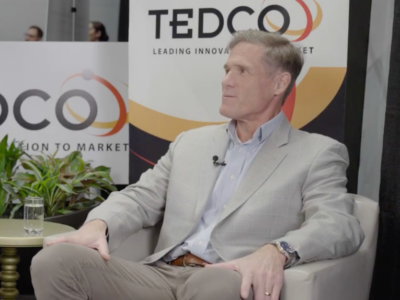

When Chris Garabedian took the stage at the QNova Life Sciences Forum at JPM Healthcare Week, the room wasn’t looking for optimism. It was looking for clarity.
After three years of capital contraction, stalled IPO windows, and a brutal reset in private valuations, the life sciences sector is finally showing signs of recovery. But as Garabedian made clear, this is not a return to the free-flowing capital environment of 2020–2021. What’s emerging instead is a selective, disciplined, and structurally different market—one that rewards operational rigor as much as scientific ambition.
“Uncertainty is the enemy of a healthy marketplace,” Garabedian told the audience, framing what has changed most since the downturn. “We kind of know what we’re dealing with now.”
Chris Garabedian, CEO of Xontogeny and a venture partner at Perceptive Advisors, has spent decades on both sides of the table building and financing biotech companies through bull and bear markets alike. Garabedian is also the host of the popular podcast, BioVenture VoiCes.
For founders and investors planning 2026 strategy, the implication is stark: the recovery is real, but access to capital is conditional.
Public Markets Are Quietly Leading the Turn
Public biotech markets remain the clearest leading indicator for the broader ecosystem, and the signal entering 2026 is constructive. Follow-on offerings reached one of their strongest years on record, valuations recovered across clinical-stage companies, and the number of companies trading below cash value declined.
“That’s not the sign of a bad market,” Garabedian said, pointing to the surge in follow-on financings. “When public companies have really depressed valuations, they don’t want to go raise more money. The fact that they are raising tells you valuations are back to reasonable levels.”
The IPO window itself remains selective. Few companies went public in 2025, but those that did largely held their value in the aftermarket—a prerequisite for a broader reopening. The bar, however, has moved.
“Most of the companies that are candidates for IPO now have Phase 2 or Phase 3 data,” Garabedian noted, underscoring how far risk tolerance has shifted. Public markets are no longer a place to finish building a story; they are a place to scale one that is already de-risked.
M&A Has Reasserted Itself as the Primary Exit Path
If IPOs are still warming up, M&A has already taken center stage.
Public and private acquisitions in 2025 were notable not for a single blockbuster, but for their breadth. Multiple pharma buyers were active across therapeutic areas, with deal sizes clustering in the multi-billion-dollar range. Just as important, upfront payments increased materially.
“This isn’t just about the number of deals—it’s the upfront value that matters,” Garabedian said. In private company acquisitions, upfront considerations approached levels last seen during the market peak, signaling renewed confidence in pipeline value.
The driver is structural. Large pharmaceutical companies continue to face patent cliffs and pipeline gaps, making inactivity its own form of risk. As Garabedian put it, buyers are being selective—but decisive.
Venture Capital Is Back—but Discernment Is the Defining Feature
Venture investment has followed public markets with a lag, and the rebound has been uneven by design.
“VC is a lagging indicator of public market sentiment,” Garabedian explained. “If the public markets remain strong, that will bode well for private venture investment—but it won’t be across the board.”
Instead, capital is concentrating. Mega-rounds—often $100 million or more at first financing—now account for roughly half of all dollars deployed at the early stage. The rationale is intentional.
“Investors are trying to take financing risk off the table,” Garabedian said. “They want to give companies enough capital to get to a clinical proof-of-concept readout in patients.”
The result is a widening divide between the “haves” and the “have-nots.” Companies seeking smaller, incremental rounds are struggling, while those with strong teams, differentiated assets, and credible clinical plans are being fully capitalized.
New Company Formation Remains the Pressure Point
One area where the recovery has not yet materialized is new company creation. First financings remain near decade lows as venture firms focus on supporting—and, in some cases, triaging—existing portfolios.
Garabedian offered a characteristically blunt analogy: many investors are still deciding “which babies they can afford to feed.” Adding new risk before clearing old positions simply doesn’t make sense.
When new companies do form, they tend to look different than those of prior cycles: fewer in number, more deliberately constructed, and backed by syndicates willing to fund through meaningful milestones.
What This Means for 2026 Strategy
The life sciences market entering 2026 is not exuberant—but it is functional. And it is far less forgiving of ambiguity.
For founders, the playbook is increasingly clear:
- Focus beats breadth.
- Clinical milestones drive valuation.
- Burn rate is a strategic variable, not an afterthought.
For investors, the environment offers renewed opportunity without erasing hard-learned lessons:
- Fewer companies, better prepared.
- M&A as a credible, repeatable exit path.
- Public markets that reward proof over promise.
As Garabedian’s perspective made clear, the last cycle didn’t fail because capital disappeared. It failed because expectations detached from reality. That gap has closed.
The next phase of growth will not reward those waiting for conditions to feel easy again. It will reward those who learned how to operate when they weren’t.