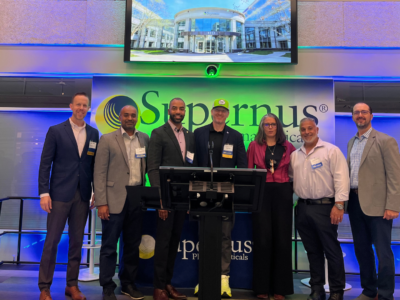
Peter Bains, Syngene International’s Managing Director and CEO shares insights on US expansion and new Bayview Baltimore facility in recent BioBuzz interview.
In an era where outsourced biomanufacturing is reshaping the life sciences landscape, one global firm has just signaled a bold move with their first US expansion. Syngene International, Ltd., a subsidiary of Biocon Limited, is a leading global Contract Research, Development, and Manufacturing Organization (CRDMO). The recent acquisition of the former Emergent BioSolutions Bayview facility in South Baltimore marks their first US asset and a bet on the continued growth of biologics.
BioBuzz recently had the opportunity to visit the facility and sit down with Syngene Managing Director and CEO, Peter Bains, to discuss the US expansion and what it means for the company, their customers and the region.
“Syngene’s direct entry into the US CRDMO market through its recent purchase of the Bayview monoclonal antibody manufacturing facility is a very significant strategic step,” said Bains. “It represents our first capital asset acquisition outside of India.”
A Strategic Foothold in the World’s Largest Market
Founded over 30 years ago in Bangalore, India, Syngene has grown into a CRDMO powerhouse with more than 8,000 employees—6,000 of whom are scientists—and capabilities spanning the drug development spectrum from discovery through commercial manufacturing. Its U.S. expansion reflects the next logical evolution for a company with ambitions to be a top-tier global player.
“The U.S. is our largest market. Many of our customers are based here and while they often outsource work to India, some also want to keep operations closer to home,” Bains explained. “This facility gives us that flexibility and proximity.”
Syngene’s U.S. investment comes amid continued growth and confidence in biologics and large molecules. “The fundamentals for large molecules are just overwhelmingly positive,” said Bains. “If you look at the global pipeline of preclinical and clinical programs—tens of thousands are in biologics. We see a long-term, structurally growing market.”
He continued, “We believe we can play a meaningful role by supporting these companies with quality, speed, and scientific rigor. And biologics manufacturing, particularly in the U.S., is a long-term growth story.”
Baltimore Facility and Ecosystem
Baltimore wasn’t chosen by accident. “This site, this facility, this ecosystem enables us to think with a degree of confidence that we can build this facility out successfully. We can find the right talent in scientists, engineers, and technicians to scale operations,” said Bains.
Located near Johns Hopkins University and the University of Maryland, the Bayview site offers a rare convergence of talent, research infrastructure, and cost-efficient operations. The site itself spans 100,000 square feet and is outfitted for single-use bioreactor capacity in the 15,000–20,000-liter range. “It’s strategically scaled and modular. It gives us the capability to operate flexibly, and we hope to have at least one suite up and running by the end of the year,” said Bains.
He cited Baltimore’s growing biotech ecosystem, strong research universities, and a workforce seasoned by companies like AstraZeneca, Kite Pharma, and Lonza as key assets. “If this facility were to become fully utilized at capacity and with a certain mix, the number of people we would hire would be on the order of magnitude of 300,” he noted.
Syngene’s arrival also helps fill a void left by Emergent’s exit, offering new employment and partnership opportunities in a region that has been historically under-leveraged despite its assets. According to Bains, “We hope we can take our foothold and anchor in manufacturing, but we want to reach out to do more because there’s a rich biotech ecosystem here. We’d love to support the science being developed here and help put it to work.”
More on Baltimore Biotech: “Made in Baltimore: $325M Recent Investments Expected to Boost Biotech Sector”
Putting Science to Work—with a Customer-First Culture
Syngene’s mission is rooted in one simple yet powerful philosophy: putting science to work. “We are a service company. It is our privilege to support our customers and help them advance in the complex arena of drug development,” said Bains. “Our ability to support them is crystallized in our scientists’ and engineers’ capabilities in advancing and manufacturing drugs for our customers.”
What makes this mission more than a tagline is Syngene’s commitment to customer-owned innovation. “Our policy is that the intellectual property belongs to the customer. What we take pride in is our scientists being named on their patents—and that’s happened over 400 times,” he added.
This customer-centric culture underpins everything, from strategic decisions to hiring. “To run an operation like this with that mindset, you need a culture built on flexibility, integrity, and a deep-seated belief in service,” Bains said.
From Bench to Commercial: An End-to-End Partner
What sets Syngene apart in the increasingly crowded CRDMO space is its scope and scale. The company supports a wide range of modalities—small molecules, biologics, ADCs, peptides, oligonucleotides, and cell and gene therapies. It works with companies ranging from lean biotech startups to pharmaceutical giants like Bristol Myers Squibb.
“We operate across the entire spectrum from discovery to the clinic. Our customers range from early-stage biotechs with a single experiment and limited budget, to large pharma running global R&D programs,” Bains said. “We believe we can help them across the full journey.”
That flexibility will be a key selling point as Syngene brings its capabilities stateside. “This facility adds flexibility to our offering. We can say to our customers: we can do this in India or here in the U.S., depending on your need.”
Beyond the bench and bioreactor, Syngene is also investing heavily in digitization, automation, and AI—areas Bains sees as critical for staying ahead. “We’re automating and digitizing – processes and systems and capabilities – strategically across the value chain. We believe that AI is going to transform discovery, development, and manufacturing.”
Syngene is already working with digital twins for bioreactors that can predict and prevent issues before they arise. “Our goal is to be not just reactive or predictive, but prognostic,” Bains said. “Quality will always matter, and that’s a domain where we excel.”
Boosting Maryland’s Innovation Economy
Syngene’s investment is a timely boost for Maryland’s life sciences economy. With its workforce demands, collaborative research opportunities, and global brand, the company is positioned to be a transformative player.
For Bains, the vision is clear: “We want this to be more than a successful facility—we want to support the broader biotech community in Baltimore and help them advance their science. We’ve been doing this globally for 30 years, and now we’re thrilled to bring that experience to the U.S.”
Maryland, it seems, has a new global anchor. And the timing couldn’t be better.