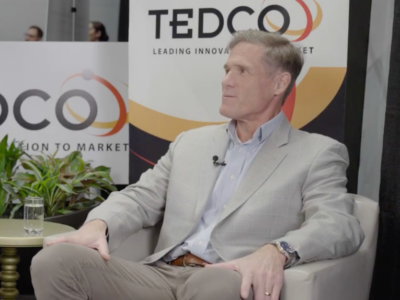
Fulton Bank’s Bret Schreiber discussed how Maryland’s life science companies can navigate the 2025 financial turbulence by leveraging the region’s strong community networks and adopting a “think differently” mindset, despite cuts in federal and venture funding.
The energy at the 2025 TEDCO Expo was unmistakable. With over a thousand companies filling the room, the event once again proved itself as one of the most important gatherings in Maryland’s innovation ecosystem. Amid the buzz of pitches and conversations, BioBuzz Networks sat down with Bret Schreiber, Senior Vice President of Life Sciences and Technology at Fulton Bank, to get his read on the state of startup capital, the power of community, and how companies & institutions can navigate an era defined by change.
A Bank Built for Early-Stage Innovation
Fulton Bank is a $34 billion financial institution operating across New Jersey, Pennsylvania, Maryland, Delaware, Virginia, and D.C. But within that large organization, Schreiber runs a specialty practice designed specifically to support early-stage life science and technology companies.
“We do debt and equity capabilities, and the idea is that we’re trying to serve a unique niche that other banks and funding entities aren’t really fulfilling in the state and region,” Schreiber explained. “We get in early with a company — we’re not going to be the first dollar in, but we can be very early stage. The idea is to surround that company with resources: capital, connections, and counsel on how to really grow and get to the next level.”
The results speak for themselves. Fulton Bank’s life sciences portfolio now stands at 220 companies, with over $67 million deployed in the last five years. In 2025 alone, the bank is on track to deploy $21 million, a new record.
“With over a thousand companies here, some of the greatest solutions to healthcare are probably sitting in this room somewhere. We just have to figure out ways to get them to market,” said Schreiber.
Watch the full interview here:
Survive to ’25 — and Beyond
Despite initial optimism for a strong year, 2025 brought unexpected turbulence to the startup community. Federal funding cuts to major agencies, shifting NIH policies affecting universities, and venture capital sitting on the sidelines have combined to create a climate of uncertainty that Schreiber acknowledges directly.
“Funding that did go up was only to two or three major deals,” he noted. “The amount of deals [in Maryland] has been cut in half. That shows some of that funding is still sitting on the sidelines.”
The disruption has been personal for companies in Fulton Bank’s own portfolio. One company saw $40 million in DARPA funding cut without warning. Another lost $26 million that was supposed to fund runway through 2027 when its investor ran out of capital. These aren’t abstract concerns, they’re the lived reality of companies navigating a rapidly shifting landscape.
Yet Schreiber is careful not to let concern tip into despair. “With some of that turbulence comes opportunity,” he said. “I think it’s an opportunity for companies to re-envision how funding should happen. It’s an opportunity for the corporate sector, which has traditionally been not very active, to become more active. And it’s an opportunity for foundations to reimagine how they do some things.”
The Network is the Lifeline
One of Schreiber’s most emphatic messages to founders is the irreplaceable value of community. He recalled a panel earlier in the day where, simply by being in the right room, he was able to mentally assemble a complete support pathway for an early-stage company — from the Maryland Department of Commerce and Prince George’s County Economic Development, to early-stage funders like Conscious Venture Partners, to established founders like Liz Clayborne of NasaClip, all the way to Fulton Bank.
“An old mentor of mine said the most dangerous place to view the world is from behind a desk,” Schreiber reflected. “MD sometimes suffers from the mindset of, ‘hey, we don’t have funding like Silicon Valley or Boston.’ But what we do have is tremendous resources and tremendous networks.”
That network acts a survival mechanism. When a company’s funding disappears overnight, it’s the relationships they’ve built that give them a fighting chance to pivot.
A Deep Partnership with TEDCO
Schreiber was effusive about the role TEDCO plays in the Maryland ecosystem, and his bank’s relationship with the organization runs deep. Roughly 80% of Fulton Bank’s life sciences portfolio is TEDCO-based. The two organizations actively refer companies to one another, and Schreiber hinted at a larger collaboration on the horizon.
“TEDCO is typically early-stage dollars in, and state and regions need those first dollars in,” he explained. “That enables entities like Fulton Bank to come from behind. We’re working with the CEO on some later-stage funding opportunities that hopefully can be announced at some point in 2026.”
For Schreiber, TEDCO isn’t just a partner, but it’s proof of what intentional ecosystem-building can accomplish. “The state is much better off because TEDCO exists to stimulate and catalyze the innovation ecosystem,” he said simply.
Think Differently
Asked what his core advice is for companies navigating 2025 and into 2026, Schreiber kept returning to one phrase: think differently.
“If you’re a life science company doing R&D, your product probably exists because you figured out how to think differently about something,” he said. “So for those of us trying to figure out how to survive in ’25 and into ’26, the key is to think differently.”
It’s a call to action not just for founders, but for every institution that touches the innovation ecosystem: banks, foundations, corporations, and state governments alike. The federal landscape may be uncertain, but Maryland’s strengths — its networks, its institutions, its talent — remain.
If you want to see the latest in innovation ecosystems firsthand, register for the 2026 TEDCO Innovation Expo today.