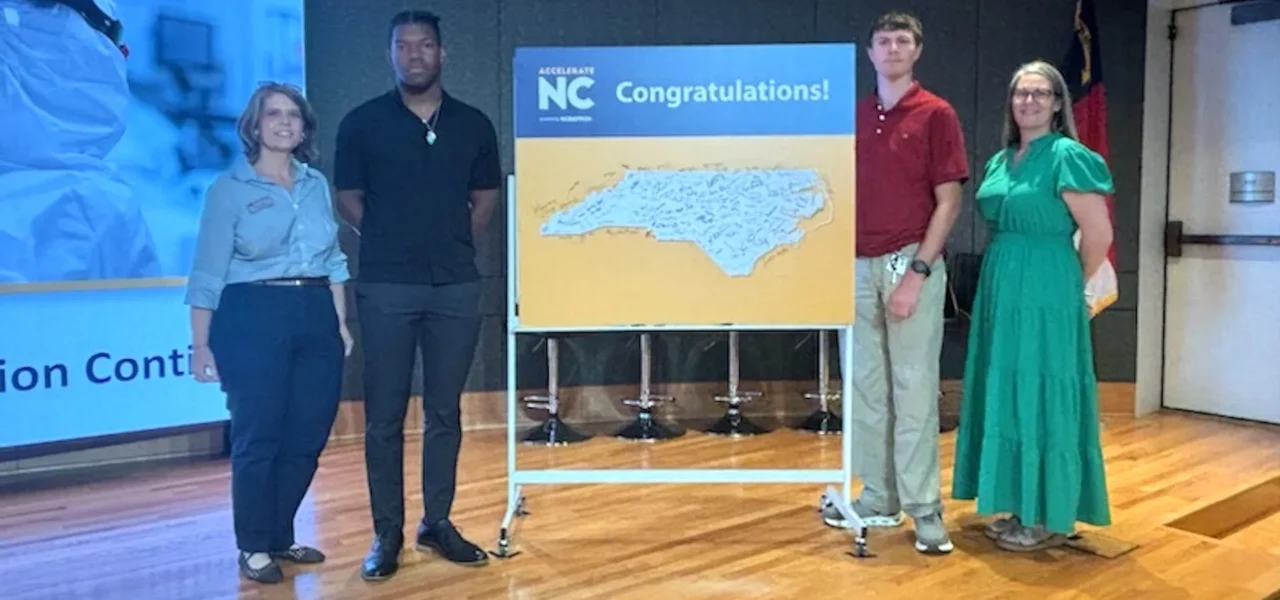
Zy’Ques Ingram, a Fike High School graduate, and Dillon Gay, a Wilson Academy of Applied Technology graduate, were celebrated on September 14, 2026 by the North Carolina Biotechnology Center at Research Triangle Park for earning BioWork certificates and becoming among the first Wilson County residents to land jobs as bio-manufacturing production technicians at Johnson & Johnson, recognized at the Accelerate N.C. Coalition and Career Celebration. Pete Goodridge, site lead for the two Johnson & Johnson plants under construction in Wilson, said: “We are really excited about the collaboration that we have seen in not only the greater Wilson area but also in North Carolina in general between Wilson Community College and NCBioTech Network. I am really hopeful that if we continue to partner with the various organizations here that we are going to be able to fill our pipeline. We are hiring over the next decade.”
Building a Pipeline for the BioPharma Crescent
BioWork is a course NCBiotech, Wilson Community College, and Wilson County Schools built together to produce a steady supply of qualified candidates, not just for Johnson & Johnson’s new biologics manufacturing facilities at Wilson Corporate Park but for the broader cluster of life sciences employers in what the state calls its BioPharma Crescent — Fresenius Kabi, Merck, Novo Nordisk, Grifols Therapeutics, Thermo Fisher Scientific, Catalent, and Reckitt among them. Ingram took his BioWork classes at night: “He was a Career and College Promise student, but he couldn’t fit BioWork into his schedule, so he would show up Monday nights from 6 p.m. to 10 p.m. after school just to take the BioWork class. He had a lot of drive and dedication to get through it,” said Stephanie Winstead, Wilson Community College’s biotechnology program coordinator. “He enjoyed the class. His instructor actually works at Johnson & Johnson and was a really good mentor for him and the entire class. It really did give him the extra drive to complete the class successfully, and it paid off.” Melissa Vandemark, dean of applied technologies at Wilson Community College, attended the career celebration and said the outcome validates years of work building the pipeline: “It makes us very proud to know that the hard work and dedication that the Wilson team has put in to having this class in the high schools and having traditional classes that the students go on to get that job. It gives you that warm feeling of success and helps us to see that all of the work that not only the students put into it, but also our instructors and staff, leads these individuals to their dream career and helps them find a job with a livable wage.”
A $36.4 Million Center and Numbers That Back Up the Pitch
Wilson Community College is backing up the individual success stories with a $36.4 million, 29,600-square-foot Biomanufacturing Education & Skills Training Center of Eastern North Carolina (BEST Center), now under construction at The Campus at 587 in Wilson County, with Winstead named as its new executive director. Wilson Community College President Jami Woods said: “We are especially proud of the students who completed BioWork training and have gone on to employment opportunities with Johnson & Johnson. Looking ahead, the BEST Center will further strengthen these efforts by serving as a regional hub for biotechnology education, workforce training and employer engagement.” Winstead said the school tracks outcomes closely: “We are seeing over 50% of our graduates from the BioWork class alone actually obtaining employment here in Wilson with Johnson & Johnson, Fresenius Kabi and Merck, so it is exciting, not just in seeing those success stories but also hearing those numbers as they evolve.” NCBiotech associate director of growth and engagement Pearl Sullivan pointed to the pay: “These are very well-paying jobs. I know 19-year-olds who have BioWork [certificates] and are making $67,000 a year. That is something that is frequently life-changing money, especially depending on where you are” — well above the roughly $200 cost of the BioWork course itself, which Vandemark noted the college helps cover through scholarships, and above the $55,000 median pay Sullivan cited statewide for certificate holders.