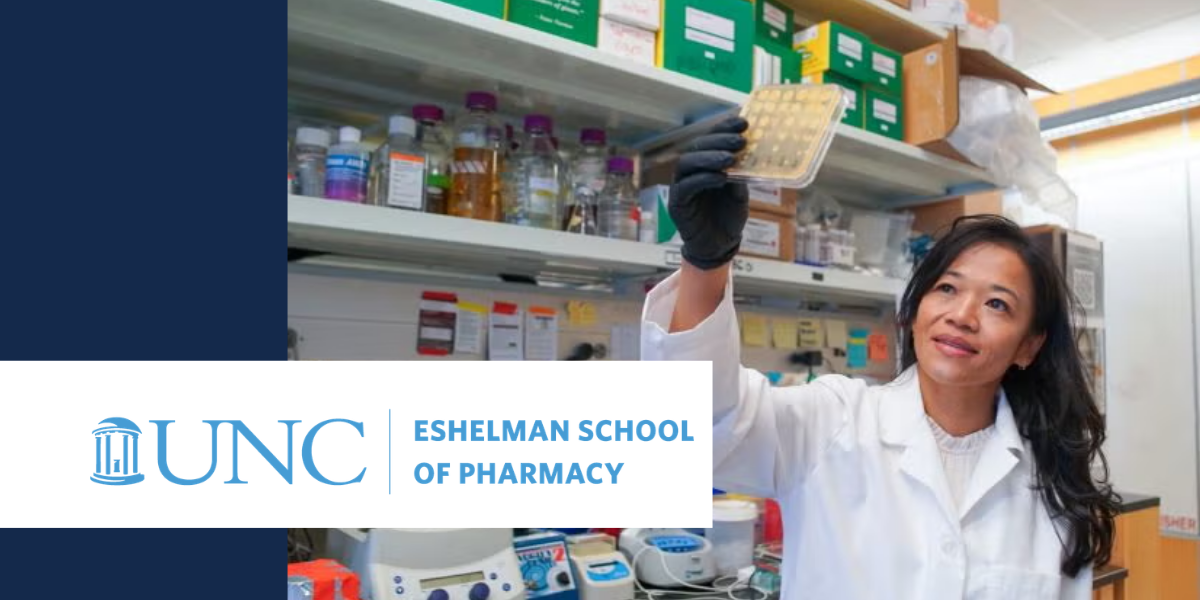
The UNC Eshelman School of Pharmacy has received funding from the National Institutes of Health to launch the C³ Drug Delivery Predoctoral Training Program. It’s a new cross-institutional T32 program designed to prepare the next generation of scientists to translate drug delivery innovations into real-world therapies. The program brings together UNC-Chapel Hill, North Carolina State University (NC State), and North Carolina Agricultural and Technical State University (N.C. A&T), the nation’s largest HBCU, to train PhD students to move drug delivery innovations from concept to clinic to commercialization (C³).
“The vision behind the C³ predoctoral training program is to rethink how we prepare the next generation of translational scientists,” said Juliane Nguyen, PhD, professor and vice chair in the Division of Pharmacoengineering and Molecular Pharmaceutics at the UNC Eshelman School of Pharmacy. “By bringing together the complementary strengths of three outstanding public research universities, we can create a training environment that no single institution could provide on its own. We want trainees to think beyond traditional disciplinary and institutional boundaries and develop a broader understanding of how scientific discoveries can ultimately make an impact.”
Three Universities, One Translational Pipeline
Nguyen serves as program director alongside three co-directors:
- Edwin Kim, MD, MS, associate professor of pediatrics and medicine at the UNC School of Medicine
- Harvinder Gill, PhD, Ronald B. and Cynthia J. McNeill Term Professor in Nanomedicine at NC State
- Yeoheung Yun, PhD, professor of bioengineering at N.C. A&T
The T32 program is part of the NC TraCS Institute at UNC-Chapel Hill. NC State and N.C. A&T are longstanding NC TraCS partners helping advance the NCATS vision of delivering more treatments to all people more quickly.
“This collaboration is particularly timely as N.C. A&T launches the nation’s first bioengineering PhD program at an HBCU and advances toward R1 research status, creating exceptional opportunities for doctoral students to engage in interdisciplinary research and translate biomedical innovations from discovery to clinical and commercial applications,” said Yun.
From Concept to Clinic to Commercialization
The C³ Drug Delivery Predoctoral T32 Training Program will support 25 PhD students over five years. The program will provide interdisciplinary training in drug delivery, translational science, new approach methodologies, biomanufacturing, clinical research, entrepreneurship, and commercialization. Trainees will gain experience navigating the full translational pathway, from identifying unmet clinical needs and developing therapeutically relevant solutions to understanding regulatory, manufacturing, intellectual property, and commercial considerations.
“The students will learn cutting edge principles of nanomedicine and learn to apply interdisciplinary knowledge to solve challenges facing human health,” said Gill. “They will be ready to evolve into the next generation of scientific leaders.”
Building Connections Beyond Institutional Boundaries
“What excites me most is bringing trainees from these three institutions together so they can learn from one another, build relationships, and break down barriers across disciplines and institutions,” said Nguyen. “My hope is that C³ will not only prepare outstanding translational scientists but also foster lifelong connections and professional networks that extend beyond traditional institutional boundaries and shape how they collaborate, innovate, and lead throughout their careers.”