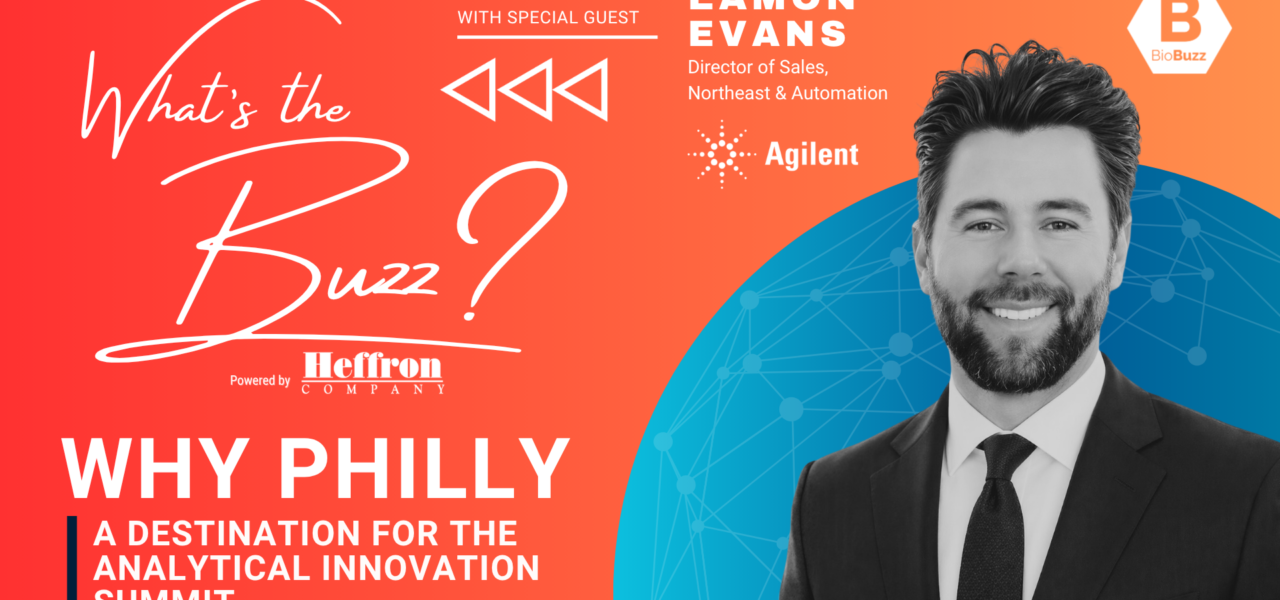
Automation, high-resolution mass spec, and digital workflows are reshaping the modern QC lab — and this September, Agilent is bringing a first-of-its-kind event to the heart of it all: Greater Philadelphia.
In this episode of What’s the Buzz?!, Chris Frew sits down with Eamon Evans, Sales Director for the Northeast and Automation at Agilent Technologies, to unpack Agilent’s newly announced Biopharma Analytical Innovation Summit — its first ever in Philadelphia — and why the region’s density of pharma, CDMOs, and academic talent made it the obvious choice. Along the way, Eamon shares how automation and mass spectrometry are moving deeper into routine QC, and what labs standing up these technologies for the first time tend to get wrong.
This episode of What’s the Buzz?! is powered by Heffron Co., a leading mechanical and engineering contracting firm specializing in life sciences facilities across the Mid-Atlantic, and BioBuzz’s national annual sponsor.
Recorded LIVE — July 30, 2026
Key Takeaways
- A first-of-its-kind event: Agilent is launching its inaugural Biopharma Analytical Innovation Summit in Philadelphia on September 16, 2026 — a scaled-down, biopharma-focused version of what the company showcases each year at ASMS, its flagship mass spec conference.
- Who should attend: dedicated tracks on peptides, oligonucleotides, and proteins, but Eamon says anyone working in the analytical world — academic, biopharma, or otherwise — will get value from the live demonstrations and expert conversations.
- Why Philadelphia: a rare combination of major pharma (Johnson & Johnson, Merck, GlaxoSmithKline), a growing base of emerging biotechs and CDMOs, and a dense cluster of academic institutions — Temple, UPenn, La Salle, Drexel, St. Joe’s, Villanova, and the University of Delaware — that Eamon says rivals Boston, Cambridge, and New York in density, if not yet in scale.
- The region is still growing: recent investment including Eli Lilly’s Allentown operation, J&J’s billion-dollar plant, GSK’s $800 million expansion, and a new Merck facility in Delaware.
- Customer needs diverge by role: drug developers prioritize speed and deep analytical insight; CDMOs focus on method transfer, validation, and regulatory compliance at scale; QC labs need robust, reproducible, and simple-to-standardize workflows above all else.
- A real shift in the last two to three years: conversations have moved from pure performance and productivity gains toward automation, data integrity, digital workflows, and AI — with high-resolution mass spec now entering routine QC settings for the first time.
- Automation’s biggest wins: reproducibility, reduced physical strain on scientists doing manual sample prep, and — most often cited by customers — greater confidence in the resulting data.
- New solutions debuting at the Summit: Agilent’s 6230 time-of-flight mass spectrometer and a new Multi-Attribute Method (MAM) workflow designed to consolidate multiple quality assays into a single, more efficient test.
Guest Bio
Eamon Evans
Eamon Evans is Sales Director for the Northeast and Automation at Agilent Technologies, with close to 18 years in the analytical instrumentation industry. A Temple University graduate, Eamon began his career in a laboratory setting using Agilent instrumentation before joining the company and commuting to Agilent’s Wilmington, Delaware facility. He lived in downtown Philadelphia for five years early in his career and has spent much of his professional life working with pharmaceutical, biopharmaceutical, and CDMO customers across the Greater Philadelphia region.
About Agilent Technologies
Agilent Technologies is a global leader in analytical instrumentation, including mass spectrometry, HPLC, and automation solutions used across drug development, contract manufacturing, and quality control laboratories. Each year, Agilent showcases new products and workflows at major industry conferences such as ASMS (American Society for Mass Spectrometry). This September, the company is bringing a biopharma-focused version of that showcase to Philadelphia for the first time with its inaugural Biopharma Analytical Innovation Summit.
Resources Mentioned
- Heffron Co. (episode sponsor)
- Agilent Technologies
- Biopharma Analytical Innovation Summit (Philadelphia, September 16, 2026)
- ASMS (American Society for Mass Spectrometry) Conference, San Diego, June 2026
- Agilent 6230 time-of-flight mass spectrometer
- Multi-Attribute Method (MAM) workflow
- Temple University
- University of Pennsylvania
- La Salle University
- Drexel University
- Saint Joseph’s University
- Villanova University
- University of Delaware
- Johnson & Johnson
- Merck
- GlaxoSmithKline (GSK)
- Eli Lilly (Allentown, PA facility)
- Amir Lieba, Agilent application scientist (teased for next episode)
Transcript
Opening Remarks (00:00 – 03:10)
Chris: Good afternoon, everybody. This is Chris Frew with BioBuzz. Thank you for tuning in to another episode of What’s the Buzz, our podcast where we talk to ecosystem builders and industry leaders about what they’re doing to support their communities and grow not only the biotech industry but advance the science. Today, on episode number 58, I’m excited to welcome Eamon Evans, Sales Director for Northeast and Automation at Agilent Technologies. Eamon, welcome, thanks for joining.
Eamon: Chris, appreciate being here, thank you so much.
Chris: I’m looking forward to diving in — you’re building a really unique community around analytical innovation, and this seems to be one of those critical areas unleashing a lot of opportunity for companies these days.
Eamon: Absolutely. The analytical world is very vast — it covers a lot of equipment and application spaces. I’ve been in it for most of my career, and I’m happy to talk about some of what we have on the horizon at Agilent.
Chris: Agilent has been a leader in this space for a long time — I’ve been in the industry 22 years and have known your team’s work throughout. Before we jump in, I want to thank our annual sponsor for What’s the Buzz, Heffron Co. We talk to ecosystem builders on this podcast, and Heffron is the physical ecosystem builder — one of the leading mechanical and engineering contracting firms specializing in life sciences. Anywhere you drive in the Mid-Atlantic, there’s a good chance they were behind the facility and the mechanical engineering that made it successful. A special thank you to Colin and the whole Heffron team. So, Eamon — today’s episode covers automation, mass spec, and the modern QC lab, but we’re also talking Philadelphia. It was just announced last week that you’re bringing the Biopharma Analytical Innovation Summit to Philadelphia this September — your first ever launch here. Tell us about the event and why you chose Philadelphia.
Announcing the Biopharma Analytical Innovation Summit (03:10 – 05:54)
Eamon: Sure. Throughout the year Agilent attends a handful of big conferences to launch new products and show workflows to customers — a major one being ASMS, which took place in San Diego this past June, where we released new mass spectrometers and workflows. Not everybody on the East Coast can get to California to see what we’re launching, so we decided to bring essentially what we do at ASMS, scale it down, and focus more on our biopharmaceutical workflows. Philly’s a great spot — a very dense population of business, academic, and government folks who use this equipment. We’ll have extremely smart people there who can work directly with customers and show them how our products work and how we generate data. I couldn’t think of a better spot than Philadelphia.
Chris: Who should be in the room? What kind of departments or roles should attend a program like this?
Eamon: Anybody in the pharmaceutical or biopharmaceutical world right now. There will be specific tracks around peptides, oligonucleotides, and proteins, so anyone working with those molecules will benefit. But this equipment touches many different applications — if you’re at an academic institution, or just trying to learn more about mass spectrometry and HPLC, you’ll find value at the symposium. You don’t have to work for a biopharma company. If you have any type of work in the analytical world, come out, talk to us, and we’ll show you what we’ve got.
Why Greater Philadelphia (05:54 – 10:17)
Chris: You cover the Northeast — what makes Philly distinct, especially as an analytical community?
Eamon: I’d first say Philadelphia is a great city with amazing energy. I completed my undergrad at Temple University, started my career just outside the city in Delaware County, and lived downtown for about five years after graduation. After working in a lab setting using Agilent instrumentation, I landed a job with the company commuting down I-95 to our facility in Wilmington, Delaware. So personally, I love Philly — I wanted to get that out of the way. But in terms of the industry itself, Greater Philadelphia is unique because it’s not just a large life sciences hub, it’s a very connected one within a relatively small geographic area. You have major pharmaceutical companies like Johnson & Johnson, Merck, and GlaxoSmithKline, emerging biotech firms, and an array of CDMOs. One of the greatest strengths is the concentration of top-notch academic institutions — Temple, UPenn (one of the best schools in the country), La Salle, Drexel, St. Joe’s, Villanova, and the University of Delaware, less than an hour from downtown and close to our Wilmington facility. I work with people who graduated from all of these schools, and I see the diplomas on office walls when I visit customers in the area. I’d say the education options in Philadelphia rival Boston, Cambridge, and New York City — the density is genuinely impressive. But what really stands out is the level of collaboration: people move between organizations, share ideas, and face similar challenges, which creates an environment where innovation spreads quickly.
Chris: I want to echo that collaboration point completely — and when we say “Philly,” we really mean Greater Philadelphia, all the way out to Doylestown, Allentown, and down into Delaware. That density keeps growing too — Eli Lilly’s built a huge operation in Allentown, J&J has a billion-dollar plant, GSK has an $800 million expansion.
Eamon: Good energy. And Merck, same thing — a facility going up in Delaware. It’s a good spot to be. A lot of talent to choose from when hiring, and the education systems are excellent — I hear from folks who went to schools in the area, and they do very well finding jobs. We’re hiring people out of all these institutions, especially the University of Delaware given how close it is in Newark. There are other strong areas in the Northeast — Boston/Cambridge has one of the biggest install bases of companies and venture capital firms — but Philly’s pretty hot right now.
Different Customers, Different Needs (10:17 – 14:15)
Chris: With all that density, do you see the problems your customers are solving shift — drug developers, CDMOs, testing labs?
Eamon: Absolutely, each group has different needs. Drug developers are focused on speed and getting therapies through development faster — they need deep analytical insights from multiple angles and high-end, complex instrumentation. CDMOs share some of those priorities, but they’re really focused on helping their customers develop, validate, transfer, and run analytical methods to ensure product quality, regulatory compliance, and successful manufacturing — method transfer, consistency, and scaling is the name of the game. QC and testing labs are often one of the last touchpoints before a drug reaches the market, so speed, reproducibility, and compliance are vital, and instrumentation needs tend to be less complex than for drug developers and CDMOs — they want robust, reproducible performance above all. Across the board, customers increasingly want workflows that are easy to standardize, scale, and transfer.
Chris: Has that shifted compared to two years ago?
Eamon: I’ve been doing this close to 18 years, and yes, I’ve seen a gradual change. Two to three years ago, most conversations focused on performance and productivity gains — that’s why we saw a lot of smart features hitting the equipment. Those topics still matter, but today we’re hearing much more about automation, data integrity, digital workflows, and AI. We’re entering an era of high-resolution mass spectrometry in routine QC environments, which wasn’t common years back. In nine out of ten labs I walk into today, automation is top of mind — teams want to reduce manual steps, simplify compliance, and get deeper product insights without added complexity, using the resources they already have.
The Shift Toward Automation (14:15 – 19:02)
Chris: When a lab automates these processes, what are the biggest things you actually see change?
Eamon: One of the biggest improvements is reproducibility — when you automate repetitive preparation steps, every sample is treated the same way every time, without the variability you’d see from different people performing the same task. Another factor people don’t often mention: manual sample-prep tools can be very hard on the wrist, hands, elbows, and lower back, so automation can save scientists real long-term physical strain — I’ve walked into labs where people were wearing wrist braces from manual pipetting. Throughput often improves too, but most customers tell us the real value is greater confidence in their data — when results are more consistent, teams spend less time troubleshooting and more time on what matters.
Chris: Where does automation make the most sense for a company?
Eamon: It delivers the most value when labs are performing high-volume, repetitive tasks that require consistency — that’s where it saves time and money, reduces errors, and frees scientists for more valuable work. Some people fear automation replaces jobs, but organizations that think about it correctly redeploy their teams elsewhere rather than having them do repetitive, mundane tasks. That said, some labs want to over-invest and automate every step before they’ve fully optimized the process itself. Automation works best when it’s solving a clearly defined problem — start with the workflow bottleneck, then determine where automation makes the biggest impact, because some tasks genuinely require human intervention.
Chris: You’re hiring people for their brains — let them use their brains, and save their wrists.
Eamon: Exactly. And these automation tools pay themselves off pretty quickly.
Chris: Does automation help with method transfer, where a lot of time can get lost?
Eamon: It can significantly reduce variability by ensuring the same process is followed at every location, which makes method transfer smoother. But it’s not a substitute for proper documentation, effective training, or clear communication within the team — successful method transfer still depends on people understanding the methodology and intent behind it. The best outcomes happen when technology and strong process management work together.
Mass Spec Moves Into the QC Lab (19:20 – 22:43)
Chris: One topic at the Summit is mass spec moving into QC. Historically high-resolution mass spec has lived in specialty labs — what’s been preventing that move, and how is it changing?
Eamon: Mass spec has historically been costly, complex, and not built for the everyday bench chemist — especially high-resolution mass spec, which required specialized expertise and complex data review because these instruments generate massive amounts of information, using workflows that weren’t designed for routine QC. What’s changing is that the technology is becoming more accessible — instruments like our latest time-of-flight platforms pair powerful mass spec capability with streamlined software and guided workflows, so QC labs can gain the benefits of accurate mass analysis without needing a team of high-level mass spec experts. I don’t think we’re at a “push a button and get the result” stage — a mass spec is a measurement tool and you still need to understand how it makes the measurement — but the guided software and data integrity tools make it far less complex and better suited to fit within regulatory guidelines.
Chris: Agilent draws a big distinction between research-purpose workflows and regulated workflows — why does that distinction matter so much?
Eamon: Researchers and QC analysts have very different goals. Researchers want flexibility and freedom to explore data in new ways; QC needs — by regulation — consistency, traceability, and compliance. The software experience has to reflect those different needs. In QC specifically, users need simple, guided workflows that minimize risk and help them avoid a bad FDA audit — purpose-built software helps analysts focus on making decisions instead of navigating complexity. Vendors like Agilent need tools that can accommodate both.
Standing Up Mass Spec for the First Time (22:43 – 24:17)
Chris: For a QC lab exploring mass spec for the first time, what shouldn’t they underestimate?
Eamon: Many teams focus heavily on instrument implementation and underestimate the importance of overall workflow planning and data strategy. The landscape has changed a lot — back in the early 2010s, customers were focused almost entirely on what an instrument could do in terms of sensitivity, speed, and dynamic range, whatever was on a spec sheet. Today, customers are rightly more concerned with everything involved in getting from point A to point B — the instrument is only one piece of the puzzle. Success also depends on having the right methods, standardized processes, and supporting software tools. The labs that plan out the entire workflow from the start tend to have the smoothest adoption.
Showcasing New Solutions: The 6230 TOF and MAM Workflow (24:17 – 27:15)
Chris: At the Summit you’ll be showcasing new solutions rolled out over the past several months, including a new MAM solution. What problem in biopharma quality does that address?
Eamon: This was an ASMS release — our new 6230 time-of-flight mass spectrometer, a very robust tool building on a strong install base of previous models, paired with a new MAM workflow. Biopharmaceutical companies need more efficient ways to monitor product quality and critical quality attributes throughout development and manufacturing. Traditional approaches often require multiple different assays to answer different questions. A Multi-Attribute Method, or MAM, consolidates testing by providing a detailed view of product attributes within a single workflow, improving efficiency while delivering deeper insight into product quality — and there’s a real ROI story compared to running multiple individual workflows on separate equipment.
Chris: What makes that different from traditional approaches like peptide mapping?
Eamon: Traditional peptide mapping is complex and has mostly been used as a characterization tool by scientists. Agilent’s vision is to make MAM more practical and accessible for routine regulated environments — emphasizing workflow simplicity and consistent software tools that support QC operations, which is the piece that has to satisfy regulatory requirements. The goal is to help organizations move from generating complex data to generating actual, actionable quality insights that support everyday decision-making.
Why Being in the Room Matters (27:15 – 31:07)
Chris: This Summit is in person and hands-on, with live instrument and software demonstrations. What can attendees experience there that a product sheet just can’t show them?
Eamon: A data sheet is just a piece of paper with specifications on it — it can’t show you what the actual user experience is like. At a live demo, attendees can see how a workflow actually runs, how intuitive the software is, how quickly results are generated, and how the pieces fit together. They can ask questions in real time and connect what they’re seeing to the challenges in their own labs. I’ve always pushed customers to visit one of our demo facilities to see the products in action — it really drives the point home, and we’ll have really smart Agilent people there showing how everything works.
Chris: So customers can bring their problems and challenges to talk to your experts live. What else should they bring on September 16th?
Eamon: Bring your toughest analytical challenge. Whether it’s a method transfer question, an automation question, modernizing QC instrumentation, data management, or new technologies like accurate mass or MAM — those real-world challenges lead to the best conversations. It’s a great opportunity to speak directly with our experts, see solutions in action, and leave with ideas you can implement immediately.
Chris: The local community element matters too — great ideas come when analytical colleagues, whether in formulation, analytical, or QC, come together around similar problems. And for smaller companies, there are great incubators and accelerators across Greater Philadelphia that could benefit from seeing what’s available.
Eamon: Exactly — get out and network. If you’re having a problem, there’s a good chance somebody else at the event has the same one. Building your network, meeting new people, talking to Agilent experts, seeing what’s new on the market — it should be a really fun event. If all goes well, we’re hoping to expand it to other cities across the US.
Chris: We want you to stay in Philly as long as possible — it’s right in the middle of the East Coast, so you’ve got your territory covered either way. At BioBuzz we’re a community-powered organization, and we believe the best solutions come when people are brought together, so September 16th should be a great day for that.
Closing Remarks (31:07 – 33:56)
Chris: Thank you for your time today.
Eamon: We’ll be there, ready to go, and happy to see everyone who comes out.
Chris: We’re proud to partner with you and the whole Agilent team for this event, and all year long. We’ll be promoting this Summit for the next several weeks — in fact, next week we have another Agilent guest on the podcast.
Eamon: Amir Lieba — my boss, he’s next.
Chris: Why should people tune in next week to hear from Amir?
Eamon: Amir’s a great guy, love working for him — he bleeds Agilent blue. He has a ton of experience, not just in pharma, but as a very talented application scientist in metals testing across the environmental and semiconductor spaces. He and I worked together when I was an account manager and he was an application scientist selling our atomic spectroscopy instrumentation — that may not be a topic at the September event, but he has a wealth of experience and is well respected in the industry. Ask him all the tough questions.
Chris: I saved all the tough questions for him. Thank you for your time today — I’m excited for the 16th. Registration is limited and open now; we’ll put the link in the show notes, and it’ll also go out in the BioBuzz weekly newsletter. Thank you for being part of today’s show.
Eamon: Chris, thank you very much, really appreciate it — we’ll see you soon.
Chris: Thank you all for tuning in, and we’ll see you next week for another Agilent-oriented podcast about the Innovation Summit. Thank you.
About What’s the Buzz?!
What’s the Buzz?! is BioBuzz’s interview series spotlighting the ecosystem builders, executives, investors, and subject-matter experts shaping the future of life sciences. Hosted by Chris Frew, CEO of BioBuzz Networks, and powered by Heffron Co., the series features candid, one-on-one conversations exploring industry trends, workforce development, commercialization pathways, and the people and partnerships driving the sector forward.
🔔 Subscribe for more conversations with the leaders, innovators, investors, and ecosystem builders driving the future of life sciences.
→ YouTube: https://www.youtube.com/@BioBuzz
→ LinkedIn: https://www.linkedin.com/company/biobuzz/
→ Website & Newsletter: /contact/
#LifeSciences #Biotech #Philadelphia #Agilent #Automation #MassSpec #QualityControl #WhatsTheBuzz #BioBuzz