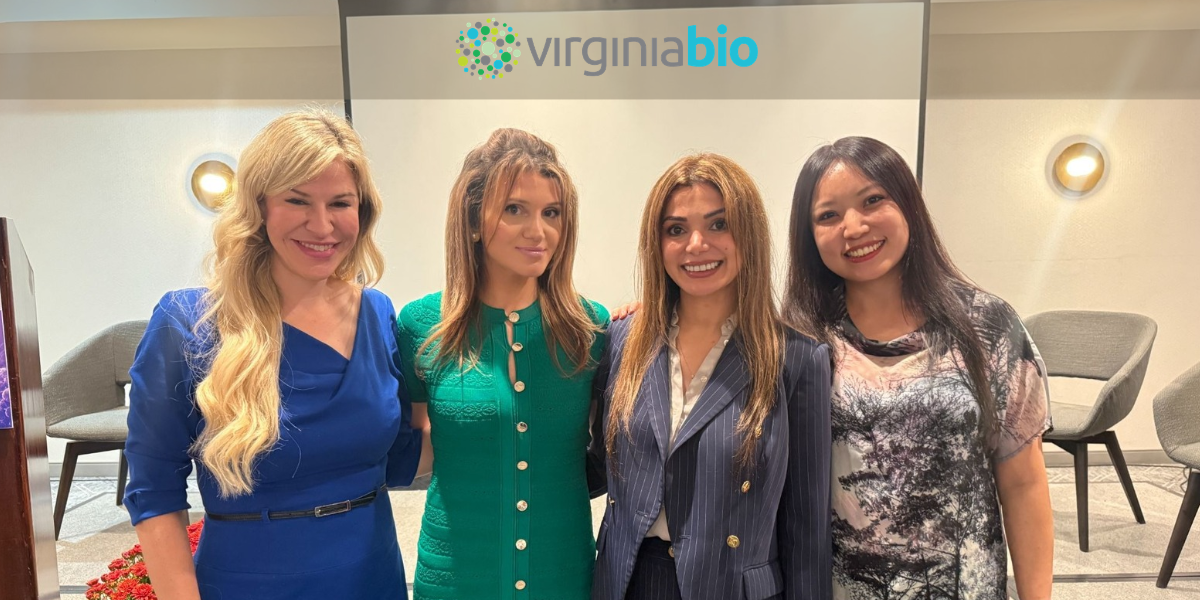
At Virginia Bio’s annual Women Building Bio evening, a VC keynote on what investors really want set the stage for three founders pitching solutions born from lived experience.
When Deborah Hemingway introduces herself as a venture capitalist, she usually gets one of three reactions: a blank stare, a barely concealed glare, or open surprise. At Virginia Bio’s Women Building Bio 2026, held October 29 at the Sheraton Suites Old Town Alexandria, she walked a room of founders, investors, and life sciences leaders through all three, then closed with a challenge for the entire region.
“If you’re on the outside looking in, they don’t see the lines that we see,” said Hemingway, Founder and Managing Partner of Ecphora Capital. “They just see a region.”
Billed as Connect. Dine. Innovate., the evening paired a cocktail reception and dinner keynote with a startup pitch showcase and closing networking reception. Caron Trumbo, Vice President of Operations at Virginia Bio, served as emcee.
The Blank Stare, the Angry Fist, and the Surprise
Hemingway joked that she may be the only person who got into venture capital by accident. She started by putting her own money into her own startups, moved into angel investing, and eventually launched a firm writing first institutional checks.
For founders who keep hearing “come back when you’re further along,” she offered a reframe: if a VC funds companies at your stage and in your space but still passes, that’s a data point worth decoding. Investors are looking for de-risked opportunities, she explained, and founders can build that case with real market evidence from customer discovery (she pointed to the NSF I-Corps program as a strong starting place), technical feasibility, IP protection, a clear path to exit, and a team built to persevere.
The “angry fist” came from a story about a recent event where the speaker just before her told the audience the region needed more investors, just not venture capitalists, because they’re greedy. Her response to the room: “He’s half right.” Returns matter, she said, but they aren’t enough on their own. The winning formula pairs that drive with genuine passion for bringing medical innovation to market. She also urged founders to make sure they’re aligned with investors on economics, control, and timeline before anyone signs.
The surprise, she said, often comes from meeting a woman with a big personality who runs a fund. Women remain a small fraction of venture fund leaders (18.6%), and she’s been asked more than once whether she’s the secretary. Her advice was to build around complementary strengths. Her partner loves the paperwork she dreads, and she loves the rooms he’d rather avoid.
That philosophy started years ago, when she was a new mom finishing her PhD at the University of Maryland while leading a startup. A neighbor’s teenage daughter began coming over once a week to do her laundry, and it turned out to be the highlight of the teen’s week. “Outsource absolutely everything I can, and only do the things that only I can do,” Hemingway said. She’s not a supermom, she added. She’s a super outsourcer.
Three Founders, Three Problems They Know Firsthand
The pitch showcase, introduced at last year’s event, returned after a strong response from attendees. Liz Powell of G2G Consulting and Women’s Health Advocates hosted, with judges Shalanda Armstrong of 100KM Ventures, Idong Essiet-Gibson of She’s Independent Investments, and Suman Rao of Lumira Ventures, who flew in from Toronto that morning.
Elizabeth Tikoyan, Founder and CEO of Healp, spent more than a decade with a debilitating condition and saw over 30 physicians, despite growing up 30 minutes from the NIH. The breakthrough came from a mom at her school who recognized the symptoms from her own daughter’s experience. “Healp is what that mom did for me at scale,” Tikoyan said. Her AI platform matches patients still searching for answers with people who have already been diagnosed, along with the labs and specialists that helped them. Healp has roughly 100,000 users across 70 countries, most of them Gen Z, and Tikoyan is seeking health system and university pilot partners as she prepares to open a seed round. “I don’t want luck to be the reason why someone got a diagnosis,” she said.
Ran Yang, CEO of iRays, traced her company to a question from her husband, an EMS chief with 26 years on the front lines: medics have an ECG for the heart, so why are they still using a penlight to guess about the brain? iRays is developing a handheld, contact-free pupillometer that gives first responders objective neurological readings in seconds, with no cloud connection required. The company is conducting human testing with City of Hampton Fire & Rescue and has support from NSF I-Corps, NIH, and VIPC. Judges pressed Yang on manufacturing costs and pricing as the company plans a lighter version for broader markets.
Hannah Kalantari, Founder and CEO of Panama Health, is tackling a problem she saw up close as Chief Marketing Officer of precision medicine company Persona Biomed: data trapped in silos across labs, manufacturers, and clinics. Pairing that experience with a background in software engineering, she’s building a federated AI operating system that lets institutions train models together while protecting their data and IP. Panama Health is building a federated AI operating system that lets institutions train models together while protecting their data and IP. Founded in April 2026, the company already has a proof of concept and two signed LOIs. Kalantari also pitched on her birthday, noting she was now officially one year more experienced.
Building as One Region
The evening closed with a networking reception, but Hemingway’s message carried through it. The region already has the founders, the science, and a growing base of investors. Maryland, DC, and Virginia, she argued, are strongest when they build together. “That’s how we’re gonna succeed,” she said, “and that’s how we’re gonna win in 2027 and beyond.”
The same idea drives BioBuzz’s BioCatalyst workforce program: no one builds a career in life sciences alone. Whether you’re a founder looking for the right investor or a student looking for a first role, progress comes from mentors, community, and connections that cross state lines. BioCatalyst brings employers, students, and the wider ecosystem together, including through Career Catalyst, a free weekly virtual series held Wednesdays at 6 PM ET. Each session pairs students, recent graduates, and early-career professionals with an industry expert for practical career guidance and a chance to connect with peers. The broader community will gather at BioCatalyst LIVE! on December 3 at 4MLK in the University of Maryland BioPark.
Learn more about Virginia Bio’s upcoming events and how your organization can get involved.
Women Building Bio 2026 was made possible by Silver Sponsors Activation Capital, VWR (part of Avantor), and VIPC; Table Sponsor Haleon; Community Sponsors Altria, DPR Construction, G2G Consulting, Medmarc, Pfizer, We Work for Health, and Finnegan; and Supporting Partner Women In Bio – Capital Region.