The NC Life Sciences Organization‘s Biotech Manufacturers Forum met September 23, 2026 to tackle a question raised at its August site leadership dinner: does North Carolina have enough biomanufacturing workforce to meet demand, and where are the gaps?
Bill Monteith, NCLifeSci’s program manager for the forum, opened the workforce session by pointing to the format itself as a differentiator for North Carolina. While speaking on a panel at the International BIO Conference in June, he had representatives from Georgia, Oregon, Texas, Massachusetts and Maryland ask how North Carolina gets industry and academic partners to sit at the same table on workforce planning. No other state represented on the panel reported doing this routinely, he said.
A State Still Growing Faster Than Expected
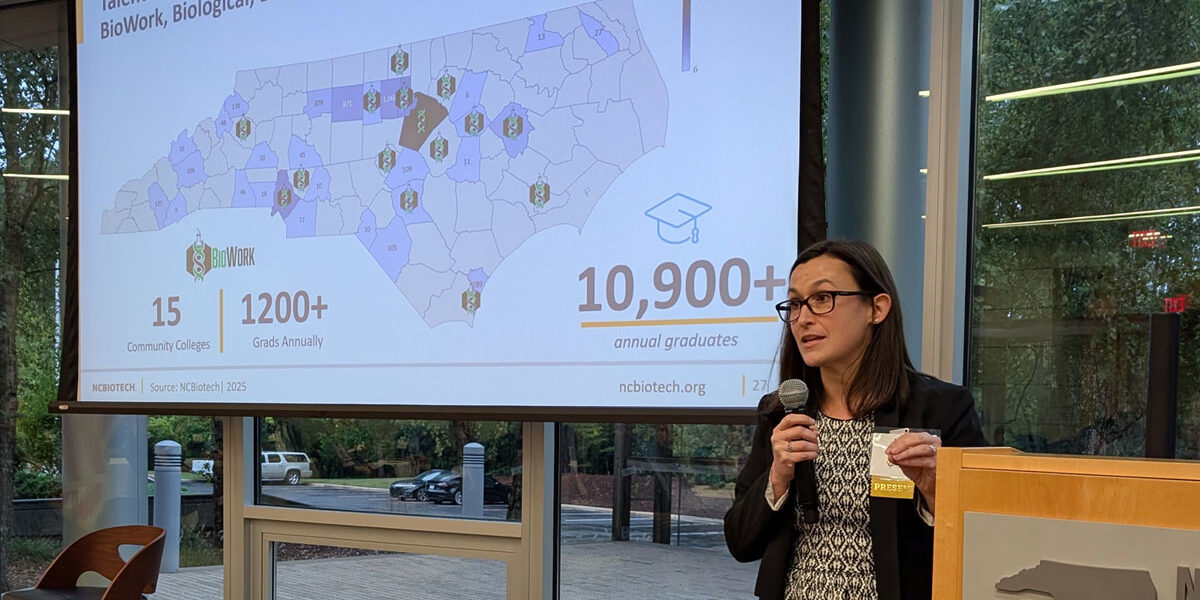
Laura Rowley, PhD, Vice President for Life Sciences Economic Development at NCBiotech, opened with the numbers: North Carolina is home to 860 life sciences companies employing 76,000 people directly, with manufacturing employment now topping 34,800 people, up from zero in 1974. Weighing the state’s talent pipeline — roughly 12,000 potential life sciences hires a year, between BioWork certificate graduates and biological/biomedical/engineering degree completions — against 10,600 new jobs announced since 2022, Rowley calculated about 8,000 jobs left to fill over a typical five-year hiring horizon, or roughly 1,600 a year. “Not every graduate is ready for every posted role,” she cautioned, even as she called the pipeline broadly positioned to support that demand.
Where Hiring and Retention Are Actually Breaking
Christie Weaver, Senior Director of the BioNetwork Capstone Center, presented a hiring pulse survey of 21 site heads and HR leaders: 65% called hiring somewhat difficult overall, with engineering — especially automation engineers, named by 57% of respondents as their hardest role to fill — topping the list of hard-to-hire functions. On retention, early-career employees proved hardest to keep, and 74% of respondents said specific skills, from automation and control systems to critical thinking and communication, are missing or limited in the NC market.
Policy Watch and What’s Next
Laura Gunter, NCLifeSci’s President, briefed the group on legislative activity, including a state budget that boosted NCBiotech funding but left new tax exposure for pre-revenue companies after North Carolina declined to adopt a federal R&D expensing fix. She also flagged pending “most favored nation” drug pricing settlements and a proposed federal rule that would add political review to grant decisions. The forum’s Q4 2026 meeting is set for Nov. 3, focused on regulatory benchmarking and AI compliance trends.