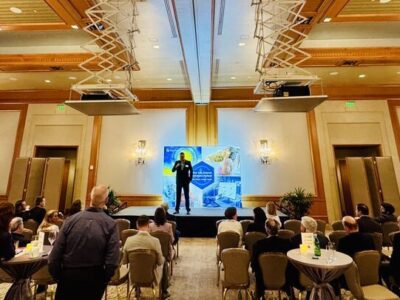
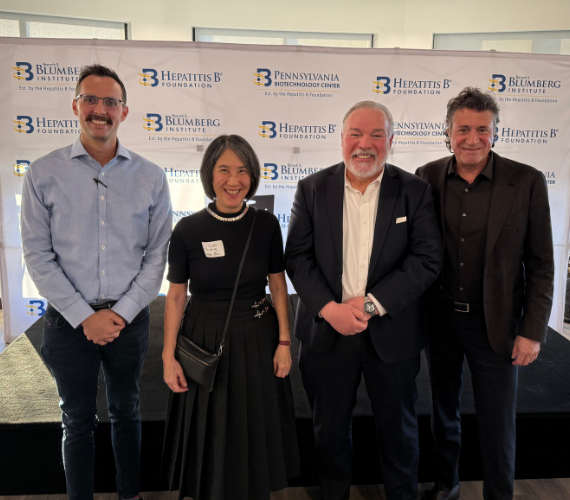
In a region long recognized as the “Pharma Belt,” audience of entrepreneurs and industry leaders gathered at the Pennsylvania Biotechnology Center (PABC) to hear four industry veterans dissect the forces transforming biotech and pharma today. The program — hosted by PABC and the Hepatitis B Foundation through BioBuzz — brought together a powerhouse panel of industry veterans who together have raised well over $1B in capital, grown several companies, negotiated multiple exits and commercialized several products.
Grant Castor, Sr Vice President Commercial Strategy & Operations, Sentynl Therapeutics (Moderator)
Lillian Chiang, Founder and CEO of Evrys Bio
Osvaldo (Lalo) Flores – VC Partner & CEO of a Stealth Mode Biotech, Former CEO of Century
Renold Capocasale – Founder & CEO of Incite Health, Former Chair and CEO of FlowMetric
What followed was a candid, often sobering, and ultimately optimistic dialogue on how global pressures, entrepreneurial resilience, and evolving capital markets are reshaping biopharma’s next chapter.
Chari Cohen, President at Hepatitis B Foundation welcomed guests with a reminder of their mission and that they do are impacted by the headwinds we face in industry and encouraged that by sticking together and strengthening our community around science and innovation we would persevere.
The Global Reordering: A Biotech Supply Chain in Flux
Castor set the tone by zooming out to the global stage, highlighting how geopolitical shifts — tariffs, the Biosecure Act, and growing scrutiny of cross-border partnerships — are forcing companies to rethink where and how they operate.
Dr. Chiang described the delicate balance for early-stage firms like hers, which rely on a global network of contract research organizations: “We’ve had to slowly move manufacturing and research activities out of China, into India, Europe, and Canada. It’s not a matter of politics — it’s about resilience and access.”
For Capocasale, who’s built and sold a CRO and now runs a diagnostics company, the cost gap between U.S. and overseas operations remains a structural challenge, but cost isn’t the only factor. “We were always hearing that you get what you pay for in China,” he shared. “We always hear that the type of work and assays that we do is better here in the U.S. than what was coming out of China. But we simply can’t compete on cost. That’s the reality.”
Lalo, who is now building his next biotech company and is also an investor, was more direct. “Our ecosystem depends on China — not just politically, but practically,” he said. “We don’t have the capacity here to support the entire biotech industry. The system is global whether we like it or not.”
However, a clear distinction was made by Lalo between non-GMP early research work where Chinese CROs provide unmatched speed and efficiency, versus regulated manufacturing or advanced biologics work, which he agrees should stay local for quality and compliance reasons.
Their shared conclusion: the biopharma supply chain isn’t decoupling — it’s diversifying. The new advantage will lie in flexibility, transparency, and the ability to pivot across geographies as policy and logistics evolve.
Resilience and Reinvention: The Entrepreneur’s Edge
If the first theme was about navigating uncertainty, the second was about surviving it.
Capocasale spoke of resilience as a matter of both mindset and adaptability. When a non-compete agreement forced his lab to pivot, he moved from a traditional CRO model to molecular diagnostics and pharmacogenomics. “Resilience means you can turn on a dime,” he said. “We cracked the code on reimbursement, learned a new business model, and found growth in the process.”
For Chiang, resilience came from building a company on grant funding instead of venture capital. “When I started Evrys Bio, I told my investors I’d raise one grant dollar for every investor dollar,” she said. “We’ve now brought in over $50 million in non-dilutive funding. It teaches discipline — running on revenues, not a bucket of money.”
Lalo reflecting on raising $800 million during biotech’s “go-go years,” offered a pragmatic view for today’s founders. “Capital efficiency and focus are everything now. Work on real problems. Validate fast. Move faster. Discipline is the new differentiator.”
The Capital Crunch and the Case for Optimism
The conversation turned toward capital markets — a reality check for founders feeling the funding freeze.
While many lamented a “dark time” for early-stage investment, Lalo pushed back on the pessimism: “There’s still a remarkable number of new funds being raised. The issue isn’t capital — it’s conviction. Investors want proof of concept in people, not just in models. Mature data, real impact.”
Capocasale noted a surge of international interest: “U.S. companies are attractive right now, especially to European and Asian buyers. You have to stay open to that.”
Chiang added that for infectious disease innovators, government partnerships remain indispensable — and cyclical. “The U.S. always retreats after pandemics,” she said, “but another will come. When it does, government support will return. It’s not if, but when.”
A Local Call to Action
The event closed on a familiar but urgent theme: strengthening the local biotech ecosystem. The panel agreed that Pennsylvania’s policy and community infrastructure still lag behind hubs like Boston and San Diego — not for lack of talent, but for lack of connection.
“We have more talent here than anywhere,” Castor said. “But we’re siloed. We need to bring the bolus of talent together.”
Flores echoed the point: “Cambridge thrives because success breeds success. We need more wins here — founders reinvesting, mentoring, and building again. That’s how you create gravity.”
“Executive Insights from the Pharma Belt” wasn’t just another panel event — it was a reminder. Against a backdrop of global realignment and economic caution, the leaders gathered at the Pennsylvania Biotechnology Center reminded the community that the region’s greatest asset isn’t capital or infrastructure, but conviction.
As Chiang put it best: “We’ve been working on the same hard problem for 12 years — and we’re still here. That’s resilience.”