
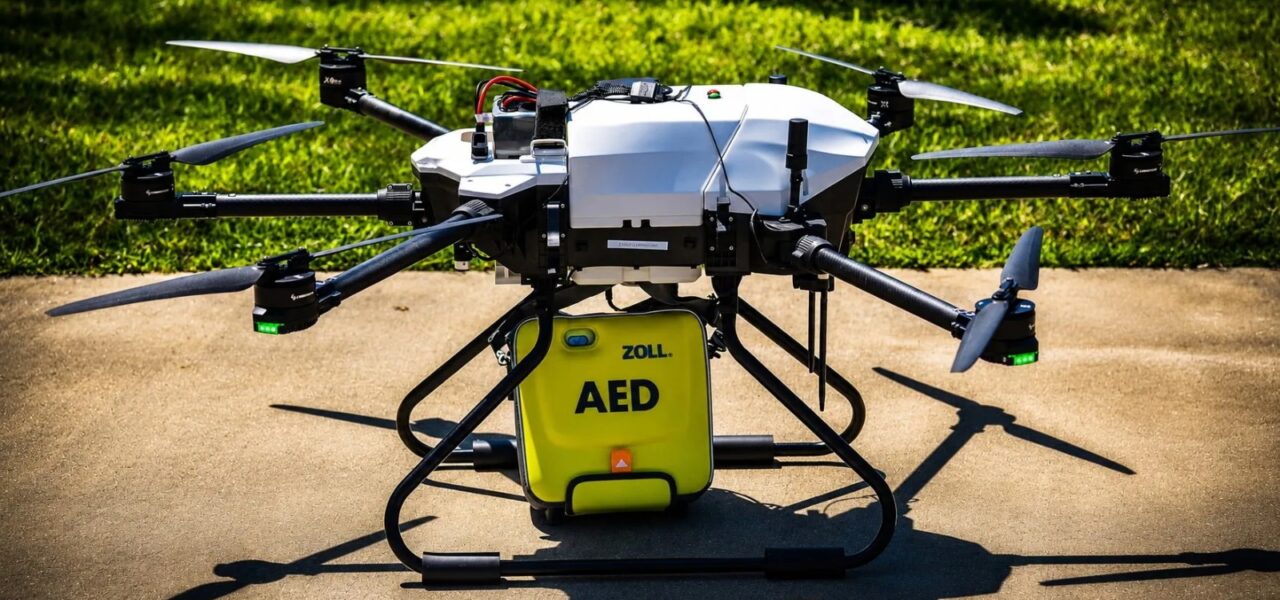
James City County Police Chief Mark Jamison and Fire Chief Ryan Ashe are pleased to announce the County’s first successful drone deliveries of Automated External Defibrillators (AEDs). The milestone is part of a research collaboration funded by the American Heart Association (AHA), with Duke University and Virginia Commonwealth University (VCU) serving as the study’s lead institutions. The project aims to evaluate whether drones can improve cardiac arrest outcomes in rural communities.
When a cardiac arrest is reported, a drone carrying an AED may be dispatched alongside first responders to determine whether it can deliver lifesaving equipment more quickly and increase the likelihood that bystanders begin treatment before emergency personnel arrive. The American Heart Association emphasizes that early CPR and rapid defibrillation are critical links in the Chain of Survival. Research shows that every minute defibrillation is delayed decreases survival by approximately 7–10%.
Early test flights showed promising results. In one example, an AED delivered by James City County’s Air10 drone reached a residence in 2 minutes and 30 seconds. The Fire Department’s average response time to the same area is 8 minutes and 6 seconds, meaning the AED arrived 5 minutes and 36 seconds faster than traditional responders. Findings like these highlight the potentially significant impact of faster bystander intervention facilitated by drone delivery.
“These early results show what this technology might be able to do for our community,” said Police Chief Mark Jamison. “This is about using every tool we have to keep people safe. We’re excited to keep learning from these tests.”
“In cardiac arrest, minutes matter,” said Fire Chief Ryan Ashe. “If we can get an AED to a bystander faster, that’s a win. These trials are helping us understand how drones can support our firefighters and medics in real emergencies.”
Dr. Joseph Ornato, a professor in VCU School of Medicine’s Department of Emergency Medicine added, “The earlier an AED is used, the better the chance of survival. These tests show how drones could give rural communities a critical head start in saving lives.”
“Drones aren’t replacing first responders—they’re extending our reach,” said Dr. Monique Starks of Duke University. “Getting an AED to someone even a few minutes sooner can make a real difference.”
James City County is the first locality in Virginia—and only the second in the United States, alongside Forsyth County, North Carolina—to conduct real-world AED drone delivery trials as part of the RESTORe–CARE clinical study.
The AED drone delivery effort is entering a pilot phase beginning August 1, following three testing phases. James City County is currently in Phase 3—the final week of testing. During the pilot phase, drone dispatches will be limited to a five-mile radius surrounding James City County Fire Station 1 at 3135 Forge Rd. in Toano and will occur during limited hours as the County evaluates performance, reliability, and real-world response times. As testing progresses, the team will explore longer distances, additional drones, and future expansion based on results.
How It Works:
When dispatchers at the Peninsula Regional Emergency Communications Center receive a report of suspected cardiac arrest during pilot‑phase testing, they may send both first responders and an AED‑equipped drone. The drone lowers the AED by tether, and dispatchers provide clear, audible instructions to support bystanders with no prior training.
Background and Next Steps:
These trials are possible through the James City County Police Department’s Drone as First Responder (DFR) program, launched in April 2025 after receiving specialized FAA waivers. The DFR program enhances emergency response by providing real-time situational awareness and does not involve proactive surveillance.
The County will share updates as the study advances and will work with community partners to expand AED awareness and public education.
To learn more about the RESTORe–CARE study, visit https://restorecarestudy.org/.
Media Contact:
Patty Schlosser, Public Information Officer, JCCPD
757-259-5173; [email protected]