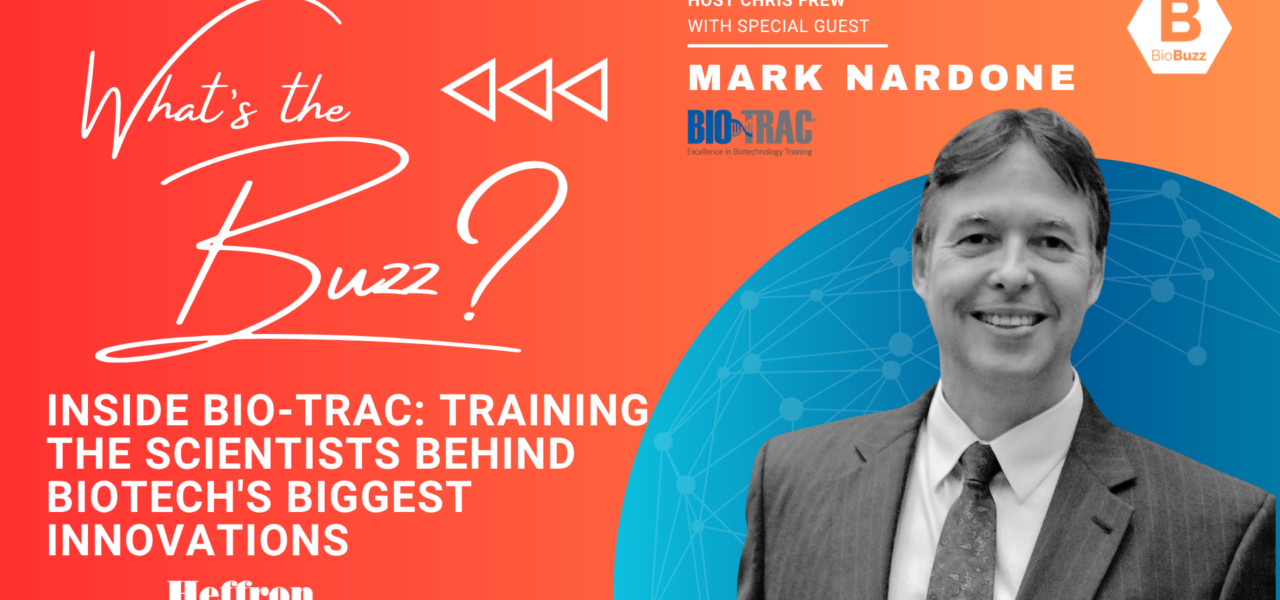
Science moves as fast as the people who practice it are trained to keep up with it. For 40 years, one Maryland-born program has made it its mission to keep bench scientists current — from the earliest days of recombinant DNA and hybridoma technology to today’s spatial transcriptomics, CRISPR, and organoid work.
In this episode of What’s the Buzz?!, Chris Frew sits down with Mark Nardone, Director and Co-Founder of Bio-Trac, to trace the organization’s path from a handful of NIH workshops in the late 1970s to a 40-year training institution now based at Montgomery College’s Bioscience Education Center. From the techniques currently in highest demand to the informal alumni network that keeps scientists connected long after a workshop ends, Mark shares what it takes to keep the region’s — and the country’s — scientific workforce at the cutting edge.
This episode of What’s the Buzz?! is powered by Heffron Co., a 104-year-old mechanical engineering and services firm specializing in life sciences and complex industries, known for its role in building some of the region’s most iconic life sciences facilities.
Recorded LIVE — July 15, 2026
Key Takeaways
- Origin story: Bio-Trac was founded in 1985 by Mark Ardone and his father, Dr. Roland Ardone, a Catholic University biology professor and tissue culture expert, growing out of hands-on workshops the two ran informally for NIH researchers in the late 1970s.
- Scale of impact: More than 19,500 scientists trained, over 1,200 workshops delivered, and 20-25 workshops run annually, alongside custom contract training for government, academic, and private-industry clients.
- Why Bio-Trac relocated after 30 years at NIH to Montgomery College’s Bioscience Education Center (BEC) in Germantown — and the industry-grade infrastructure that made the move possible, from mock CGMP suites to five flow cytometers and a cell sorter.
- Techniques in highest demand: CRISPR and gene editing, iPSCs, spatial biology and spatial transcriptomics, 3D cell culture and organoids, and flow cytometry — and how Bio-Trac tracks emerging science before demand fully materializes.
- An enduring scientific community: Bio-Trac’s instructor network (many with the program for 10-20 years) and shared class lists, with collaborations, papers, grants, and even job placements traced directly back to workshop connections.
- An earlier inflection point: Bio-Trac’s role in the NIH iPSC training initiative built with Dr. Mahendra Rao — and how Mark sees echoes of that moment in today’s organoid and regenerative medicine push at Frederick National Laboratory.
- Outreach beyond Bio-Trac: hosting the Maryland Science Olympiad, running monthly biotech symposium days, and organizing 2025 networking and job-fair events for displaced federal research scientists.
- A full pipeline vision: Montgomery College’s BEC as an end-to-end pathway — from an early college program for high schoolers to a state-sponsored apprenticeship with AstraZeneca and Charles River Laboratories — built to make biotech an accessible, debt-free career path.
Guest Bio
Mark Ardone Mark Ardone is Director and Co-Founder of Bio-Trac, an organization that has run hands-on scientific training workshops for research scientists for 40 years. Mark co-founded the program in 1985 with his father, Dr. Roland Ardone, then a professor of biology at Catholic University and an expert in tissue culture, after years of informal workshops the two ran for researchers at the NIH. Bio-Trac operated out of NIH facilities for 30 years before relocating to Montgomery College’s Bioscience Education Center in Germantown, Maryland, where Mark has also become a driving force behind broader workforce and community-building initiatives well beyond Bio-Trac’s own programming.
About Bio-Trac
Bio-Trac conducts hands-on training workshops for research scientists, focused on the latest techniques and methods across the life sciences. The organization runs roughly 20-25 workshops per year and takes on contract training work across every segment of the biotech ecosystem — government research institutions, private industry, and academic research institutions. Founded in 1985 and based at NIH for three decades, Bio-Trac has trained more than 19,500 scientists across over 1,200 workshops, and is now headquartered at Montgomery College’s Bioscience Education Center in Germantown, Maryland.
Resources Mentioned
- Heffron Co. (episode sponsor)
- Bio-Trac
- Montgomery College Bioscience Education Center (BEC)
- National Institutes of Health (NIH), including NIDDK and NINR
- FAES (Foundation for Advanced Education in the Sciences)
- Dr. Roland Ardone
- Dr. Michael Kelly, Director, Single Cell Core, NIH National Cancer Institute
- Dr. Mahendra Rao, former Director, NIH Center for Regenerative Medicine
- Frederick National Laboratory for Cancer Research (organoid/NAMS-related initiative)
- 10x Genomics
- AstraZeneca
- Kelly Government Services
- Millipore Sigma
- GSK
- Charles River Laboratories
- Maryland TEDCO
- Maryland Science Olympiad
- BioBuzz’s new jobs and community platform (BioBuzz.io)
- Agilent Technologies (teased for upcoming “Agilent Week”)
Transcript
Opening Remarks (00:00 – 03:30)
Chris: Good afternoon, everybody. This is Chris Frew with BioBuzz, back with another episode of What’s the Buzz — our interview series where we talk to ecosystem builders. These are the people and companies who really enable innovators and drug developers to move medicines forward and get them to the patients who need them. Today I’m talking with a good friend I’ve known for the better part of a decade or more: Mark Ardone, Director and Co-Founder of Bio-Trac. Mark, welcome.
Mark: Chris, absolute pleasure to be here. Before we jump in, kudos to you and BioBuzz. You’re the one who stirs the drink in this community — when people ask me who’s doing what in a given area and I don’t know, I send them straight to you. That’s one of BioBuzz’s real strengths.
Chris: We appreciate that, Mark. You’ve been coming to our events for a decade, and I’ve been coming to yours — the ecosystem that grows together, thrives together. Before we get into what you’re building at Bio-Trac, I want to thank our year-long sponsor, Heffron Co. — a 104-year-old mechanical contractor and service provider with one of the best safety and reputation profiles in the industry, and the team behind many of the iconic buildings you’ll see driving up and down I-270. Thank you to Colin, Tarek, and the whole Heffron team. So, Mark — today we’re talking about training the scientists behind biotech’s biggest innovations, because you can’t push science forward without scientists who have the cutting-edge techniques and understanding — and you can’t rely on what you learned in your PhD program five, ten, or twenty years ago. Before we dig in, can you give us your own introduction and a bit of Bio-Trac’s history?
Bio-Trac’s Origin Story (03:31 – 06:50)
Mark: Happy to. I’m Director and Co-Founder of Bio-Trac. We run hands-on training workshops for research scientists, focused on the latest relevant techniques — about 20-25 workshops a year — plus contract work across every segment of biotech: government, private industry, and academic research institutions. It’s a unique story. Bio-Trac started back in 1985 as a program my dad and I built together. My father, Dr. Roland Ardone, a professor of biology at Catholic University and an expert in tissue culture, had been running one-off hands-on workshops for NIH, NIDDK, and other institutes since the late 1970s. Leadership at NIH took notice, and by 1985 a formal agreement came together through FAES to contract with us to run these programs. We started in small spaces in Building 8, pulling lectures into the main conference hall of Building 10, running four or five workshops a year — tissue culture, hybridoma, PCR, recombinant DNA methodology. When it was clear this had legs, NIH built us a dedicated lab in 1989 in Building 60, “the Cloister” — the other half of the building was the Howard Hughes Medical Institute. Forty years later, we’ve trained more than 19,500 scientists across 1,200-plus workshops. We ran a Summer Genetics Institute for NINR, and for about 15 years we ran the Minority Student Faculty Partnership Program — a one-week hands-on workshop for third- and fourth-year students from HBCUs and Hispanic- and Native American-serving institutions, reaching more than 400 students and their mentors.
From NIH to Montgomery College (06:51 – 09:24)
Chris: A lot of good things come out of NIH that impact human health, and you’re clearly one of them. Tell us about the move — you’re not at NIH anymore. You’ve taken the program up the road to Montgomery College in Germantown.
Mark: We were at NIH for 30 years and eventually needed upgraded facilities beyond the basement of the Cloister. The state directed us to look at a few venues, including Montgomery College’s Bioscience Education Center — and when I walked in, my jaw hit the floor. There’s a mock CGMP lab, upstream and downstream suites, four industry-grade bioreactors, multiple sequencers, and — after the college supported a build-out — five flow cytometers and a cell sorter for our flow workshop. They’ve also built out smart, HyFlex classrooms so we can bring in remote participants or presenters from around the country for our NGS and bioinformatics workshops. During COVID we expanded further — one classroom alone now has nine biosafety cabinets, ten research-grade microscopes, and a confocal microscope. Scientists visit from prestigious institutions around the country and just start looking around, saying, “Mark, we don’t have this.” It’s a phenomenal setup.
Infrastructure, Engagement, and Why Scientists Come (09:25 – 13:17)
Chris: Infrastructure like that is so important to a thriving bio economy — and honestly, your training track record is its own kind of infrastructure. How do companies and individuals actually engage with Bio-Trac?
Mark: It’s a real mix. About 70-75% of our attendees are MD/PhDs, and 95% are active researchers, split fairly evenly across government, private industry, and academia. Roughly 60% come from the DMV region, 30% from around the country, and the rest from overseas. The reasons vary — upskilling and career advancement, research taking them in a new direction (funding-driven or science-driven), or resource pressure. I’ve looked out at a flow cytometry workshop and seen a lab chief I know sitting in the audience because budget cuts cost them staff and now they need the skill themselves. The constant theme is that people know the quality of instruction — we run a 95%-plus satisfaction rate, year in and year out, and the majority say they’d take another Bio-Trac workshop if it’s in an area they need. CRISPR is a good example of demand tracking science: since it emerged around 2012-2013, we’ve trained close to 600 scientists on CRISPR experiments through a full-immersion workshop.
Instructors and the Long Tail of Community (13:18 – 16:38)
Chris: It’s not just the technique or the information — the instructors and how people learn matters just as much. How do you find instructors, and do they stick around?
Mark: I have quite a few instructors who’ve been with us for 10, 15, even 20 years — a real testament to their buy-in. They’re not doing it for the money; they’re doing it for the interaction with other researchers. In a workshop like single-cell RNA-seq, you’ll have 15-20 scientists in the room coming from completely different fields — neuroscience, cardiomyocyte research, cancer — all converging on the same technique, and I get to sit back and hear how the instructors help them think through experimental design. Our workshop director for that course is Dr. Michael Kelly, Director of the Single Cell Core for NIH’s National Cancer Institute — that gives you a sense of the caliber we bring to the table. We also keep the conversation going after the workshop ends: we share the class list with the group, and our instructors remain resources for attendees three, six, even twelve months later. Word gets back to me about collaborations, papers, and successful grants that trace back to a connection made in one of our workshops — including someone I later found out was working in Mike Kelly’s lab at NIH after meeting him in a flow workshop.
What’s Hot Right Now (16:59 – 20:12)
Chris: You’re on the front line of this — what techniques are in demand right now?
Mark: CRISPR and gene editing remain hot, along with a real uptick in iPSC work, which I think partly reflects the NAMS initiative. Spatial biology and spatial transcriptomics are growing fast too — we’ve run a symposium with AstraZeneca in that space for about six years, and we’ve seen AI’s growing influence on that market as well. On the analytical side, 3D cell culture and organoids are very active — we have a three-day 3D cell culture workshop coming up, and we’re watching adjacent areas like organ-on-a-chip, CRISPR-organoid combinations, and spatial biology applied to organoids, including a spatial transcriptomics workshop we run with 10x Genomics. Right now it’s not a one-size-fits-all technique — it’s fit-for-purpose. And the staples like flow cytometry are still going strong, with advances like spectral flow cytometry finding new applications across immunology, cell and gene therapy, and antibody validation. I’ve had people tell me — as recently as a couple of months ago — that a Bio-Trac flow workshop directly enabled them to land a new role. A quick search of DMV job postings turned up over 500 listings asking for flow cytometry experience, which is a bigger number than I expected.
Organoids, Frederick National Laboratory, and Echoes of the iPSC Era (20:13 – 24:53)
Chris: You mentioned organoids — this region is a hotbed for that. Frederick National Labs just won a major government contract to advance organoid research, which has to be a great fit being right here in Maryland.
Mark: I’m already in conversation with them — they recently ran a strong event on reproducibility, which I’m passionate about: rigor, cell line authentication, cross-contamination, mycoplasma testing. I focused my input specifically on the organoid side of their SOM NAMS initiative. It reminds me of where stem cell research stood back in 2012-2013. We worked with Dr. Mahendra Rao, then Director of NIH’s Center for Regenerative Medicine, to build a series of iPSC-related workshops — neural, hepatocyte, cardiomyocyte, and other iPSC applications — training close to 100 scientists. The goal wasn’t just training; it was building a repository of protocols, recommended reagents, and other reference material that then opened up to the broader scientific community and fed collaborations between private industry and government. I see real parallels between that moment and what’s happening now around organoids at Frederick National Laboratory.
Chris: Does that kind of thing happen often — experts coming to you saying, “we’re seeing demand here, can we build something together”?
Mark: I’ve got a core group of 15-20 instructors who flag emerging interest areas, and we’re also watching the literature and where research is heading — though timing that is tricky. Back in the mid-1990s, we ran a nanotechnology-in-medicine workshop, and the first attendees were almost all regulatory staff; research scientists didn’t show up in force until four or five years later, once the field caught up. On the organizational side, we’ve done contract work for groups like Kelly Government Services — a bioinformatics workshop and a CRISPR workshop in 2024 — and custom trainings like a two-day Quality 101/201 program for roughly 200 employees at one company. If you don’t see something in our existing catalog, ask — we can usually find the right people and build exactly what’s needed.
Beyond Bio-Trac: Building Community at Montgomery College (25:50 – 29:47)
Chris: You go well beyond Bio-Trac itself — you’re practically the mayor of Montgomery College. What else are you proud of building there?
Mark: The college has given me the flexibility to do a lot of outreach. We’ve hosted the Maryland Science Olympiad for the last six or seven years, bringing out 400-450 high schoolers from 32-36 different schools for a high-energy competition. We also run MC Biotech Symposium Days roughly once a month (on hiatus over the summer, picking back up in the fall) — free events where a company brings out field application scientists and researchers to talk about their work, often with demonstrations, drawing anywhere from 40 to 100 scientists per event. But the initiative I’m proudest of came out of something I just couldn’t sit by and watch happen: in 2025, I organized networking and job-fair events for recently displaced federal research scientists. Having spent 30 years at NIH, I felt a real responsibility there. We brought in 10-15 area biopharma companies across two events, drawing more than 200 scientists total, who got CV reviews, professional headshots, and direct interaction with HR teams — all free of charge. The transition from an academic research CV to an industry one looks completely different, and these scientists needed to be seen, heard, and appreciated.
A Full Pipeline: The Montgomery College Ecosystem (30:10 – 35:06)
Chris: As we close, what else should people know about the ecosystem you’ve helped build at Montgomery College’s BEC?
Mark: I call it a unicorn — there’s nothing else quite like it. It starts with an Early College Program, where Montgomery County public school juniors and seniors take college courses alongside high school and graduate with an AS degree in biotech already in hand. Then there’s the two-year credit program, shaped in real collaboration with area biopharma — Millipore Sigma, AstraZeneca, GSK, Charles River Laboratories — who’ve directly influenced the curriculum. It’s heavy on hands-on training: twelve weeks growing mammalian cells in culture, aseptic technique, proper GMP practices, mycoplasma testing, cell line authentication, and record-keeping, followed by downstream purification work on four industry-grade ACTA FPLC systems. More than 450 graduates of that program are now working in DMV life sciences. On top of that, we have certificate programs in biotechnology, biomanufacturing, and cell and gene therapy for people who already have a bachelor’s, master’s, or even a PhD but lack hands-on lab experience. BioTrain offers free, EARN grant-funded short workshops for incumbent workers — things like Quality 101/201 or bringing a drug to market — plus a boot camp initiative. And then there’s Bio-Trac, training MDs and PhDs on cutting-edge techniques. We also just launched a three-year, Maryland state-sponsored apprenticeship program with AstraZeneca and Charles River Laboratories — the only one of its kind in the state — and other companies are now looking at joining. Graduates start around $55-60K, with area biopharma partners contributing roughly $10K a year toward continuing education. Do it right, and you can come out debt-free and be earning six figures within about six years.
Closing Remarks (35:07 – 40:22)
Mark: If you’re working with cell lines, please test for mycoplasma. When I poll our attendees — even those in biopharma — only about 20-30% are actually doing it, and it can quietly affect your results without you ever seeing it. It’s all about rigor and reproducibility.
Chris: I love that. Mark, thank you — this has been a real pleasure, and kudos to everything you’ve built.
Mark: Thank you, Chris, and kudos right back to BioBuzz for what you bring to the biotech community — and for branching out to Philly, RTP, and beyond. It’s been an amazing story to watch — you’re a good novel, you just don’t know the ending yet.
Chris: I’m excited for the next chapter. Speaking of which — we have a brand-new platform live this week, currently in soft launch with an early community signed up. Free BioBuzz membership gives you access to more than 11,000 validated biotech and life science jobs, updated daily, curated from over 340 Maryland companies (and growing weekly), along with personalized event curation and stories like this one delivered straight to your feed. We’re launching in Maryland thanks to a partnership with Maryland’s TEDCO, and we’ll be expanding into Philadelphia, North Carolina, and Virginia soon — with a goal of roughly 3,500 companies across the East Coast by year’s end. Check it out at BioBuzz.io. And join us in a couple of weeks — Mark, you know this company well — for Agilent Week: a full week of podcasts and announcements dedicated to Agilent Technologies, the last week of July. Thanks again, Mark, and thank you all for tuning in to What’s the Buzz.
Mark: Thank you, Chris.
About What’s the Buzz?!
What’s the Buzz?! is BioBuzz’s interview series spotlighting the ecosystem builders, executives, investors, and subject-matter experts shaping the future of life sciences. Hosted by Chris Frew, CEO of BioBuzz Networks, and powered by Heffron Co., the series features candid, one-on-one conversations exploring industry trends, workforce development, commercialization pathways, and the people and partnerships driving the sector forward.
🔔 Subscribe for more conversations with the leaders, innovators, investors, and ecosystem builders driving the future of life sciences.
→ YouTube: https://www.youtube.com/@BioBuzz
→ LinkedIn: https://www.linkedin.com/company/biobuzz/
→ Website & Newsletter: /contact/
#LifeSciences #Biotech #Maryland #BioHealth #WorkforceDevelopment #ScientificTraining #WhatsTheBuzz #BioBuzz #BioTrac