As billions in new biomanufacturing capacity come to the Mid-Atlantic and Southeast, leaders from Samsung Biologics and Pureflow share how utilities, documentation, talent and resource planning determine which facilities can keep growing.
American biopharmaceutical manufacturing is in the midst of a major buildout as global drugmakers have committed tens of billions of dollars to domestic capacity, and international manufacturers are establishing their first American footholds. The BioHealth Capital Region has become one of the clearest examples. In Maryland, three international biomanufacturers selected the state for their first U.S. sites in the span of a few months: Samsung Biologics acquired GSK’s Rockville facility, India-based Syngene International is establishing a biologics plant in Baltimore, and South Korea’s Nature Cell is building a 100,000-square-foot stem cell manufacturing and R&D campus in Baltimore expected to create about 500 jobs by 2031. Taiwan’s Bora Pharmaceuticals followed by acquiring MacroGenics’ Rockville manufacturing operations for $122.5 million, with roughly 140 employees expected to transition to the company.
In Virginia, AstraZeneca is investing $4.5 billion in two manufacturing facilities in Albemarle County, the largest single manufacturing investment in the company’s history, while Eli Lilly is building a $5 billion facility in Goochland County and Merck has begun construction on a $3 billion manufacturing center of excellence at its long-standing Elkton site. North Carolina continues to add some of the largest biomanufacturing projects in the country, including Novo Nordisk’s $4.1 billion fill-finish expansion in Clayton, FUJIFILM Biotechnologies’ $3.2 billion cell culture campus in Holly Springs, Amgen’s expanding drug substance operations and Genentech’s $2 billion facility in the same town, and Johnson & Johnson’s $2 billion biologics plant in Wilson.
Those announcements are big headlines, but what determines whether each one delivers on their promise depends on systems most people never see. High-purity water, clean utilities, power, gas, and HVAC run continuously behind every batch, and the facilities that house them are designed years before anyone knows exactly what they will need to produce.
Priyesh Malegaonkar, Senior Director of Facilities and Engineering Operations at Samsung Biologics sees that work that goes into these facilities from a broader vantage point than most. Samsung Biologics is one of the world’s largest contract development and manufacturing organizations by capacity, with roughly 845,000 liters of drug substance capacity across its global network, and its completed acquisition of the Rockville site in March added two cGMP plants, 60,000 liters of capacity, and more than 500 employees to its network as its first U.S. manufacturing presence. Malegaonkar leads facilities and engineering operations, giving him direct responsibility for the infrastructure that commercial-scale production depends on, and for planning how that infrastructure grows.
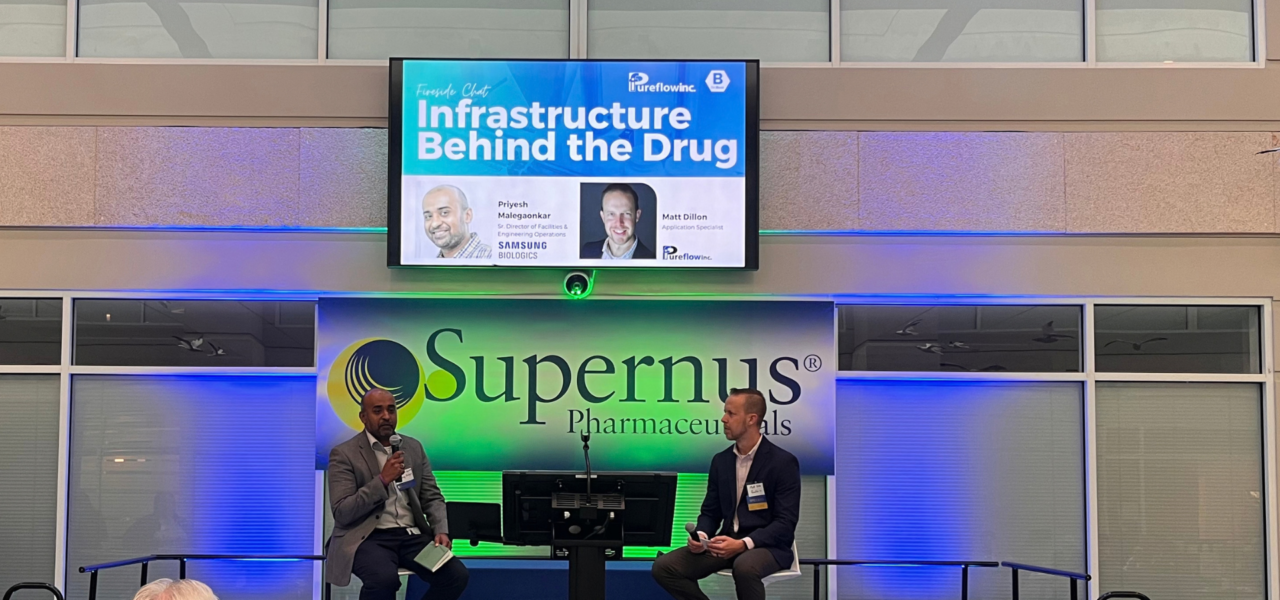
Their discussion, held during a fireside chat at BioBuzz’s Built to Scale gathering in Rockville, Malegaonkar had the opportunity to expand on this topic, along with Matt Dillon, Application Specialist at Pureflow and Sustainability Committee Chair of the ISPE Chesapeake Bay Area Chapter. Dillon’s work places him at the intersection of the utility that biomanufacturing cannot run without and the industry’s growing commitment to using resources responsibly. Through his ISPE leadership, he also helps shape how the region’s engineering and operations community approaches sustainability as a technical discipline rather than an aspiration.
The 7 on Scaling Biomanufacturing Facilities
- Design for future products, not just the current one. Demand forecasts will change, so plan space and utility capacity with expansion in mind from the first stages of design.
- Expect utilities to be the constraint. Water, power, and HVAC capacity frequently limit expansion even when physical space is available.
- Document why design decisions were made. Recording the reasoning behind long-term choices lets future teams build on that intent instead of rediscovering or undoing it.
- Engage operations and quality early. Bringing site operations and quality into design before it is finalized avoids expensive late-stage changes.
- Develop capital project talent from operations. Engineers who start in operations bring firsthand knowledge of how facilities actually run into every design decision.
- Plan resource availability 5 to 15 years out. Water, gas, and electricity are growing constraints, and sustainability goals work best when built into design from the start.
- Rethink how ROI is measured. Resource stewardship investments may not pay back on traditional timelines, but they increasingly determine whether a site can keep scaling.
1. Design for the Forecast You Don’t Have Yet
Malegaonkar’s starting point is one every capital project leader eventually learns: facilities are designed against demand forecasts, and those forecasts will change. Designing only for today’s product leaves a site with nowhere to go when the pipeline shifts. His approach is to plan explicitly for future products, available space, and utility capacity from the earliest stages of design, so that the facility can absorb new programs without a fundamental redesign.
2. Expect Utilities to Be the Constraint
Of everything a growth plan must account for, utility capacity deserves the most attention. It is frequently the constraint that surfaces during expansion, after the space question has already been answered. A building can have room for another production suite and still lack the water, power, or HVAC capacity to support it. Sizing and routing utilities with growth in mind is far less costly than retrofitting them once a facility is operating under GMP.
3. Document the Reasoning, Not Just the Design
Long-term design decisions — reserving space, oversizing a system relative to current demand, choosing one layout over another — are made by people who are often gone by the time those decisions pay off. Malegaonkar emphasized documenting the reasoning behind them so that future teams can build on that intent rather than rediscover it.
Drawings and specifications record what was built. They rarely record why. When an expansion team arrives years later, a written account of what the original designers anticipated can be the difference between using capacity that was deliberately built in and inadvertently designing around it, or removing provisions whose purpose was never explained. For facilities that change ownership or mission over their lifetime, which is increasingly common across the industry, that institutional memory becomes even more valuable.
4. Bring Operations and Quality to the Table Early
The people who will run a facility and the people who will hold it to GMP standards understand constraints that design teams may not see. Malegaonkar recommends engaging site operations and quality early in the design process, while changes are still inexpensive, rather than inviting them to review a design that is largely set. Early involvement surfaces issues around workflow, maintainability, cleaning, and compliance at the point where they cost the least to address, and it builds shared ownership of the facility before it is ever commissioned.
5. Grow Capital Project Engineers From Operations
How a facilities organization balances the pressure to add capacity quickly with the need to manage risk is ultimately a question about people. Malegaonkar’s answer is a deliberate talent pathway: build expertise in operations first, then move those team members into capital projects.
Engineers who have run equipment, managed utilities day to day, and lived with the consequences of earlier design choices carry that experience into every project decision. They design for how a facility actually behaves once it is running, not only for how it appears on paper. The approach also addresses a persistent workforce challenge. Professionals who combine operational depth with capital project experience are difficult to recruit externally at scale, and developing them internally builds that capability from within while keeping site knowledge inside the organization as it grows.
6. Plan Resource Availability 5 to 15 Years Out
Dillon’s sustainability lens shaped the final part of the conversation, and it brought the most forward-looking challenge into focus. Water, gas, and electricity are becoming growing constraints on biomanufacturing growth, and Malegaonkar acknowledged that sustainability and scale can sometimes pull in different directions. Expanding production increases demand on the very resources that sustainability efforts aim to conserve, and the two agendas are best served by recognizing that tension openly.
The response is a longer planning horizon. Facilities leaders need to be thinking 5, 10, and even 15 years ahead about whether the resources a site depends on will remain available and affordable. Sustainability goals can be built into system design from the outset, with portions of a facility engineered for resource efficiency rather than retrofitted later.
7. Rethink How Return on Investment Is Measured
A longer planning horizon also calls for a different way of evaluating investments. Projects that improve resource efficiency or secure long-term utility supply may not pay back on a conventional capital project timeline, and judged by that standard alone they can lose out to near-term priorities. Malegaonkar’s point was that these investments increasingly determine whether a site has the capacity to keep growing at all, which makes resource stewardship part of the business case for scale rather than a cost competing against it.
Infrastructure as Strategy
The investments reshaping Maryland, Virginia, and North Carolina will be counted in billions of dollars and thousands of jobs, but their long-term value will be decided by the kinds of choices Malegaonkar and Dillon described. Whether a new plant can absorb its owner’s next product, whether an acquired facility can be expanded without rediscovering decisions made a decade ago, whether utility capacity and resource availability keep pace with production, and whether the people running these sites grow into the engineers who design the next ones are all questions that capital alone does not answer. Taken together, the seven lessons reframe facilities and utilities from a supporting function into a strategic one.
The same principle applies beyond any single site. Many of the region’s facilities are being repurposed, upgraded, or brought under new ownership, and the knowledge that makes them work tends to live with the people who have operated, designed, and expanded them. Just as a facility depends on documented design intent and early collaboration between engineering, operations, and quality, a growing manufacturing region depends on leaders who share what they have learned with one another before it is needed rather than after something goes wrong.
That exchange is what the fireside between Malegaonkar and Dillon represented. BioBuzz’s Insights to Impact series brings industry leaders together in a peer-oriented setting built for practitioners rather than pitches, where the people building and running the region’s manufacturing base can compare notes on the decisions that determine commercial success. As billions of dollars in new capacity come online across the BioHealth Capital Region and its neighboring hubs, that leadership infrastructure will matter as much as the physical one, helping both the companies making these investments and the region they are investing in continue to grow.
Frequently Asked Questions
Why are biopharmaceutical companies investing in U.S. manufacturing? Companies are expanding domestic manufacturing to strengthen supply chain resilience, reduce dependence on offshore production, and respond to policy and tariff pressure favoring medicines made in the United States. The result has been multibillion-dollar facility investments across states including Maryland, Virginia, and North Carolina, along with international manufacturers establishing their first U.S. sites.
What are critical utilities in biomanufacturing? Critical utilities are the systems that directly support GMP production, such as high-purity water, clean steam, process gases, HVAC, and electrical power. Because they affect product quality and compliance, they must be designed, qualified, and maintained to the same standards as the manufacturing process itself.
Why do utilities often limit biomanufacturing facility expansion? Utility systems are typically sized for a facility’s initial production needs. When a company adds a new product or production suite, the available space may be sufficient while the water, power, or HVAC capacity is not, and expanding those systems in an operating GMP facility is costly and disruptive.
How should companies design a biomanufacturing facility for future growth? Plan for future products, space, and utility capacity from the earliest design stages, recognizing that demand forecasts will change. Document the reasoning behind long-term design decisions, and involve site operations and quality teams early so their requirements are built in rather than added later.
Why is documenting design intent important for biomanufacturing facilities? The engineers who make long-term design decisions are often not the ones who later execute an expansion. Documenting why space was reserved or a system was oversized helps future teams use that built-in capacity rather than overlook or remove it, which is especially valuable when facilities change ownership or purpose.
When should operations and quality teams be involved in facility design? As early as possible in the design process. Operations and quality teams identify workflow, maintainability, cleaning, and compliance issues that design teams may miss, and addressing those issues early costs far less than making changes once a design is finalized or a facility is built.
How can biomanufacturers build facilities and engineering talent? One effective approach is to develop engineers in site operations first and then move them into capital projects. Their firsthand operating experience informs design decisions, and building this talent internally helps address the difficulty of hiring professionals with both operational and project expertise.
How does sustainability affect biomanufacturing scale-up? Scaling production increases demand for water, gas, and electricity, which are becoming growing constraints, so sustainability and scale can pull in different directions. Facilities leaders are planning resource availability 5 to 15 years ahead, building efficiency into system design from the start, and rethinking how return on investment is measured for resource stewardship projects.