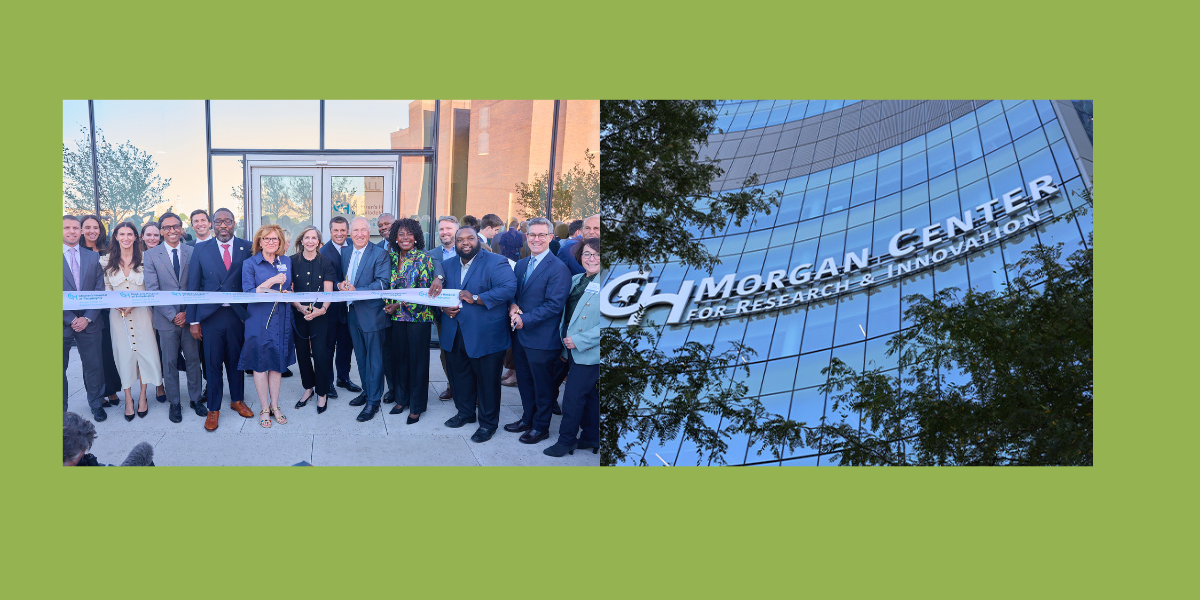
Children’s Hospital of Philadelphia (CHOP) leaders cut the ceremonial ribbon on the new Morgan Center for Research & Innovation on September 14, 2026, marking what the hospital calls a “cutting-edge” start to a new era of pediatric research. The event drew government officials, scientists, and stakeholders — including Philadelphia Mayor Cherelle Parker, City Council President Kenyatta Johnson, State Representative and Appropriations Chairman Jordan Harris, State Senator Nikil Saval, and State Representative Ben Waxman — alongside the Morgan family, CHOP leaders, and vendor partners, who toured the 350,000-square-foot facility. Named after a $50 million gift from Mitchell L. Morgan, Hilarie L. Morgan, PhD, and their family, the 17-story building stands across from CHOP’s Roberts Center for Pediatric Research overlooking the Schuylkill River.
Susan Furth, MD, PhD, CHOP’s Executive Vice President and Chief Scientific Officer, said at the ceremony: “The Morgan Center expands our research capacity, but more importantly, it expands what we can imagine for the future of pediatric medicine.” Joseph Mitchell, MD, President of CHOP, added: “Today’s celebration is about not what happens today, but what happens next. It’s about the discoveries that haven’t yet been made, the questions that haven’t been answered, and the children and families who will one day benefit from the work that happens right here in this very building.”
A Microbiome Lab Already Moving In
On the building’s third floor, Ahmed Moustafa, PhD, Co-Founder and Co-Director of CHOP’s Center for Microbial Medicine, is already settled into his new lab space. “What excites me the most about the Center for Microbial Medicine and being here [at Morgan], is how we can change the standard of care for pediatrics going forward,” Moustafa said. “How we can get microbiome-based therapeutics from discoveries in labs and publications to the bedside, and how we can improve the health of our patients and children.” He co-leads the Center alongside Paul Planet, MD, PhD; Joseph Zackular, PhD; and Robert N. Baldassano, MD, in a space designed to bring together basic scientists, clinicians, data scientists, biomedical engineers, and bioinformaticians in close physical proximity. “Imagine all of these researchers together face to face, having coffee and spending time together,” Moustafa said. “Different labs can talk to each other about their different experiments.” The building’s advanced infrastructure supports sequencing and AI/machine learning-based analytical work, which Moustafa says can help identify the microbiome as an early disease biomarker, a predictor of treatment success or failure, and an indicator of post-procedure complications — work supported in part by the Morgan Center’s new Gnotobiotics Core, which enables controlled study of host-microbiome interactions.
An In-House “Incubator” for New Ideas
The first floor houses the IDEA Lab (Innovate, Design, Engineer, and Accelerate) — one of CHOP’s Core Facilities and what Moustafa calls an “incubator for new ideas,” offering computational modeling, bio fabrication, 3D printing and imaging, and prototyping support led by an in-house team of engineers and scientists. “Thinking about it from research, 3D printing allows you to quickly prototype and design rather than having to wait for long-term fabrications to make your entire device,” said IDEA Lab leader Elizabeth Silvestro, PhD. “The engineer can follow you to your lab, learn exactly what you want, and then hopefully get you what you need.” In a Bench to Bedside podcast episode hosted by Furth, Silvestro described plans to build a customized 3D cell chip — a microfluidic device that grows cells in three dimensions — on CHOP’s campus, to test drugs, study organ function in disease, or develop precision medicines. Furth said: “I love the story behind the IDEA Lab because it reflects what makes CHOP special. It grew from a simple recognition that engineering expertise already existed across CHOP and [the Perelman School of Medicine at the University of Pennsylvania], but that we could accomplish even more in a highly collaborative environment.”
Built With Researcher Input From the Start
Principal investigators, faculty, and research teams helped shape the building’s design during planning, including the IDEA Lab and features like a 250-seat lecture hall, conference terrace, planned on-site restaurant, and the co-location of wet and dry labs to let biomedical researchers work seamlessly alongside data scientists and engineers. Donald Moore, A Senior Vice President of CHOP’s Real Estate, Facilities, and Operations, said: “It is very important for the future of health sciences in Philadelphia that this building exists.” The nearly half-billion-dollar construction project created more than 500 construction jobs between 2022 and 2026. The facility will house hundreds of researchers, expanding CHOP’s lab research capacity while creating synergy with clinical research at the neighboring Roberts Center for Pediatric Research, with outdoor space known as the Schuylkill Greene connecting it to the broader campus.